

SpaceX tries to catch Starship's upper stage, a first for any rocket
Test Flight 15 was Elon Musk's first attempt to recover both halves of Starship on one flight, the milestone that decides whether full reusability becomes routine or stays theoretical.
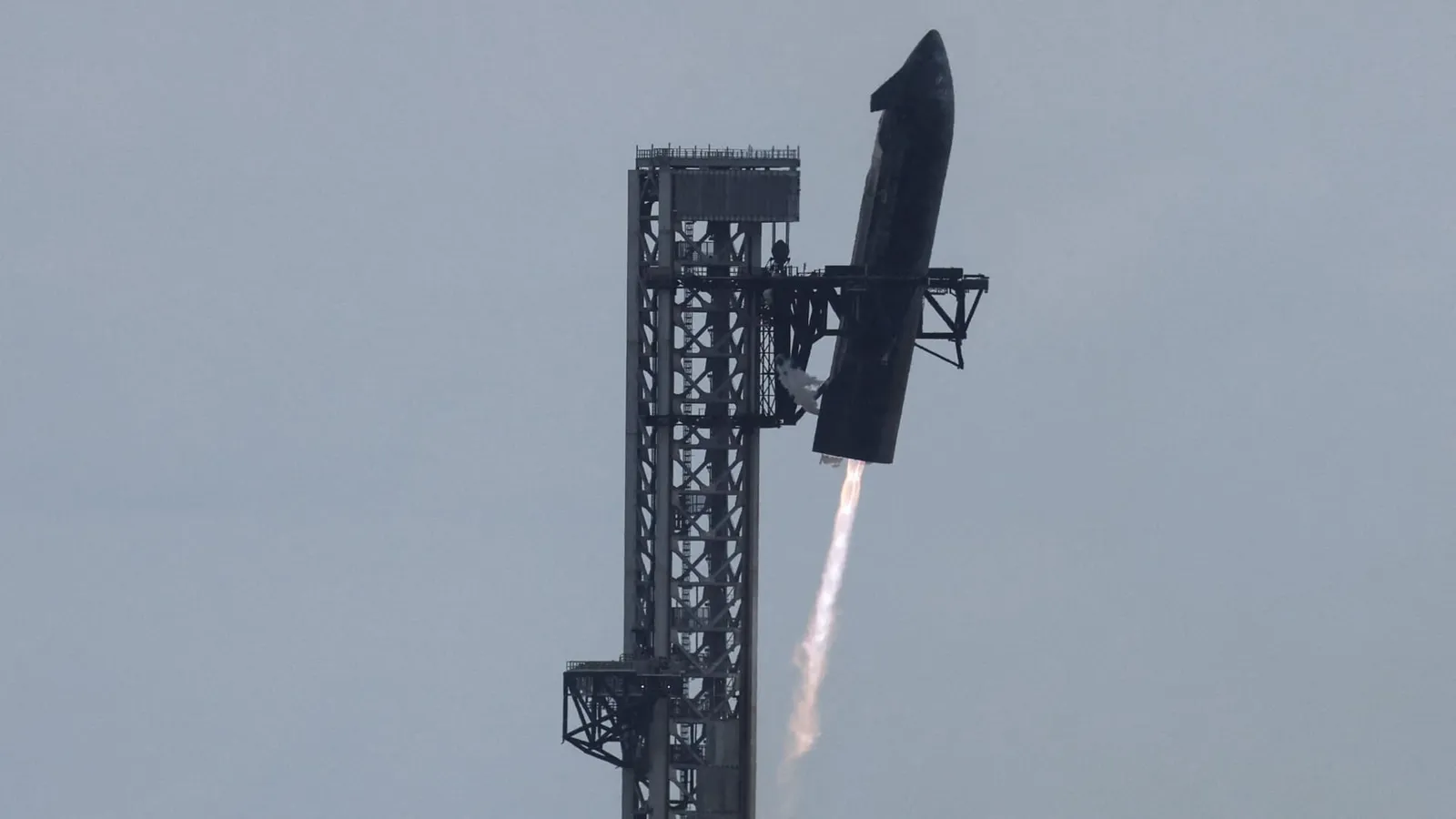
SpaceX attempted to catch both the booster and the upper stage of its Starship rocket during Starship Test Flight 15, the first time Elon Musk's company has tried to recover both vehicles on a single flight, with CNBC reporting the upper stage catch as a historic first. If full-vehicle recovery becomes repeatable, it resets the cost and cadence assumptions behind satellite constellations, NASA's lunar plans, and every launch competitor's pricing model.
SpaceX just tried something it had never tried before: catching both halves of one rocket. Starship Test Flight 15 marked the first time Elon Musk's company attempted to catch the booster and the upper stage of its Starship vehicle, and CNBC reported the upper stage catch as a historic first. The word catch is doing a lot of work here. It is the line between hardware you throw away after a single trip and hardware you fly again, and until now no one had crossed that line with an upper stage.
To be clear about what was caught, Starship is a two-part machine. The booster is the massive first stage that does the loud, dirty work of hauling the stack off the pad, and SpaceX calls it Super Heavy. The upper stage is the ship itself, the part that pushes on toward orbit. The booster is heavy and powerful, but it separates early, at comparatively modest altitude and speed. The upper stage goes much faster, much higher, and comes home much hotter. That difference in energy is why one catch is an engineering milestone and the other is an engineering frontier. For context, SpaceX has been recovering boosters by having the launch tower's mechanical arms pluck them out of the air, a maneuver the company has worked hard to make look routine. Recovering the upper stage is a different problem entirely.
Start with physics. The booster separates from the upper stage and falls back before reaching orbital energy, so the thermal load it endures is manageable. The upper stage, by contrast, has to survive a return from near-orbital velocity, which means it comes back behind a heat shield and inside a narrow corridor of acceptable speed, angle, and position. Then something on the ground, or more accurately a set of arms on the tower, has to touch it without crushing it. Miss by a little and you destroy the vehicle. Miss by a lot and you damage the tower. Every variable is unforgiving, and the margin is small. That is why the industry has historically treated upper stages as disposable hardware.
The financial logic follows the physics directly. SpaceX's Falcon 9 has been recovering its first stage for years while expending its upper stage on every single flight, a design compromise baked into the economics of every mission it flies. Starship was designed with both stages meant to return, which is the entire thesis behind the program. If the second catch becomes as repeatable as the first, the marginal cost of a launch shifts from manufacturing new hardware to refurbishing and refueling used hardware. That is a completely different cost curve, and it is the reason competitors watch every one of these flights closely.
The blast radius reaches well beyond SpaceX's own balance sheet. NASA has contracted Starship as a human landing system for its Artemis lunar program, which ties a public agency's schedule to a private company's test cadence. Starlink, SpaceX's satellite internet business, is the internal customer that would benefit most from cheaper, faster launches, since every recovered vehicle is capacity freed up for constellation replenishment. On the other side of the ledger sit Blue Origin, United Launch Alliance, Arianespace, and Rocket Lab, all building or flying vehicles that are only partially reusable or fully expendable. If full reusability becomes routine, their pricing assumptions get squeezed from above.
Regulation is the other variable. Starship launches from a site in Boca Chica, Texas, and each test flight typically rides on a license and environmental framework that the FAA administers, with modifications and reviews tied to the pace and profile of the flights. Historically, rocket cadence has been limited by engineering first and paperwork second. In a world where catching and reusing vehicles becomes normal, the constraint can invert: the bottleneck becomes how fast a regulator is willing to approve flights, not how fast a factory can build rockets. That reframes launch from a manufacturing story into a licensing and turnaround story.
So what actually matters next, and what the historic catch does not by itself prove? Three things. First, whether the recovered upper stage is intact enough to fly again, because a catch that produces a museum piece is not a cost breakthrough. Second, turnaround time, the metric that separates real reuse from spectacle. Third, whether the cadence holds as the flight profile gets more ambitious. A single successful catch is a milestone. A dozen routine ones are a business model.
For executives and boards, the takeaway is not to admire the engineering and move on. Launch cost is an input to almost everything: satellite constellations, imaging, defense payloads, scientific missions, and the insurance market that wraps them. Any team that modeled long-range plans on the assumption that rockets are expensive, slow, and partly disposable should stress-test that assumption now. Musk's company just demonstrated that the last major piece of a rocket can be caught. The strategic question is no longer whether full reusability is possible. It is how fast it becomes boring.
This story's Key Insights and Take-aways are locked.
Create a free account to unlock Executive Actions for one credit.
Register to UnlockAlways free for Executives Club members. Join the Club
More in Technology

Anthropic Mathematician Claims Claude Helped Prove Riemann Hypothesis in Six Weeks
Levent Alpöge says the AI tool helped him develop a solution to one of math's most important unsolved problems in about six weeks, a claim that, if verified, would reshape AI's role in research.

Anthropic mathematician claims Claude helped crack the Riemann hypothesis
If the proof holds, AI has toppled math's most famous open problem; if it does not, it is a case study in announcing breakthroughs before anyone verifies them.

AI's $4 Trillion Wipeout Erases Nasdaq's Gains for the Year
A brutal week took roughly $4 trillion off the AI sector and left the Nasdaq flat for the year, and the damage ran the full length of the supply chain.