
Synchron implants brain chip in 15 people, neck and neck with Neuralink at FDA
The first FDA-approved brain implant could unlock a market built on neural data, and Synchron says its Stentrode is now in 15 people while Neuralink races from seven to 26.
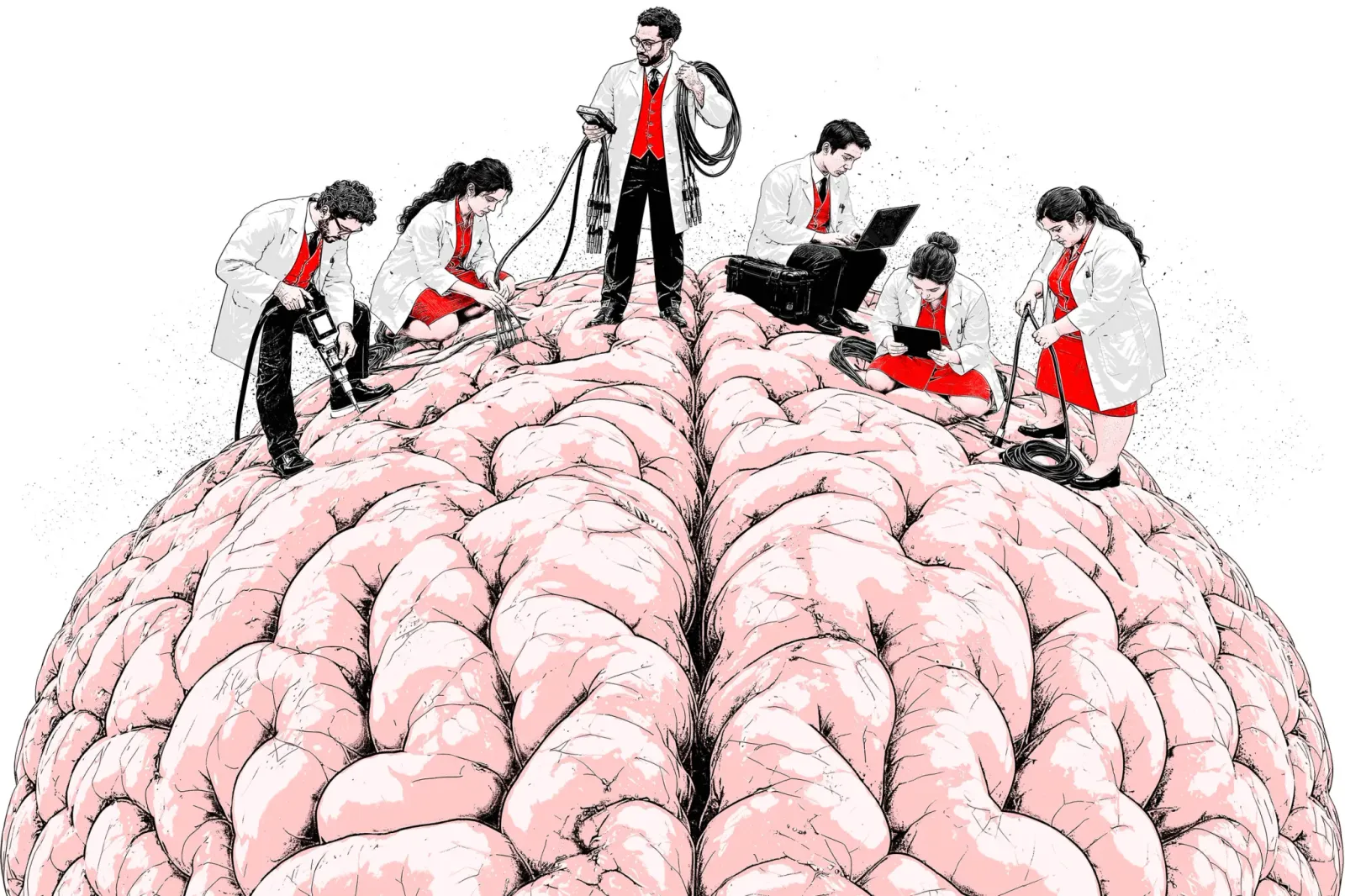
Synchron CEO Thomas Oxley told Fortune that his company has implanted its Stentrode brain device in 15 people, adding five since last year, while Neuralink has grown from seven to 26 patients as both chase the first FDA approval. The winner will set the commercial and privacy terms for a market built on neural data, forcing executives to treat brain signals as a strategic and regulatory asset before implants reach the workplace and consumer tech.
Thomas Oxley, founder and CEO of Synchron, told Fortune that his company has implanted its Stentrode device in 15 people, adding five more since last year. That disclosure matters because it puts a less invasive rival in the same regulatory conversation as Neuralink, the Elon Musk-owned brain-computer interface company that has grown from seven patients to 26 over the same period. "They're going fast," said Oxley, himself a neurosurgeon. Synchron is neck and neck with Neuralink in the FDA process, and its device may well be first to market because it does not require a skull-breaking craniotomy.
The race is not academic. No brain implants are on the U.S. market yet, so the first one that becomes available will be a watershed moment for the tech sector, for society, and arguably for humanity, setting off what those in the industry expect to be a decades-long process to merge minds with machines. Neuralink has made science fiction a reality for approximately 26 people using its N1 implant in the product's testing phase, all with severe disabilities. The N1 is a quarter-size device with 64 wires, each thinner than a human hair, that picks up electrical signals from neurons and transmits data to a phone or tablet, letting patients text, post on social media, and play video games without lifting a finger. Musk founded Neuralink in 2016 with the goal of far broader adoption; in 2017 he argued that humans will need to connect our brains to technology to keep up with artificial intelligence and avoid "being left behind and being effectively useless, or like a pet." By 2025, Neuralink was valued at roughly $9.7 billion, and its $1.3 billion in funding is more than double the next-best-funded brain implant company.
The competitive field is widening. Paradromics is focused on restoring speech, and Precision Neuroscience is pursuing a brain interface for patients with paralysis. Neuvotion makes a commercially available, AI-guided wearable that can help restore movement in stroke and spinal cord injury patients, and its CEO, Chad Bouton, is blunt about the stakes. "It is definitely a race," he says. "I think in the next three or four years we might see an FDA clearance." That timeline matters because the first clearance will not just be a medical milestone. It will create the template for how neural data is collected, stored, shared, and monetized, long before most consumers ever consider an implant.
The regulatory path explains why capital alone cannot buy speed. Companies in the running begin with animal testing, then clear a hurdle to perform a first human implant and begin early feasibility studies. The pivotal study comes next, when companies expand to more patients and focus on manufacturing. That means having the "whole manufacturing line established and frozen," Oxley said, which he called "a huge investment." It also means experimentation is largely over, device design is locked, and the final trials assess benefits for a specific, target user. The pivotal study concludes with FDA approval to sell the products to patients with eligible, clearly defined medical conditions, with insurance likely helping to cover the cost.
Artificial intelligence is the accelerant. The race had been underway for years before AI became a household term with the debut of ChatGPT in 2022, but rapidly advancing AI stands to dramatically enhance the power of brain implants by allowing them to better decipher thoughts and intentions. One day, AI-enhanced BCIs could enable people to control humanoid robots or AI agents on their behalf, taking instructions directly from their thoughts, says Matt Angle, CEO of Paradromics. As research goes "cognitively upstream from language," he says, implants could know our desires before we are even aware of them. If a human is hungry, Angle said, "then the BCI would already understand what we are hungry for, and it would deduce the next reasonable thing," perhaps ordering food on a delivery app. "It won't be mainstream right away," he explained, but "it'll come sooner than a lot of people are expecting."
The privacy question is already arriving at work. For workers, brain implants could usher in a new wave of employee surveillance in the name of productivity. Connecting a BCI to a work computer could help people type and navigate faster, while also recording biological signals that reveal whether they are focused on work or letting their minds wander. Employers could even nudge them back to work if BCIs develop two-way communication, Nita Farahany, a Duke University professor who authored a book on defending freedom of thought in an era of brain implants, writes in her book. She suspects punitive brain surveillance is unlikely to be tolerated by the public, but even today we accept new forms of workplace tracking, from how many times a day we badge in to the office to transcriptions of what we say in meetings and monitoring of which applications we open on our computer. "What you're thinking and feeling is your last space of true privacy. It's the most fundamental aspect of what it means to be human," Farahany says. "We are rapidly heading toward a world of brain transparency, in which scientists, doctors, governments, and companies may peer into our brains and minds at will. Companies [could] know what products we want before we do."
Some argue that the cyborgization of humanity has already begun, even if the devices and algorithms we are joined with are external to the body. In a 2017 blog post titled "The Merge," OpenAI CEO Sam Altman wrote, "Our phones control us and tell us what to do and when; social media feeds determine how we feel; search engines decide what we think." By 2025, an OpenAI analysis of 1.5 million ChatGPT conversations found that roughly three-quarters concerned practical guidance, information seeking, or writing, suggesting that people are increasingly turning to AI to help decide what to do and what to say. Altman cofounded the BCI company Merge Labs in 2025, and in early 2026, OpenAI invested in it. The company's goal is to create a more seamless relationship with AI, presumably ChatGPT or one of the models behind it. A Merge Labs spokesperson was not ready to reveal its product yet in the conversation with Fortune, but expects to have more to share in "a couple months."
The human payoff is already visible, even if the legal and ethical framework is not. Neuralink's first patient, Noland Arbaugh, who became paralyzed after a diving accident, has used the implant he had installed in January 2024 to play video games such as Civilization and is now working on a book in partnership with a writer. His implant has enabled him to travel the world for speaking engagements and facilitated being in a relationship. Even though "being paralyzed still sucks," he posted a few months ago, he is "constantly blown away" by the advances of his implant. When he interviewed with Fortune in 2025, he said, "It has absolutely changed my outlook on life and what I'm able to accomplish and what I think I can do in the future. So it has given me a lot of hope for myself." For executives, the strategic stakes are now clear: the first FDA approval will decide who controls the portal between minds and machines, and every board in tech, health care, insurance, and HR will soon need a position on neural data before it becomes as ordinary as a badge-in log.
This story's Key Insights and Take-aways are locked.
Create a free account to unlock Executive Actions for one credit.
Register to UnlockAlways free for Executives Club members. Join the Club
More in Business

GTA VI hauls $3.79bn in one day, out-earning every film ever made
Rockstar's own estimate covers a single Thursday plus a record 32.5m prerelease units, and it lands on every board weighing IP concentration, pricing power and launch risk.

FBI's crime database breached again, the second hack in months
CNN reports hackers hit the National Crime Information Center, the shared backbone of US policing, and the repeat timing is the part every security team should study.

S&P 500 Enters Correction, Down 10% From Its High on AI Worries
The index's slide past the 10 percent line is a symbolic verdict on investor mood, and the AI trade that powered the rally is now the thing testing it.