
Syrian teen Bilal Kreidi tops Germany’s Mathematical Kangaroo, beating 881,000 rivals
The 16-year-old’s contest win is now turning into a scalable math teaching playbook on TikTok.
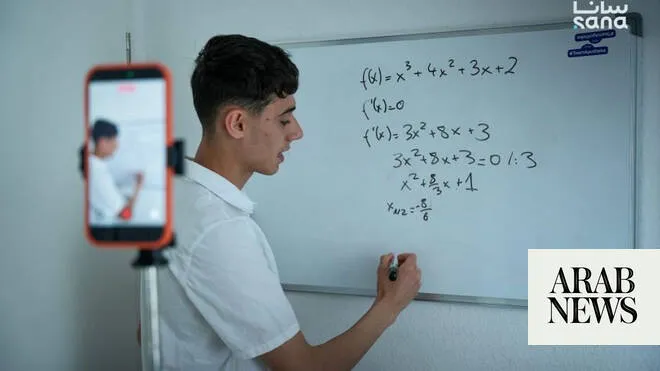
Bilal Kreidi, a 16-year-old Syrian student based in Germany, won first place nationally in the Mathematical Kangaroo. After the win, he launched an educational TikTok channel with simplified lessons across five grade-to-secondary levels.
Bilal Kreidi, a 16-year-old Syrian student based in Germany, didn’t just win first place nationally in the Mathematical Kangaroo. He did it in a field so big it barely feels human: the competition drew more than 881,000 students from over 12,600 schools across Germany. That scale matters, because it means Kreidi’s win is not a niche “local talent” story. It is a top-of-the-curve result against a massive slice of the country’s school math pipeline.
And the interesting part is what happened after the podium. Kreidi has since launched an educational TikTok channel where he posts simplified math lessons spanning five levels, from fifth grade through to advanced secondary. The payoff from this matters for decision-makers and operators, because it turns a one-time achievement into repeatable content, built for students who struggle with math and need instruction that is clear, paced, and accessible.
The story’s core facts are straightforward, but the implications are not. The Mathematical Kangaroo is held annually in more than 100 countries and attracts around six million participants globally. Its stated aim is to nurture interest in mathematics and build logical thinking and problem-solving skills among young students. Put simply, this is not a test designed to trap you, it is designed to train your brain to reason. That distinction becomes important when you think about why a teen’s win can ripple outward. When the learning objective is skill-building, the “winner” is also a potential teacher model, and Kreidi’s post-win pivot suggests he understands that.
Kreidi frames his mission in the language that educational strategists pay attention to: he said his primary goal is to help students understand mathematics and develop their skills. He told SANA on Tuesday that the strong response from viewers has motivated him to keep going. Even without more metrics in the source, the direction is clear. He is not treating TikTok as a vanity stage. He is treating it as a feedback loop for explanation quality. For busy executives watching education attention economies, that is the difference between “content” and “a distribution-backed learning product.”
The background also helps explain how he got there. His father, Khaled Kreidi, recalled the family’s journey since arriving in Germany in 2015, describing a deliberate effort to integrate into German society while keeping Arabic language and the Syrian curriculum alive at home. He also noted academic excellence runs in the family, with all of Bilal’s siblings performing strongly, particularly in mathematics. His mother, Lucy Dabbagh, said Bilal’s win drew coverage from the German press and the official media channel of North Rhine-Westphalia state, the region where the family is settled.
Now, zoom out to what this means in the real world for organizations and leaders. Math education is often a battle over access and comprehension, not raw intelligence. Competitions like Mathematical Kangaroo can identify high performers and spark interest, but they rarely solve day-to-day understanding problems for the majority of students who are stuck on fundamentals. TikTok, meanwhile, is not a classroom substitute by default. It is a distribution channel. The second-order insight here is that Kreidi’s approach is effectively bridging the gap between “who wins competitions” and “who learns what they needed before the competition.” If the lessons are simplified and structured across five levels, that hints at curriculum design thinking, even if the format is social media.
There is also a policy and social dimension worth noting, especially for leaders in education, media, and tech. The source frames the win as part of a string of accomplishments by Syrians abroad, a reminder that talent and resilience can travel well. For stakeholders evaluating how integration, language support, and community learning practices affect outcomes, this is a vivid, public example. It also shows how local institutions and media coverage can amplify individual success, with North Rhine-Westphalia’s official media channel stepping in, according to Kreidi’s mother.
Finally, the strategic stakes. When an individual can convert a global-scale competition result into an educational content engine, it changes how ambitious students, parents, and schools think about what “visibility” can do. For executives and boards, the lesson is not that every teen should start a TikTok channel. The lesson is that learning is increasingly distributed, and attention is now part of the education stack. Kreidi’s story asks a hard question: are your organizations building only programs, or also the channels that make those programs actually scalable at scale. With six million participants worldwide in the Mathematical Kangaroo ecosystem, the talent pool is enormous. The differentiation will go to whoever can turn performance into ongoing instruction, not just celebration.
This story's Key Insights and Take-aways are locked.
Create a free account to unlock Executive Actions for one credit.
Register to UnlockAlways free for Executives Club members. Join the Club
More in Business

SpaceX stock jumps 3% after it overtakes Amazon’s market cap
CNBC says SpaceX’s shares surge following its IPO Friday, forcing investors to reprice what “space” and “AI” are worth.

SpaceX’s first options day breaks U.S. records after a $85B IPO win
Big IPO, bigger options debut: what it means for investors, risk teams, and anyone benchmarking market appetite.

SpaceX buys Cursor for all-stock $60B, signaling Elon Musk’s next AI move
SpaceX exercised its option for Cursor in an all-stock deal worth $60 billion, reshaping AI dealmaking expectations.