
Tim Cernak uses AlphaFold to design drugs for frogs, turtles, and hemlocks
A Merck-trained chemist at the University of Michigan is building “conservation chemistry” with AI speedups and lab robotics.
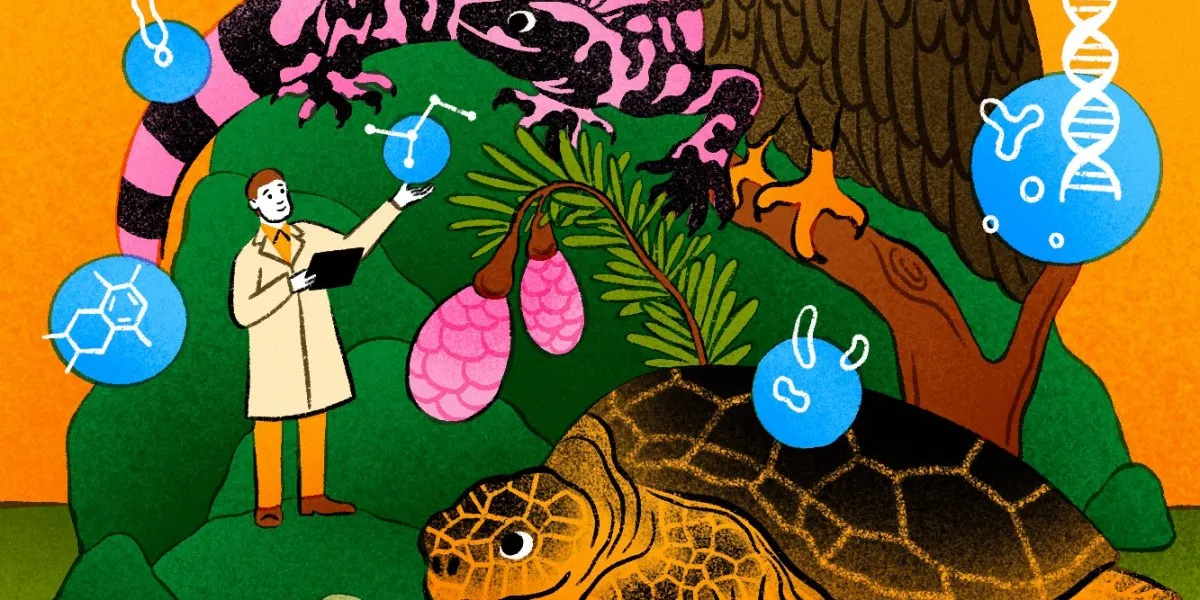
Tim Cernak, an associate professor at the University of Michigan, left Big Pharma after nearly two decades at Merck and now designs precision treatments for non-human patients using Google DeepMind’s AlphaFold and high-throughput lab robots. For decision-makers, it signals a new drug-design model where ecosystem health becomes the test case, not a side project.
In 2018, after nearly two decades working in Big Pharma, chemist Tim Cernak was ready to put his skills to a new use. For Merck, he’d developed precision therapies for cancer, HIV, and diabetes that could target disease while minimizing harm to healthy cells. But he worried that the same “precision” logic was not being applied to ecosystems. In his framing, animals are often treated with pharmaceuticals formulated for humans, and those drugs can behave like old-school cancer treatments, indiscriminate in the harm they cause.
That mismatch shows up in a concrete example: the standard of care for frogs infected with a deadly skin infection is itraconazole, an antifungal that is often lethal for the amphibian. Cernak wants to reverse the default assumption. He imagines a world where “the patient was always meant to be a frog in the first place, from the beginning to the end.” Now an associate professor at the University of Michigan, he’s worked across a range of creatures, from a Gila monster with a parasite to bald eagles with avian flu.
Why this is more than a feel-good pivot is how drug design actually works. Developing any drug is extremely expensive, failure-prone, and slow-going. The bottleneck is turning a molecular idea into candidates that plausibly bind to a target and then iterating quickly enough to survive. Cernak’s answer is to use AI to speed up the entire drug-design workflow, starting with structure. Google DeepMind’s AlphaFold model lets him visualize a mutant protein’s three-dimensional structure on a screen rather than growing it on a plate, the traditional methodology. Instead of waiting for physical experiments to reveal structure, he can move faster straight into candidate generation.
From there, the next step is to run a series of reactions and see which potential drugs may be effective. With the help of robots in the lab, he can speed through as many as 1,500 per day. That detail matters for anyone thinking about R&D strategy, because “orders of magnitude faster” changes how you can manage risk. When you can evaluate far more candidates quickly, you can afford broader exploration early, then narrow down once you have signals. In human medicine, this is the familiar pitch behind AI-assisted pipelines. Cernak is applying the same logic to conservation problems where the “targets” are proteins and pathogens, but the “patients” are species that can become collateral damage.
His curiosity about creatures of all sizes is not just a personality quirk. It reflects an operational question: can the same technical stack solve across very different biology? He has worked on treatment for loggerhead sea turtles after he was shocked to learn that the iconic species suffered from contagious tumors. He is also drawn to creatures that have helped humans, like the Gila monster, whose hormones have informed popular weight-loss drugs like Ozempic. And it is not only animals. Cernak is also developing a precision insecticide to treat hemlock trees under attack from invasive species. This broad scope is a hint at how conservation chemistry could scale, because ecosystem threats range from infections to pests to disease dynamics, and they rarely respect disciplinary boundaries.
Cernak calls this new discipline “conservation chemistry.” The phrase is loaded, and he knows it. It nods to how chemicals have shaped conservation outcomes before, from DDT decimating US bald eagle populations in the 1960s to cow painkillers killing millions of Indian vultures in the 1990s. He recognizes the risks. That history creates a credibility gap for chemical interventions in conservation, even when the goal is protection. Cernak’s argument is that excluding chemists from conservation is a missed opportunity, and he frames the stakes sharply: “I’m just sick of looking at the chemical tools that are used in the conservation space, and they’re not cutting-edge.” He compares it to having “this super high-tech engine over here for making human medicines, while we’re living through a mass extinction.”
For executives and investors, the second-order implication is that the innovation target is shifting. In human health, regulators and markets already define what counts as evidence, what counts as safety, and how risk is managed across populations. In conservation, those guardrails are often looser, the timelines can be urgent, and the “population” can be a single species. That means investment decisions and partnerships will hinge on how you translate precision and safety principles from human drug development to ecosystems. If AI accelerates candidate discovery and robotics accelerates testing, the question becomes whether governance, monitoring, and translational science can keep pace with speed.
The strategic stakes are immediate for anyone running R&D, building partnerships with academia, or underwriting biotech programs. Cernak’s work suggests a new category of medicine-like pipelines aimed at non-human patients, with AlphaFold and lab automation as the catalytic layer. It is not simply conservation as a mission. It is conservation as a proving ground for modern drug design, where failure is costly, and where the “wrong default drug” can be lethal to the very species you are trying to save.
This story's Key Insights and Take-aways are locked.
Create a free account to unlock Executive Actions for one credit.
Register to UnlockAlways free for Executives Club members. Join the Club
More in Technology

OpenAI says 10,000 agents cracked a 90-year math problem in 88 hours
The company's claim is audacious, but one mathematician is pushing back. Here's what it means for AI-driven discovery.

Meta still serves child sexual abuse ads on Instagram in India - BBC report
A new report following the BBC Eye investigation says the ads are still there - what it signals for every platform with a self-serve ad engine.

White House yanks 'Build the Wall' game after Tetris Company copyright warning
The administration's arcade game vanished in hours - and the takedown playbook every brand can learn from.