
Trump warns Pickaxe Mountain is a next Iran target, hitting underground nuclear sites “pretty soon”
The president says the US is not finished with Iran and flags an underground complex as the next military focus.
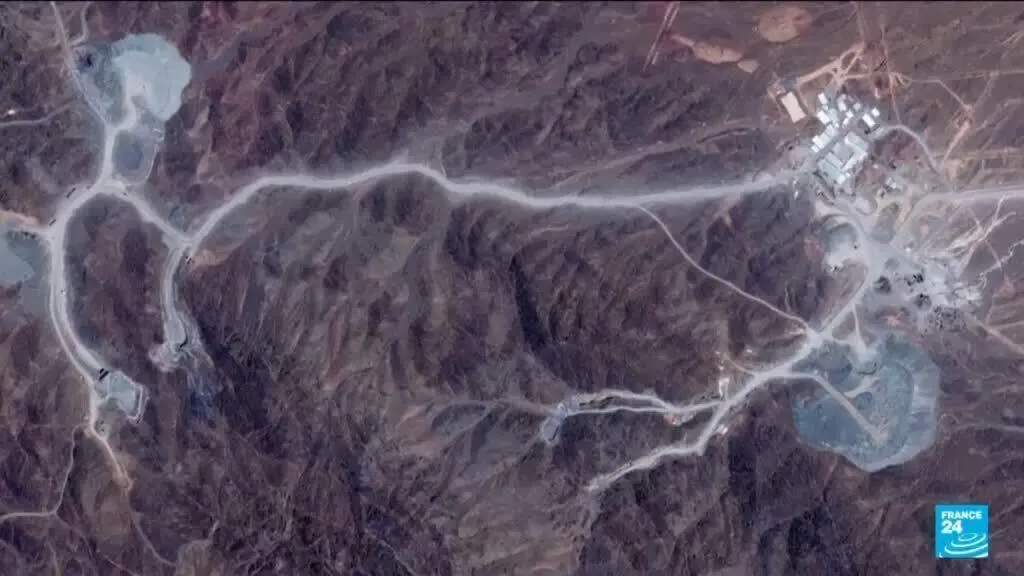
President Donald Trump said the United States is far from finished with Iran and warned the next US military target could be an underground nuclear complex known as Pickaxe Mountain. The remark raises near-term geopolitical and compliance stakes for anyone underwriting risk in the region.
President Donald Trump said Tuesday that the United States is far from finished with Iran, and he specifically warned that the next US military target could be an underground nuclear complex known as Pickaxe Mountain. FRANCE 24 reporter James Vasina reported the statement as part of Trump’s broader messaging that US action against Iran is ongoing.
The key word in Trump’s warning is not just “Iran.” It is “underground” and “complex,” because those details change how militaries plan and how markets price risk. Pickaxe Mountain, described by Trump as an underground nuclear site, signals that whatever comes next may not be about visible infrastructure alone. It suggests a focus on facilities built for survival and concealment, which typically means higher uncertainty, longer timelines, and heavier knock-on consequences once operations start.
To understand why this matters beyond headlines, you have to connect public threat statements to the way governments and markets behave. High-level officials often use warnings to shape expectations among multiple audiences at once: domestic politics, deterrence toward Iran, and signaling to allies and adversaries about escalation control. Even when no strike is confirmed in the underlying reporting, the phrase “pretty soon” is still a timeline signal, and timeline signals are what financial and operational decision-makers react to.
For executives and boards, the second-order effect is not “will a specific site be hit today.” It is the ripple: contingency planning, supply chain stress tests, and risk modeling that assumes the worst plausible move could happen faster than internal teams expected. In environments like the Middle East, uncertainty is a cost. When leaders add new location specificity, like an underground nuclear complex, they reduce ambiguity for planners while increasing volatility for everyone else.
There is also a regulatory and compliance dimension that tends to get underestimated. Geopolitical escalation does not stay in the defense column. It drives compliance workloads in sanctions and export-control programs, because companies with cross-border links, even indirect ones, must reassess counterparties, shipping routes, and permissible transactions. When US-Iran tensions intensify, regulators and enforcement agencies typically do not wait for certainty. They interpret heightened risk as a reason to scrutinize how firms prevent prohibited flows.
Now put yourself in the position of a CEO or CFO watching counterparties and markets. The threat targeting an underground nuclear complex like Pickaxe Mountain implies that US action could be aimed at strategic deterrence and nuclear capability disruption. That can change how insurers price war and political risk. It can also influence energy pricing and shipping risk premiums, because even unrelated commercial routes can be re-rated when security conditions worsen.
It is also a reminder that the “next target” framing is meant to communicate momentum. Trump’s statement that the US is “far from finished” is not a soft rhetorical flourish. It is a signal that the current phase of US-Iran confrontation is moving into the next chapter rather than winding down. When leaders talk like that, boards should expect that management teams will be asked to produce faster scenarios, clearer controls, and more explicit risk ownership.
The strategic stakes for peers are straightforward: threat language tied to specific facilities raises the probability that escalation becomes more operationally real. Even for companies not in defense, the surrounding ecosystem of logistics, energy, insurance, and compliance can move quickly. In a world where capital is allocated under uncertainty, the organizations that stay ahead are the ones that treat statements like Trump’s as inputs to risk processes, not just information to read and forget.
This story's Key Insights and Take-aways are locked.
Create a free account to unlock Executive Actions for one credit.
Register to UnlockAlways free for Executives Club members. Join the Club
More in Politics

LA County: DOJ's 20,000 'noncitizen' voter list is 'unreliable,' includes U.S.-born
Preliminary review by Los Angeles County election officials finds errors in the federal list, raising the stakes for voter roll integrity ahead of November.

Trump's $1.5B Pentagon chip investment lands in North Carolina
A $1.5 billion defense infusion for North Carolina chipmaking signals a new era of Pentagon-backed reshoring - here's what it means for the industry.

Nigeria confirms first Ebola case in Abuja, a woman just off a Uganda flight
Health Minister Muhammad Ali Pate says the patient flew in from Uganda, putting Africa's latest outbreak on Nigeria's doorstep.