

US medics train for weeks of care as drones make evacuation “on life support”
The Pentagon is quietly shifting trauma training for a future where the “golden hour” may not exist.
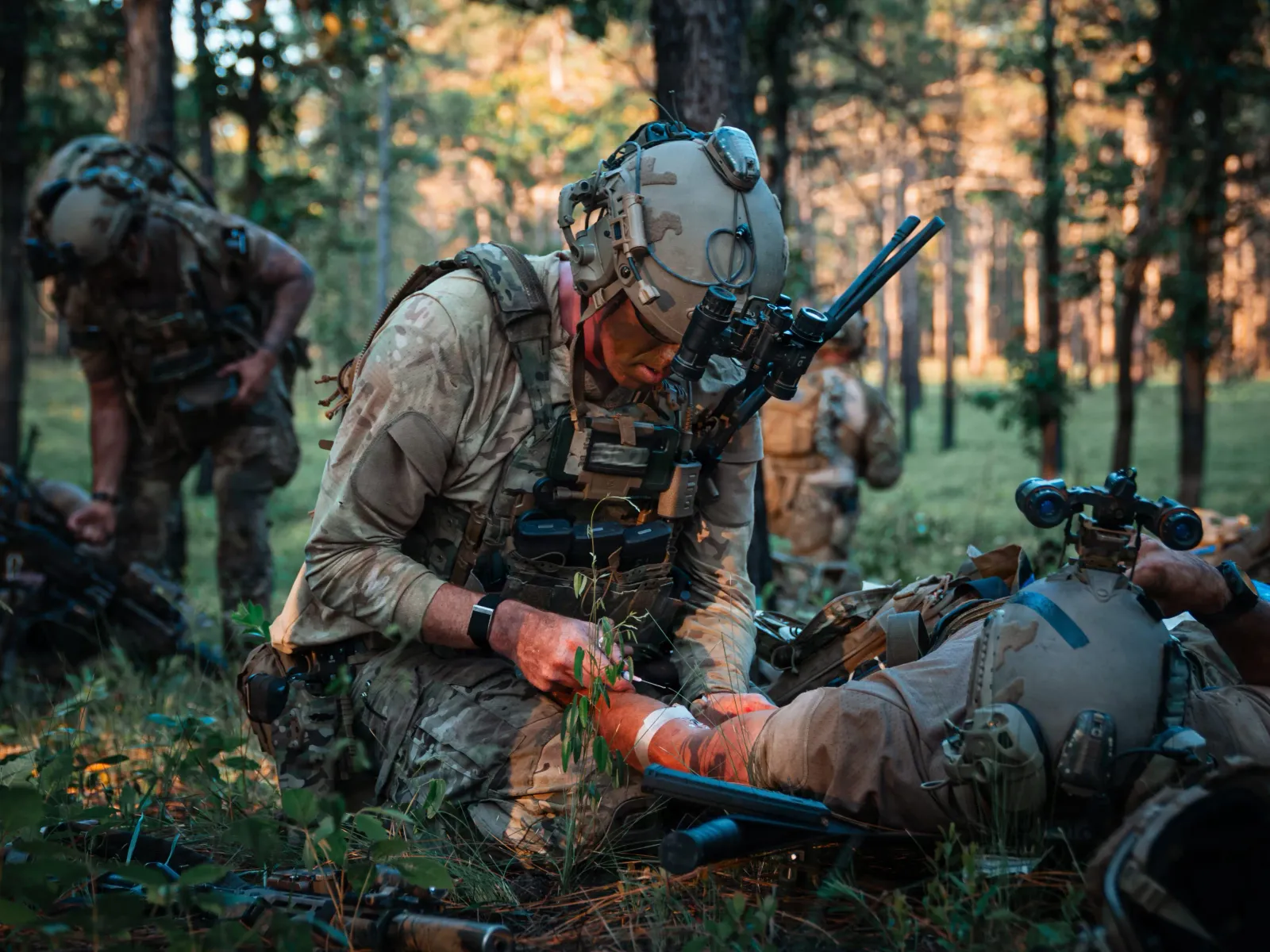
Military medics and trauma teams are being trained to provide prolonged field care because fast evacuation may break down in a future large-scale war shaped by drones and electronic warfare. The consequence for decision-makers is clear: training, logistics, and medical capacity planning have to assume days or weeks, not hours.
Military medics are training now for a brutal future: wounded teammates may need care for days or even weeks before they can be evacuated. The U.S. military’s modern trauma system has long depended on a simple idea. Triage fast. Evacuate quickly to advanced lifesaving care. Let surgeons take over. In a future large-scale war, that chain is expected to fracture.
The core reason is operational. In conflicts where drone threats and electronic warfare disrupt movement, casualty evacuation can become effectively impossible along the front. Col. Ken Dwyer, the school’s commander at the Army’s Joint Special Operations Medical Training Center, frames it bluntly: the idea that some evacuations will still happen within an hour “hasn’t entirely vanished,” but it’s “on life support” based on what the military has been told to prepare for. That is not just a training tweak. It changes the entire job description of a combat medic.
To make that shift real, instructors are using hands-on simulations that look almost absurd until you remember what’s at stake. In the parking lot of the training center, medics quell enemy fire, stop bleeding, draw blood bags from teammates for the wounded, and sprint with casualties to protected positions while a “helicopter” arrives with the help of a leafblower. The point is familiar to anyone who knows how the U.S. built trauma care after 9/11: medics stop the bleeding, restore breathing and circulation, and get patients to higher-level care. But that familiar narrative assumes aircraft and roads are available. The training the military is now prioritizing assumes those assumptions will fail.
During the post-9/11 wars, military medics became experts at immediate battlefield damage control. They plugged gunshot wounds, stopped hemorrhage with tourniquets on limbs shredded by roadside improvised explosive devices, and cleared shattered teeth and debris from airways with their fingers. Yet a large-scale war against a sophisticated foe brings a new bottleneck: evacuation itself. The source describes an adversary with advanced tech on par with the U.S., including millions of small attack drones potentially ready. In that environment, medics may have to keep stabilized casualties alive for days or weeks while advanced care stays out of reach.
The military has quietly started preparing some medics to carry more of the burden when evacuation simply is not possible, but the source is clear about the limit. A single medic can buy time. They cannot replace an entire medical logistics system disrupted by drones and electronic warfare. That matters because the job becomes not just “trauma care” but almost system-level nursing and ICU-like monitoring in the field.
Ukraine is the stress test no one asked for. The source notes that casualty evacuation within the “golden hour” for life-saving trauma care is effectively nonexistent. Surveillance drones and the threat of explosive-laden drones make traversing the battlefield harder than ever, so evacuations are often impossible along the front lines. Ukrainian troops say evacuation often means waiting for nightfall or for foggy or stormy weather that disrupts drone operations. Even then, soldiers have increasingly turned to robotic systems to evacuate wounded troops, with varying degrees of success.
The U.S. military’s response is to shift the training emphasis toward prolonged field care. The special operations medical course chief says the new emphasis on prolonged field care is “baked into what we’re doing now,” and that the emphasis is shifting to “the amount of work that goes on after the point of injury for our medics,” so they can confidently take care of someone. Instructors are exposing students early to skills like battlefield amputations and infection management, which previous generations usually learned years later into their careers and at higher ranks. Tomorrow’s medics, the source says, could face a deluge of responsibilities after stabilizing casualties, including feeding patients, tracking intravenous fluids, and dealing with infections. It even flags the potential need for supporting battlefield dialysis in the event of kidney failure, a consequence of tourniquets being left on too long.
There’s also the human reality of scale. Michael Davis, a retired Air Force colonel who previously directed the U.S. Combat Casualty Care Research Program and served as deputy commander of the U.S. Army Institute of Surgical Research, warns that prolonged casualty care is not new in the U.S. military, but doing it at scale is different. Special operations troops in Africa have long deployed with limited medical support, often without advanced hospitals nearby or quick airlift throughout the enormous continent, and have trained for prolonged “field” care. But the vast majority of the U.S. military’s medical services do not sit inside nimble special operations formations. With multiple casualties, Davis says it creates a “massive cognitive burden” as medics triage patients with different levels of injury severity. He also ties the concern to a skills pipeline problem: experts have been haunted by preventable deaths, many have retired, and those outside special operations may not have developed advanced prolonged care capabilities even as lessons from Ukraine spread.
Congress is not ignoring this. The source says draft versions of the annual defense policy bill include lawmakers seeking Pentagon estimates of how many casualties U.S. forces could suffer in a future large-scale war. It also references multiple government watchdog reports with “similarly worrisome concerns” about military trauma skills development and notes that concerns about prolonged casualty care in an overwhelmed trauma system have garnered congressional attention. For leaders across the defense ecosystem, the second-order implication is straightforward: if evacuation timelines stretch from minutes to days or weeks, then preparedness is not only a training issue. It becomes a logistics and system design problem, including how medical teams are developed, how they operate under drone pressure, and how the military assumes it will sustain casualty care when the “next stop” for patients is no longer reliably reachable.
This story's Key Insights and Take-aways are locked.
Create a free account to unlock Executive Actions for one credit.
Register to UnlockAlways free for Executives Club members. Join the Club
More in Politics
Obama Defends Ilhan Omar After Agents Search Her Home in Trump Inquiry
The former president's intervention raises the stakes in a federal probe into immigration paperwork that has put a prominent progressive lawmaker in the crosshairs.

Blair-era minister: cut welfare to fund youth job support
Alan Milburn's call for welfare cuts to fund employment support opens a Labour fight over benefits and the Neet crisis.

Hot September CPI: energy costs surge, voters feel the squeeze before midterms
The latest inflation print lands as Trump campaigns for GOP control of Congress, putting cost-of-living worries at the center of the midterm fight.