
Venezuela quake survivors still waiting as La Guaira reports: “All the buildings have collapsed”
The June 24 twin earthquakes flattened La Guaira’s infrastructure, leaving families searching for loved ones under rubble.
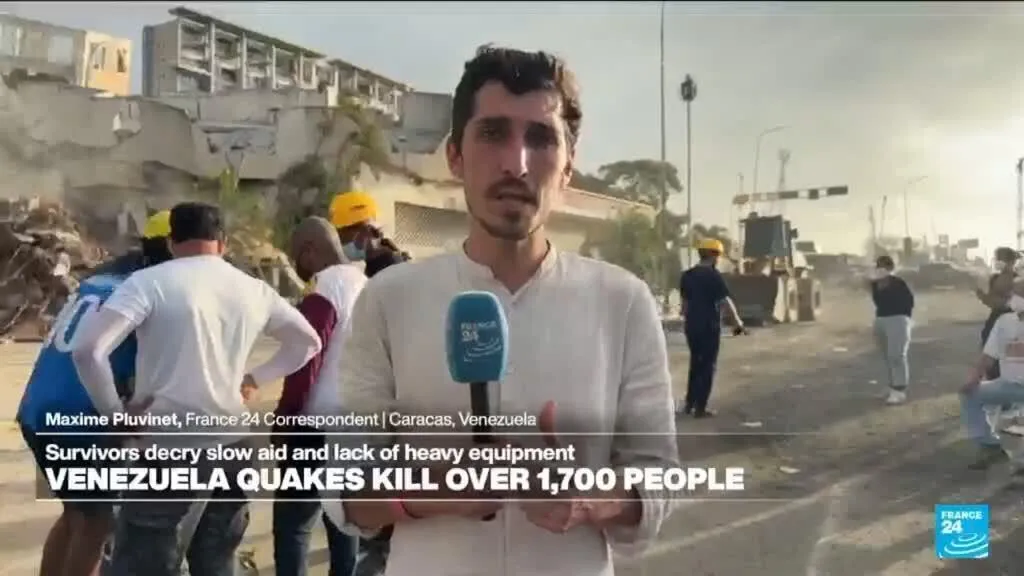
France 24 correspondent Maxime Pluvinet reports from La Guaira state, one of the areas hit by Venezuela’s June 24 twin earthquakes. The consequence for decision-makers is immediate: disaster response capacity and supply chains are being tested in real time.
France 24 correspondent Maxime Pluvinet is reporting from La Guaira state, one of the areas hit hardest by the twin earthquakes that struck Venezuela on June 24. His on-the-ground message is blunt: “All the buildings have collapsed.” In the same report, he adds that “Venezuelans are still waiting for news from their loved ones trapped under the rubble.”
That is the lede that matters, because it tells you what the crisis looks like from the street, not the spreadsheet. When a correspondent says all the buildings have collapsed in a specific state, you are no longer talking about localized property damage. You are talking about housing loss, access disruption, and communication breakdowns occurring at once, with search and rescue competing against time.
For executives and board members, disasters like this create a nasty, second-order problem: operational fragility becomes visible overnight. Even before thinking about reconstruction budgets, you have to contend with the immediate constraints that follow structural collapse. Roads can be blocked. Utilities can fail. Buildings that normally house teams, clinics, warehouses, and local offices may be gone. In that environment, the basic question for any organization is not “How fast can we plan?” It is “Can we even reach the locations and people we are responsible for?”
There is also an often-missed governance angle. In a situation where families are still waiting for news from under rubble, uncertainty becomes a currency. That can delay aid coordination, slow down verification of needs, and complicate decisions about which partners or suppliers are actually able to operate. For humanitarian and commercial actors alike, the lack of confirmed information tends to produce risk-averse behavior, which can further slow response. The practical result is that time pressures intensify, and the hardest-to-reach zones can stay hardest to reach.
Zoom out one level and consider the capital and compliance pressures that disasters trigger. Governments and major local institutions typically face emergency procurement needs, shifting priorities, and heightened scrutiny around contracting and distribution. Even if the immediate story here is physical collapse, the downstream effects often show up in altered procurement flows, temporary regulatory adjustments, and intensified requirements for documentation. In other words: the rubble creates not only immediate humanitarian demand, but also a governance test for how quickly institutions can mobilize resources without losing control of accountability.
La Guaira’s status as one of the hardest hit areas matters because it signals where disruption will concentrate. When impact is concentrated, logistics becomes a bottleneck. That can ripple into freight planning, inventory positioning, staffing decisions, and insurance claims administration. If communications are disrupted, organizations may be forced to make decisions with incomplete data, which increases the likelihood of misallocation. For boards, that is the uncomfortable trade: faster decisions versus better information. In crises, the cost of waiting can be as real as the cost of acting.
Finally, there is a strategic lesson for decision-makers across the region and beyond. Catastrophes do not only damage buildings; they stress the systems that connect people to help. The report that “Venezuelans are still waiting for news” underscores that beyond search and rescue, the crisis includes the question of connection: how families get information, how responders coordinate, and how partners communicate capabilities. The organizations that plan for that operational reality, not just the physical response, tend to perform better when the phones go silent and the usual routes disappear.
In the end, this story is not abstract. It is a specific location, La Guaira state, hit by the twin earthquakes on June 24, described by a correspondent on the ground as a place where buildings have collapsed and where people are still waiting for word about loved ones trapped under rubble. For executives, the takeaway is equally direct: response readiness, continuity planning, and coordination capacity are not “nice to have.” In moments like this, they are the difference between action and delay.
This story's Key Insights and Take-aways are locked.
Create a free account to unlock Executive Actions for one credit.
Register to UnlockAlways free for Executives Club members. Join the Club
More in Politics
Obama Defends Ilhan Omar After Agents Search Her Home in Trump Inquiry
The former president's intervention raises the stakes in a federal probe into immigration paperwork that has put a prominent progressive lawmaker in the crosshairs.

Blair-era minister: cut welfare to fund youth job support
Alan Milburn's call for welfare cuts to fund employment support opens a Labour fight over benefits and the Neet crisis.

Hot September CPI: energy costs surge, voters feel the squeeze before midterms
The latest inflation print lands as Trump campaigns for GOP control of Congress, putting cost-of-living worries at the center of the midterm fight.