
A 2.2M-parameter ChatGPT now runs on a Super Nintendo cartridge
Tech journalist Benj Edwards distilled OpenAI's open-weight GPT-OSS-120b into a 4MB ROM that boots on 1990 hardware, and the experiment exposes exactly what breaks when you shrink a model.
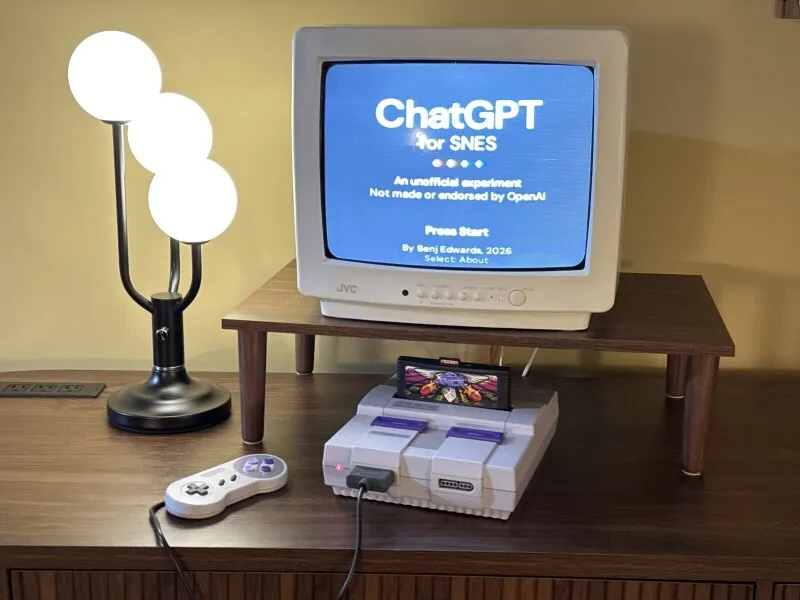
Benj Edwards, a tech journalist and retro tech enthusiast, built ChatGPT for SNES, a 2.2 million-parameter distilled offshoot of OpenAI's open-weight GPT-OSS-120b that runs on a Super Nintendo cartridge and is downloadable as a ROM. The build is a controlled demonstration of what distillation and retrieval actually buy you, and what they quietly cost, at a moment when every AI roadmap is pushing inference toward cheaper, smaller, on-device models.
Benj Edwards has answered a question nobody in a boardroom was asking, and the answer is more useful than it sounds. The tech journalist and retro tech enthusiast built ChatGPT for SNES, a working chatbot that runs on a Super Nintendo cartridge. It is a 2.2 million-parameter offshoot of OpenAI's GPT-OSS-120b, the open-weight model Edwards used to develop its training conversations, which makes it a genuine descendant of the same family tree as the chatbot on your phone. He published it online running in an emulator, complete with SNES-era music and sound effects, and released it as a downloadable SNES ROM.
For anyone who wants to try it, Edwards shipped two versions. The first is the pure model, with every word generated from what amounts to its tiny silicon brain. The second bolts on a fact book culled from the opening sentences of roughly 150,000 simple English Wikipedia articles. Run both against the same questions and the gap is enormous. Storage is not the constraint: the base build is about 4MB and the factbook build is 19MB, trivial by modern standards. Edwards is blunt about the ceiling. 'It is not a useful assistant: the model is millions of times smaller than the models behind ChatGPT, knows about 8,000 words, and often gets things wrong, sometimes confidently,' he wrote in his own writeup. He adds that 'the fact book can carry mistakes too.'
Getting there meant fighting hardware that predates the commercial internet. The Super Nintendo launched in 1990 with a processor clocked in the low single-digit megahertz and memory measured in kilobytes, a machine built for sprite scrolling, not inference. Edwards leans on Nintendo's Super FX graphics coprocessor, the chip that powered Star Fox, and on flash carts such as the FXPak Pro and SD2SNES that can run custom ROMs. The factbook build also needs the aftermarket Media Streaming Unit 1, an add-on that gives the SNES CD-ROM-like features. The pure version is leaner. Edwards told The Register it 'could run from a real custom SNES cart' and does not strictly need the Super FX chip at all. 'I do have a version of ChatGPT for SNES that can run without the Super FX chip, but without the extra processing power the answers are not as good.'
The more interesting detail is who wrote the software. Edwards designed the scope, the interface, the chip choice, and even the sounds the machine makes while it types out responses. The coding itself was done by AI agents, which he frames as an AI and human collaboration and the arrangement he believes works best. Those agents have already delivered a verdict. 'The AI agents who did the coding for this project currently advise that we've hit the limit of how good the AI model can be on the limited hardware,' Edwards said. He is not accepting it. 'It's up to human creativity to transcend those assumptions. I have already come up with new ideas that I believe can make a tiny model like ChatGPT for SNES even more coherent, and I'm working on them now.'
ChatGPT for SNES is not a one-off. Edwards also built an NES ROM called Seance that runs an even smaller model on the original Nintendo Entertainment System, simulating a conversation with a ghost trapped in a haunted game cartridge. He says he has been theorizing about what he calls 'tiny talking machines' for the past year, an interest that stretches back to the 1990s, and that coding agents finally let him turn those ideas into working software. That is the quiet shift buried in the novelty: one person with a strong concept and access to frontier models can now ship experiments that would once have required a small engineering team and a budget.
Strip away the nostalgia and this is a distillation story with a familiar shape. Big models are expensive to train and expensive to serve, so the industry keeps pushing capability downward into smaller, cheaper, more specialized packages. Edwards's factbook is a crude version of retrieval-augmented generation, the same trick enterprises use to ground a model in a private corpus instead of trusting its memory. His results show both the promise and the trap. A 4MB model with a curated fact file beats the same model alone by a wide margin, which is precisely the argument for giving AI systems better data rather than simply more parameters. But the factbook inherits its own errors, and the base model fails confidently, the exact failure mode that has embarrassed every company that shipped a chatbot without guardrails. Edwards finds it charming. 'ChatGPT for SNES can definitely make mistakes too, but it's almost cute when it does it because of its limited knowledge and its playful interface.' Your customers will not be nearly as forgiving.
For executives, the takeaways are less about retro hardware than about where the cost curve is heading. If a 2.2 million-parameter model can hold a conversation on a 1990 console, the floor for useful on-device AI keeps dropping, and the case for pushing inference onto phones, cars, sensors, and appliances gets stronger every quarter. The binding constraint that remains is not compute, it is data quality and evaluation. Edwards's two builds are a controlled experiment in exactly that: same model, same hardware, different knowledge, wildly different output. The second lesson is about who builds. Edwards supplied taste, scope, and stubbornness; the agents supplied code. That division of labor is arriving inside ordinary companies right now, and the managers who learn to direct it will outrun the ones still waiting for permission.
This story's Key Insights and Take-aways are locked.
Create a free account to unlock Executive Actions for one credit.
Register to UnlockAlways free for Executives Club members. Join the Club
More in Technology

Anthropic mathematician claims Claude helped crack the Riemann hypothesis
If the proof holds, AI has toppled math's most famous open problem; if it does not, it is a case study in announcing breakthroughs before anyone verifies them.

AI's $4 Trillion Wipeout Erases Nasdaq's Gains for the Year
A brutal week took roughly $4 trillion off the AI sector and left the Nasdaq flat for the year, and the damage ran the full length of the supply chain.

Anthropic mathematician says AI proved the Riemann hypothesis. Verification will take time.
A single unverified claim from inside Anthropic now sits against more than 160 years of open mathematics, and the gap between asserting a proof and surviving peer review is the entire story.