
Andy Burnham’s Prime Minister week begins Monday, but budget reality tests his living-standards pledge
Labour leader Andy Burnham promises tangible improvements, yet the UK’s financial situation and prior commitments may squeeze his options.
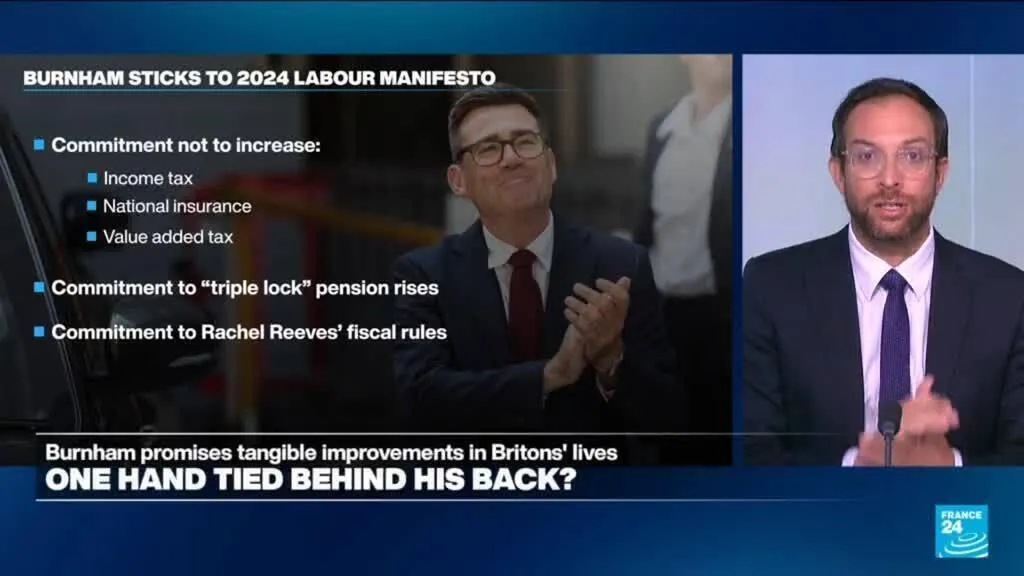
Former Greater Manchester mayor Andy Burnham is set to become the United Kingdom's new Prime Minister this Monday. His Labour agenda aims to raise living standards, but his ability to deliver is constrained by the country's financial situation and his previous commitments.
Andy Burnham, the former Greater Manchester mayor and Labour leader, is set to become the United Kingdom's new Prime Minister this Monday. His promise is straightforward on the surface: deliver tangible improvements and help raise living standards for Britons. But the real question for markets, businesses, and policy watchers is not whether he wants better outcomes. It is whether he can fund them, fast enough to show results, given the UK’s financial situation and the commitments he has already made.
The agenda, as described in the segment, will be put to the test immediately. Burnham’s plan is expected to be evaluated against two constraints that tend to decide governments in practice, not in speeches. First, the country’s current financial position limits what can be spent or changed without triggering knock-on risks, including pressure on borrowing expectations and knock-on effects for the broader economy. Second, his prior commitments reduce his “room for manoeuvre,” meaning he cannot simply pivot toward whatever is easiest in the moment. In political terms, that is a classic trap. In investor terms, it is the difference between a strategy and a slide deck.
To understand why this matters beyond Westminster, zoom out to how living-standards promises typically collide with fiscal math. Raising living standards usually means a mix of public spending, tax decisions, and policy tradeoffs that affect costs for households and businesses. When a country’s finances are tight, every policy choice has an opportunity cost. Spend more in one place, and you either cut somewhere else or borrow more. Borrow more, and you potentially absorb higher costs in the future, or spook expectations that businesses and consumers rely on when they decide whether to invest, hire, or hold onto cash.
That “financial situation” constraint is especially important because governments do not control the entire economic system. Even if a new leader moves quickly, growth can be slow to respond when confidence is fragile or when households feel uncertain. Burnham’s agenda is framed in the segment as promising higher growth in the short and long term. That promise will likely be tested by whether early actions translate into measurable momentum, not just longer-term hopes.
There is also a second-order effect that executives and boards should recognize: constraints on manoeuvre can shift how reforms are designed. When leaders are boxed in by prior commitments, they often have to focus on policies that are either already underway or can be delivered within existing fiscal and legislative guardrails. That can mean tighter prioritization. It can also mean less flexibility to tailor policy to fast-changing conditions, like inflation dynamics, wage pressures, or sector-specific shocks.
For business leaders, the implications show up in planning cycles. If government priorities are set but funding is constrained, companies may face a higher probability of policy workarounds, phased timelines, or incremental delivery rather than big-bang changes. That affects everything from regulatory strategy to capital budgeting. Even if the direction is pro-growth, the pace and mechanism of delivery can determine whether a policy helps demand soon, or mainly changes the outlook later.
Regulatory framing becomes part of the story here as well, even though the segment does not list specific regulations. In the UK, policy is not delivered in a vacuum. The government influences how rules evolve across areas like taxation, public services, labour markets, and infrastructure. When a new Prime Minister arrives with clear commitments, stakeholders expect continuity on headline goals but also look for detail on execution. If the financial situation restricts sweeping changes, the implementation style becomes more important than the ambition.
So what is at stake for decision-makers watching from the outside? Burnham’s first test is whether promises to raise living standards can survive contact with budgets and prior commitments. That determines not only his political credibility, but also how quickly the broader system can see stability. For peers in similar leadership roles, the lesson is painfully practical: setting an agenda is only step one. Step two is proving that the plan can be paid for and delivered within constraints, in a way that supports growth in both the near term and the long term.
This story's Key Insights and Take-aways are locked.
Create a free account to unlock Executive Actions for one credit.
Register to UnlockAlways free for Executives Club members. Join the Club
More in Politics

LA County: DOJ's 20,000 'noncitizen' voter list is 'unreliable,' includes U.S.-born
Preliminary review by Los Angeles County election officials finds errors in the federal list, raising the stakes for voter roll integrity ahead of November.

Trump's $1.5B Pentagon chip investment lands in North Carolina
A $1.5 billion defense infusion for North Carolina chipmaking signals a new era of Pentagon-backed reshoring - here's what it means for the industry.

Nigeria confirms first Ebola case in Abuja, a woman just off a Uganda flight
Health Minister Muhammad Ali Pate says the patient flew in from Uganda, putting Africa's latest outbreak on Nigeria's doorstep.