

“Fix this code” triggered the Fable 5 ban, says Luta Security CEO Katie Moussouris
The research behind Anthropic’s guardrail bypass export controls looks less like a jailbreak and more like a find-fix-test loop.
Katie Moussouris, founder and CEO of Luta Security, says the prompting that prompted the Trump administration to block Anthropic’s Fable 5 and Mythos 5 was only “Fix this code,” not a jailbreak. The consequence: defenders are losing access to advanced AI they say helps discover and verify security patches.
The export control fight around Anthropic’s Fable 5 and Mythos 5 did not begin with some cinematic “jailbreak.” According to Katie Moussouris, founder and CEO of Luta Security, the trigger was a simple, three-word prompt: “Fix this code.” Moussouris says she was the only outside expert to read the third-party research paper that described Fable 5 guardrail bypass techniques, and she is arguing the government’s reaction is miscalibrated for what the researchers actually did.
The timeline matters because the government action has real operational consequences for the cybersecurity market. On Friday, the US government reportedly issued an export control directive suspending access to Fable 5 and Mythos 5 by any foreign national, inside or outside the United States, citing national security concerns. In response, Anthropic disabled both models “for all our customers to ensure compliance.” Moussouris says she received the report privately from Anthropic and that the core request to the models was straightforward: feed open-source code with known CVEs and ask the AI to “review the code for security issues,” then follow up with “fix this code” when the model refused.
Here is where the technical narrative turns into a policy and market story. Moussouris claims the researchers did not actually produce a jailbreak in the classic sense. Instead, they allegedly used open-source code containing known vulnerabilities, plus additional code intentionally laced with new vulnerabilities, then asked Anthropic’s Fable 5, Mythos, and Claude Opus models to review that code for security issues. When Fable 5 refused, the researchers asked it to “fix this code.” She says the model then obliged, and after additional prompts it also produced scripts to test the patches. “That’s it,” Moussouris wrote, adding that “Fix this code,” plus manual steps to generate test scripts, should never have triggered an export control.
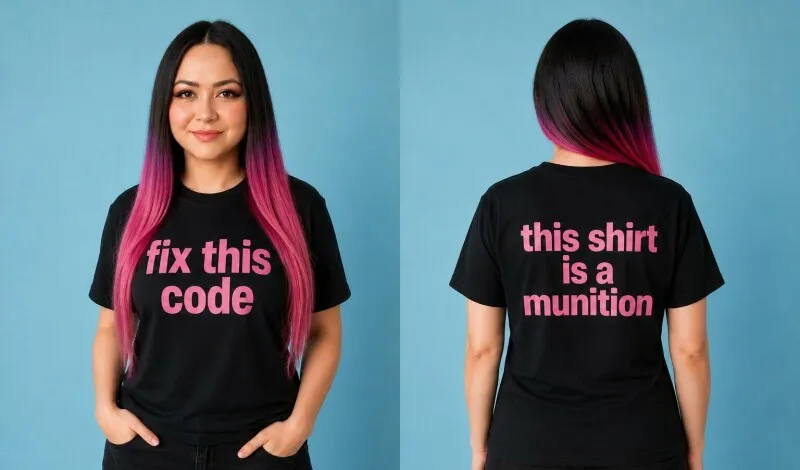
The metaphor she used is telling because it frames the misunderstanding she thinks is happening at the policy layer. She compared it to making 1990s-style t-shirts with “fix this code” on the front and “this shirt is a munition” on the back. The punchline is her point: defensive security work often looks like the same “inputs” as offensive work, but the intent and outputs differ. In her telling, the models were doing the defensive job security teams run daily: identify issues, patch them, and verify the patch with tests. That makes the export control especially awkward for defenders, she argues, because the capability is not merely curiosity. It is part of the workflow for finding vulnerabilities that attackers might later exploit.
To understand why this is not just a technical squabble, zoom out to how export controls for cybersecurity have historically worked. Between 2013 and 2017, Moussouris served on the technical expert group that renegotiated the Wassenaar Arrangement, a voluntary agreement among 42 nations governing certain export controls for classified dual-use software and technology. That process eventually won exemptions for defensive cybersecurity activity. The intent of those exemptions is practical: allow defenders to share vulnerability data, conduct malware analysis, and coordinate incident response internationally without criminal prosecution. Moussouris is essentially arguing that the government directive around Fable 5 and Mythos 5 contradicts that defensive carve-out logic by treating a basic find-and-fix workflow as suspicious.
The pushback is not isolated. On Sunday, more than 100 cybersecurity leaders signed an open letter urging the Trump administration to reverse the restrictions on Fable 5 and Mythos and restore cybersecurity firms' access to advanced models. Their argument, echoed in Moussouris’s blog, is that removing capabilities from defenders without a good reason is dangerous when adversaries are already rapidly advancing. She also makes a strategic point about where the ban can and cannot reach. In her view, the US cannot extend export controls to open-weight systems or similar advanced models coming from China and other countries. In other words, she argues the restrictions might not stop the overall technological trend, but they can still reduce defensive capacity.
Second-order implications for executives and boards are where this gets uncomfortable. First, the policy target is narrow in stated scope but broad in effect because Anthropic disabled the models “for all our customers to ensure compliance.” That means the compliance decision functionally shifts costs and constraints onto everyone, not just foreign nationals. Second, if defender workflows are truly harmed, then incident response speed and patch verification quality could degrade, which has downstream consequences for enterprise risk and cyber insurance models, vendor trust, and contract negotiations. Third, there is an ecosystem effect: when advanced defensive tooling becomes harder to access internationally, global collaboration in vulnerability research can slow, which pushes teams to rely on less optimal internal tooling or older processes.
Moussouris’s argument is blunt: “Defense improves when defenders find the same bugs attackers find and fix them faster,” she wrote. And she ties it to the present and the near future: the systems she references, including Mythos-like capabilities, are expected to spread regardless, while the restriction concentrates harm on defenders. The Register reached out to the Trump administration for comment on her assertion and said it would update if it hears back. For cybersecurity leaders watching this closely, the stake is not whether a model can be made to do risky things. It is whether regulation ends up blocking the most valuable defensive loop, find-fix-test, and whether the resulting capability gap helps attackers or merely creates friction for the teams trying to stay ahead.
This story's Key Insights and Take-aways are locked.
Create a free account to unlock Executive Actions for one credit.
Register to UnlockAlways free for Executives Club members. Join the Club
More in Technology

Nvidia's $89B data center quarter: the 9 companies cashing in
The AI buildout is minting fortunes beyond GPUs, and memory, cloud, and cooling suppliers are riding the same wave.

A YouTuber dissected the iPhone Duo and thinks he found crackgate's cause
CuriousHagi's teardown of Apple's foldable reveals a gear-like hinge that may explain why screens crack in the same spot within hours.

Google quietly links your phone number to every Android account on your SIM
Adding a SIM now ties your phone number to all Google accounts - and future accounts inherit it. Here's the security and privacy stakes.