
Germany’s World Cup exit spills into politics, Merz and the “humiliated” Iran spat
A disallowed goal, weak approval ratings, and a threatened 5,000 troop pull show how governance cracks leak everywhere.
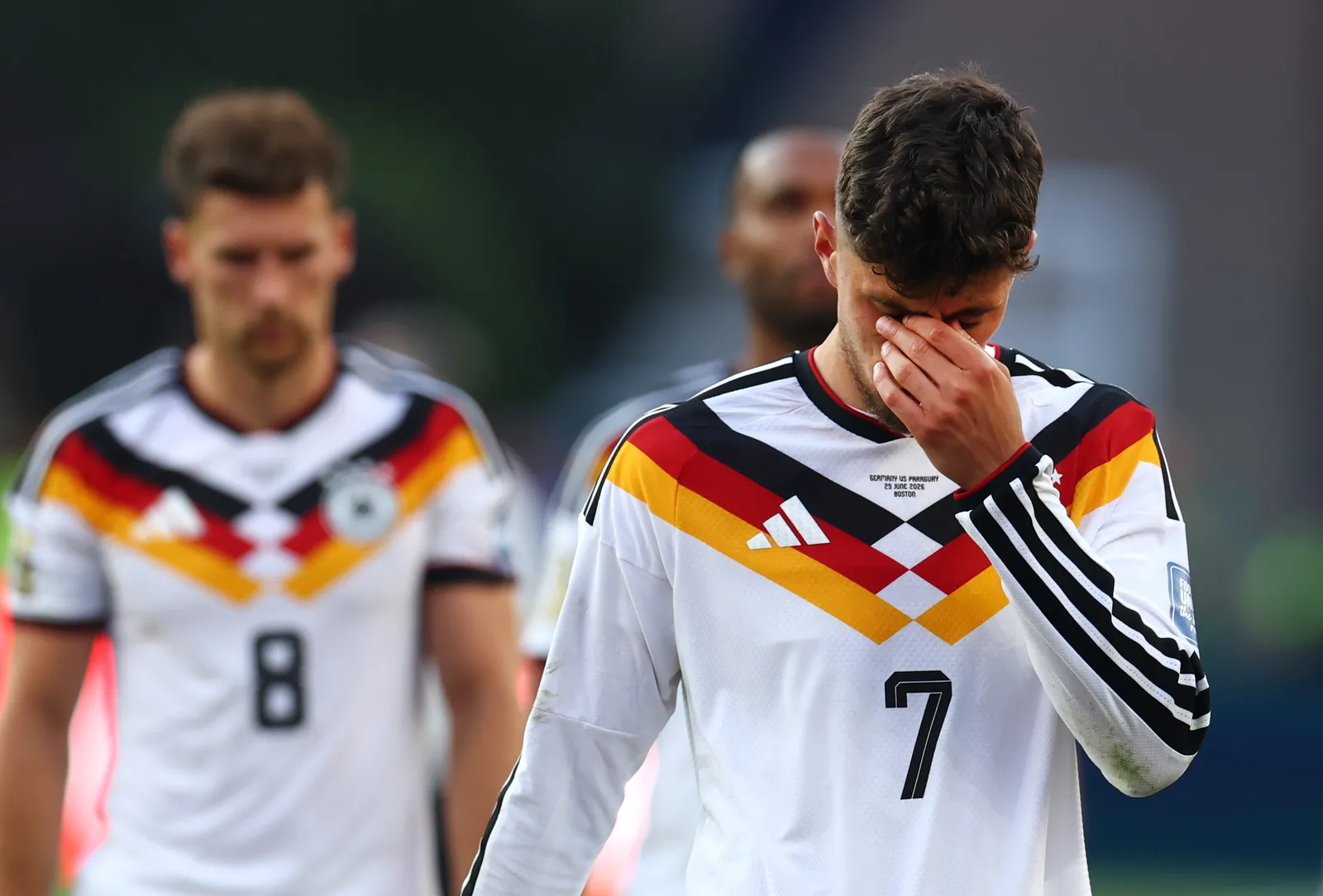
Germany’s men’s national team crashed out of the World Cup after losing to Paraguay on penalties, with a controversially disallowed overtime goal. The sports shock is landing in a wider political and economic moment: low approval for Chancellor Friedrich Merz, weak reform delivery, and rising pressure over US-Germany tensions.
Germany’s men’s World Cup run ended in penalties, but the real shock is how instantly it became a mirror for national governance. After the 2014 champions suffered a bruising defeat against Paraguay, losing 3-4 on penalties in a tournament hosted in the Americas, German leaders were forced to reckon with an added layer of symbolism: a controversially disallowed goal during overtime that would have brought Germany victory. Chatter did not stay on the pitch. Within hours, politics and public mood folded into the storyline, because for many Germans, this did not feel like one bad night. It felt like a familiar pattern.
The person pulling that thread publicly was Marie-Agnes Strack-Zimmermann, a German Member of the European Parliament, who wrote on X that “this national team plays the way this federal government governs: big on ambition, short on resolve.” Her point was brutally concrete, and it connects directly to the missed moment in the match: “Everyone struggles on their own, no one takes responsibility, and when luck finally does appear, the goal doesn’t count.” That same theme also shows up in the way Germany’s coalition government is currently seen by political observers, where major economic reforms have struggled to land. Only a planned pension overhaul is generating slight optimism, according to the source.
If you are an executive or board member, the relevant part here is not soccer. It is the credibility gap. Germany has spent years trying to stay the reliable performer in Europe’s economy, the country associated with performance, reliability, efficiency, and engineering excellence. But the source paints a broader trend of institutional strain over the last decade, reaching from industrial performance to public infrastructure and political stability. The automotive backbone, once the pride of Volkswagen’s trajectory toward becoming the world’s largest automaker, is now associated with tens of thousands of job cuts. Last week, Volkswagen announced job cuts, and major supplier Bosch is planning similarly large-scale layoffs. Even unemployment has climbed to its highest level since the Covid pandemic, while economic growth remains weak.
That matters because Germany’s governance credibility is being stress-tested on multiple fronts at once, and the incentives inside institutions change when the public loses trust. When the country gets framed as “chronically delayed trains,” infrastructure mega-projects plagued by years of holdups and ballooning costs, and an ailing automotive industry, boards and management teams feel it indirectly. Costs rise, timelines slip, and political tolerance for disruption shrinks. You can see the second-order effect in how companies operate when state capacity and regulatory coordination are questioned: planning cycles lengthen, risk premiums harden, and labor negotiations become more volatile, especially when layoffs move from “announcement” to “restructuring reality.” In other words, governance is not an abstraction. It becomes a budget line.
The political instability overlay is also not confined to sports metaphors. After Chancellor Friedrich Merz told students at a high school that the U.S. was being “humiliated” by the Iranian regime, Donald Trump responded by attacking the German leader on Truth Social and threatening Berlin’s nightmare scenario: a withdrawal of 5,000 U.S. troops from Germany. Add low government approval ratings and the far-right Alternative for Germany party rising in the polls, and the source suggests that many Germans do not believe Merz can turn things around. For decision-makers, this is a reminder that geopolitics and domestic legitimacy are intertwined: credibility at home affects leverage abroad, and vice versa, especially when budgets, alliances, and industrial policy all depend on political capital.
Even how leaders communicate is showing strain. After the final whistle late Monday night, Merz wrote on X: “Even though the loss hurts: What a game, @DFB_Team! Your determination and team spirit throughout this World Cup inspired our country. We’re proud of you.” That post was met with ridicule and pushback from German fans. German media outlet Tagesspiegel reported the post was accidentally published by a junior member of the chancellor’s staff, who selected the wrong prewritten message, and then altered the report saying that this version of events “apparently did not fully reflect the process.” The episode is small compared to troop deployments or layoffs, but it is consistent with the larger narrative: when institutions struggle to coordinate, even messaging becomes a governance test.
So is Germany doomed, or is this just negativity catching the next headline? Professor of political science Alexander Straßner offered a counterframe, arguing the headline narrative should not be taken as an irrefutable sign of imminent defeat. In a political culture shaped by negativity, he says, the decline of the West is always framed as “just around the corner,” with the state treated as the national team’s latest omen: “First the national team collapses, then society itself. That is utter nonsense.” That may sound like comfort food. But it still lands as useful for leaders: when boards and executives see public institutions failing in sequence, the temptation is to assume the worst and plan for perpetual drift. The source’s deeper warning is that the failure mode is contagious, unless decision-making explicitly restores resolve and accountability.
For peers managing in politically exposed economies, the stakes are clear. When a country’s industrial backbone is cutting jobs, infrastructure delivery is delayed, and international standing is getting challenged, talent retention and investment decisions start to tilt. If governance is seen as “big on ambition” but “short on resolve,” capital does not just wait. It reallocates. Germany’s World Cup exit may be a sports story, but the governance lesson is executive-sized: credibility is a system outcome, and when multiple institutions slip at once, trust can evaporate faster than any single department can fix it.
This story's Key Insights and Take-aways are locked.
Create a free account to unlock Executive Actions for one credit.
Register to UnlockAlways free for Executives Club members. Join the Club
More in Politics

Glacial collapse, not rain, killed 180 in Nepal's Himalayan flood
The Himalaya's extreme geography hid the true cause of Nepal's catastrophic flood, a glacial collapse that turned a geological battleground into a mass-casualty zone.
Iran’s Esmail Baghaei says Oman talks start shipping via Hormuz, not US talks yet
Temporary route plans with Oman aim to restart commerce while Tehran says Washington dialogue is not on the table.
Standards watchdog opens probe into Reform UK deputy leader Richard Tice over interests
The parliamentary standards commissioner says it began an investigation on 28 July into a possible undeclared interest.