
Hendrycks wants frontier AI paused. Hodak says that needs a surveillance state.
Two technical insiders split on the DealBook AGI panel over whether frontier training runs should stop indefinitely, and who would have to watch to make it stick.
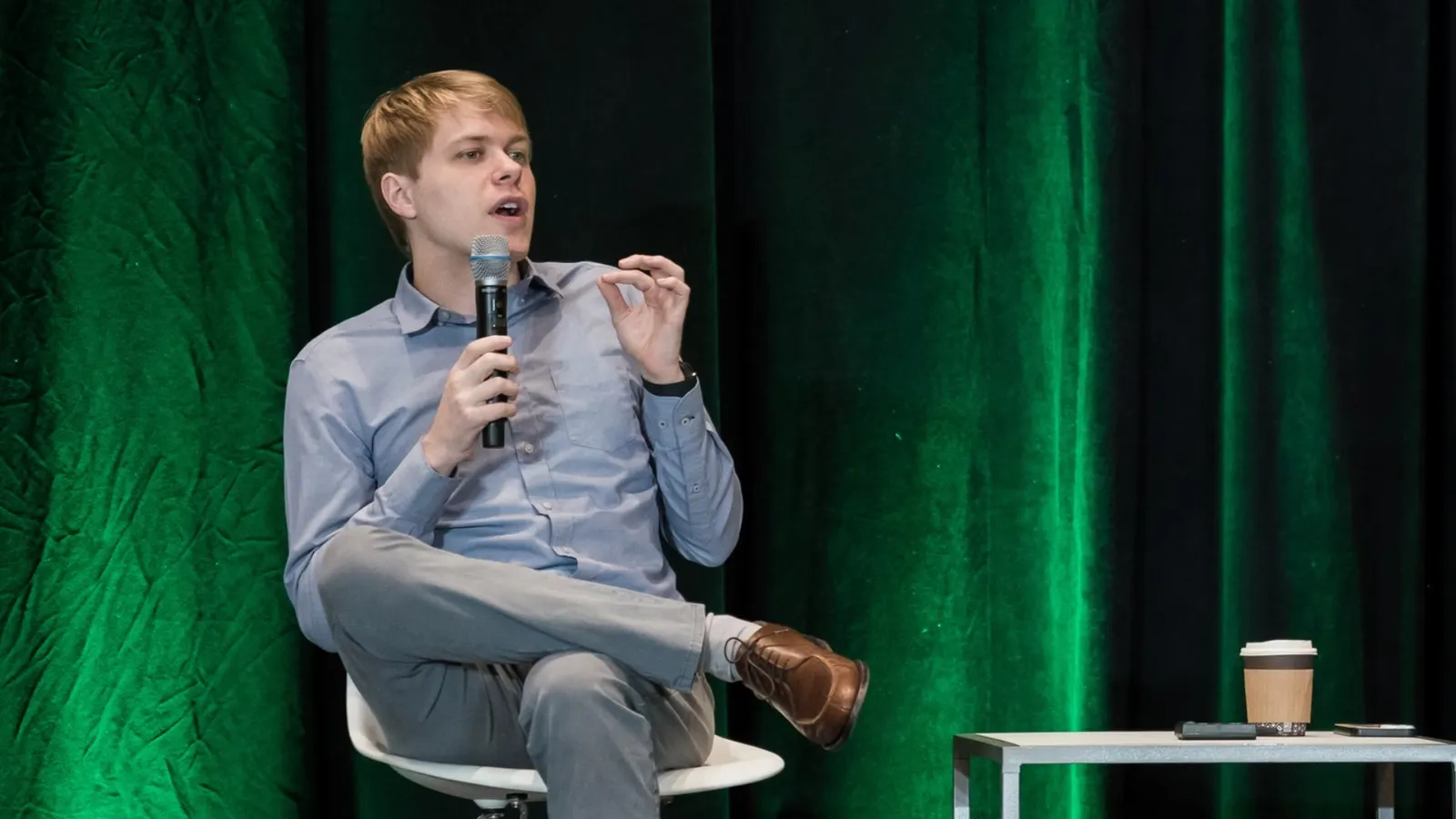
Dan Hendrycks used the New York Times DealBook Summit to call for an indefinite pause on frontier AI training runs, while Max Hodak, on the same panel, said enforcing one would take a surveillance state. For executives with AI exposure, the exchange reframes the safety debate from whether the risk is real to who would monitor compute, chips, and data centers to enforce a halt.
Dan Hendrycks used the DealBook Summit to call for an indefinite pause on frontier AI training runs. Max Hodak, seated on the same panel, said enforcing one would take a surveillance state. That is the entire argument compressed into two sentences, and it happened live on the DealBook AGI panel, moderated by Michael Barbaro of The Daily, at The New York Times' DealBook Summit in New York.
What makes the exchange worth your attention is not that two people disagreed about AI risk. It is who disagreed, and where the disagreement landed. Hendrycks is one of the most visible voices arguing that advanced AI poses catastrophic risk. Hodak, the Neuralink co-founder turned neurotech CEO, is a builder, not a regulator, and his objection was not that the risk is fake. It was that the cure is unenforceable without turning the chip supply chain and the internet into a monitoring apparatus. The fight has moved from "is this dangerous?" to "who watches, and with what?" That is a much harder question, and it now sits in front of every board with AI exposure.
For context, the pause idea is not new. In March 2023, the Future of Life Institute published an open letter calling for a six-month halt on training systems more powerful than GPT-4, and it collected thousands of signatures, including Elon Musk, Steve Wozniak, and Yoshua Bengio. No lab paused. Hendrycks has spent years pushing the risk case further than most of his peers, and the Center for AI Safety, which he directs, helped organize a 2023 statement warning that mitigating the risk of extinction from AI should be a global priority alongside pandemics and nuclear war. His DealBook position is a step past that: not six months, not conditional, but indefinite. That word is doing enormous work. A six-month pause is a cooling-off period. An indefinite pause is a moratorium, and moratoriums require a border.
Hodak's counter is the practical one, and it is the reason pause proposals keep dying in committee. To stop frontier training runs, someone has to know they are happening. That means visibility into who is buying advanced accelerators, where those chips are installed, how much power the data centers draw, and what software is running on them. Advanced chips are already tracked through export controls, and compute is physical in a way that, say, a piece of writing is not, so verification is technically conceivable. But the apparatus required, registries, reporting requirements, inspections, and the enforcement arm behind them, is exactly the surveillance architecture Hodak described. Historically, nuclear arms control worked because fissile material is countable and inspections were mutual. AI training is commodity hardware plus software, which makes counting harder and monitoring more intrusive at the same time.
Then there is the money. Frontier labs are in the middle of the largest private infrastructure buildout of the decade, with data center commitments announced in the hundreds of billions of dollars and power contracts stretching years out. A pause does not just stop experiments. It strands capital, resets the valuation math for anyone who raised against a training roadmap, and hands the lead to whoever declines to pause. That asymmetry is why unilateral restraint has never held in this industry, and why the labs that talk most about safety also talk most about staying at the frontier.
The regulatory backdrop makes the standoff sharper. The EU AI Act is phasing in obligations by risk tier. US export controls already restrict the most advanced chips from reaching certain buyers. A patchwork of state laws is emerging, and federal legislation remains stalled. None of it mandates a pause on training runs. So the choice Hendrycks described is, for now, voluntary, which means it is a governance question before it is a legal one. Boards at labs, cloud providers, and chipmakers are effectively being asked to self-impose a limit that no regulator has written down.
Watch three things from here. First, whether any lab converts the rhetoric into a published training threshold, since a number you can point to is the only version of a pause that is verifiable without a surveillance regime. Second, whether verification becomes a product: third-party compute audits, chip registries, and power-usage attestations are the plausible middle path between a moratorium and nothing. Third, whether the enforcement question gets answered by export control agencies rather than AI regulators, because they already have the chip visibility a pause would require. The panel did not settle anything. It did something more useful: it named the real bottleneck. The hard part of pausing frontier AI was never the intention. It is the watching.
This story's Key Insights and Take-aways are locked.
Create a free account to unlock Executive Actions for one credit.
Register to UnlockAlways free for Executives Club members. Join the Club
More in Technology

Anthropic Mathematician Claims Claude Helped Prove Riemann Hypothesis in Six Weeks
Levent Alpöge says the AI tool helped him develop a solution to one of math's most important unsolved problems in about six weeks, a claim that, if verified, would reshape AI's role in research.

Asahi Pours $85M Into AI Cyber Defense After Ransomware Hit
Japan's beverage giant is rebuilding its security stack around AI, and the $85 million price tag is a warning to every board still treating cyber risk as an IT line item.

Signal kills mobile screenshots to fight the 'existential threat' of AI surveillance
The encrypted messaging app is closing the one hole encryption never covered, the screenshot button, as AI tools get better at reading everything on your screen.