
Huang Left Nvidia Last Week. At DealBook, Altman and Luckey Backed Him
Two of the most closely watched founders in AI and defense used tech's biggest stage to vouch for the chipmaker's departed CEO, a signal that his influence outlasts the job title.
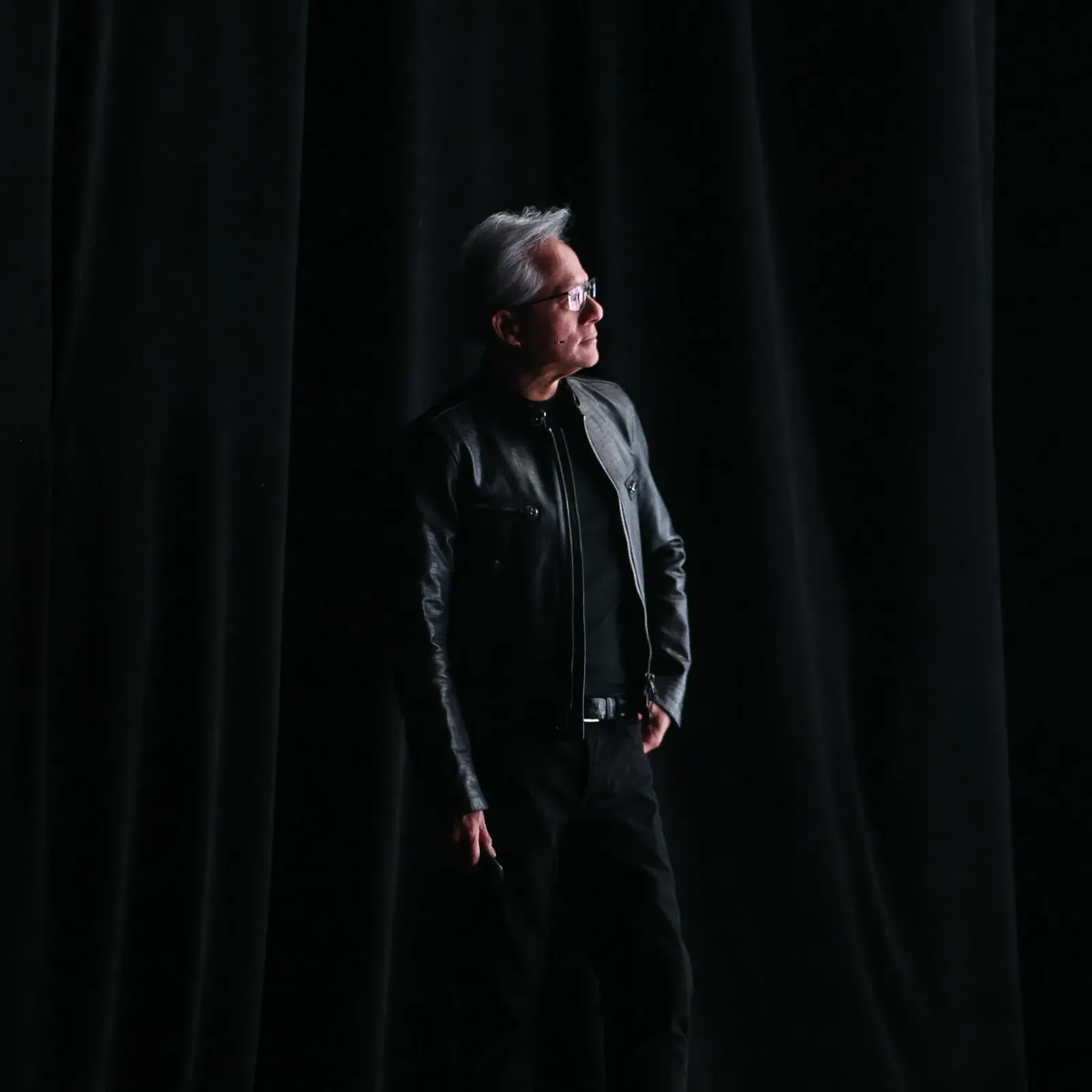
Sam Altman of OpenAI and Palmer Luckey of Anduril expressed support at the DealBook Summit for Jensen Huang, who resigned as chief executive of Nvidia last week. The endorsements signal that the AI and defense industries are treating Huang's departure as a continuity risk to be managed publicly, not a routine succession.
Sam Altman of OpenAI and Palmer Luckey of Anduril both used the DealBook Summit to express support for Jensen Huang, who resigned as chief executive of Nvidia last week. Two of the most closely watched operators in artificial intelligence and defense technology, on one of the year's most heavily covered stages, spending their airtime to vouch for a man who no longer holds the job. That is not a normal thing to do. It is also the clearest signal yet that Huang's influence over the industry is not tied to his title.
The timing is what makes it land. Nvidia is not a peripheral player. It is the company whose chips sit underneath nearly every serious AI training run, and it joined the $3 trillion market-cap club in 2024, briefly ranking as the most valuable public company on earth. Losing the chief executive who built that position, and built it over three decades, is the kind of event that normally triggers a very different conversation: succession plans, guidance risk, customer anxiety, analyst downgrades. Instead, the first public reaction captured by DealBook was peers closing ranks.
For context on why that matters: Huang co-founded Nvidia in 1993 and has been its only chief executive, steering it from graphics cards for gamers to the accelerator business that made the AI boom physically possible. Founders who stay that long become the company's operating system. They set the roadmap cadence, hold the relationships with the biggest buyers, and personally absorb the pressure when supply cannot meet demand. When that person leaves, markets typically reprice the uncertainty before they reprice the business, because the business is still shipping and the uncertainty is not yet measurable.
Altman's endorsement carries its own subtext. He runs OpenAI, the most prominent consumer of exactly the hardware Nvidia sells, and he has lived through a sudden leadership crisis himself: he was ousted as OpenAI's chief executive in November 2023 and reinstated within days after employees and investors revolted. Anyone who has been through that tends to have strong views about what a company loses when its leader walks out the door, and about how quickly the ecosystem around that leader mobilizes. His willingness to say it out loud, at a summit built for exactly this kind of on-the-record moment, tells you where OpenAI thinks its supply chain risk sits.
Luckey's support comes from a different direction. He founded Oculus VR, sold it to Facebook, and then built Anduril into one of the most valuable private defense technology companies in the United States. Anduril's business, autonomous systems and defense hardware, depends on advanced semiconductors and on a supply chain that has become a national security question rather than a procurement one. For that world, Nvidia's leadership is not a corporate governance story. It is an industrial policy story, and the person at the top of the chip supply chain is treated as infrastructure.
What the account does not tell us is just as important. It does not say why Huang resigned, and it does not name a successor. That gap is where the real risk sits for anyone with exposure to the AI trade. Boards and investors are being asked to price a company whose competitive moat has been inseparable from one person's judgment, and the loudest voices in the room are responding by praising the person rather than explaining the plan. Praise is a sentiment signal. It is not a succession strategy.
There is a broader pattern here worth naming. Over the past two years, the AI buildout has concentrated extraordinary value in a handful of firms, and it has concentrated decision-making in a handful of people. Regulators in Washington and Brussels have spent that same period tightening controls on advanced chip exports and scrutinizing how compute moves across borders. In that environment, a leadership vacuum at the most important supplier is not only a shareholder problem. It is a question governments will want answered too, and they have more leverage over the answer than most boards like to admit.
So watch three things. First, who Nvidia names next, and whether that person is an internal operator who preserves the roadmap or an outside reset who rethinks it. Second, whether customers like OpenAI start hedging their silicon bets more aggressively, which would be the quiet beginning of the end of Nvidia's pricing power. Third, whether the peer endorsements turn into something concrete, like public commitments to keep buying, partnering, or co-developing. Endorsements are cheap. Purchase orders are not.
The lesson for every chief executive and board reading this is uncomfortable but simple: if your strategy depends on one person, you do not have a strategy, you have a bet. Huang's peers just demonstrated how much goodwill a founder can accumulate over thirty years. They also demonstrated how little of it transfers automatically to whoever sits in the chair next.
This story's Key Insights and Take-aways are locked.
Create a free account to unlock Executive Actions for one credit.
Register to UnlockAlways free for Executives Club members. Join the Club
More in Technology

Anthropic mathematician claims Claude helped crack the Riemann hypothesis
If the proof holds, AI has toppled math's most famous open problem; if it does not, it is a case study in announcing breakthroughs before anyone verifies them.

AI's $4 Trillion Wipeout Erases Nasdaq's Gains for the Year
A brutal week took roughly $4 trillion off the AI sector and left the Nasdaq flat for the year, and the damage ran the full length of the supply chain.

Anthropic mathematician says AI proved the Riemann hypothesis. Verification will take time.
A single unverified claim from inside Anthropic now sits against more than 160 years of open mathematics, and the gap between asserting a proof and surviving peer review is the entire story.