

Jensen Huang resigned. Nvidia shed $573 billion in a week.
The chipmaker had no succession plan and roughly 60 direct reports to its CEO, and the market just priced founder worship at more than all but 18 S&P 500 companies.
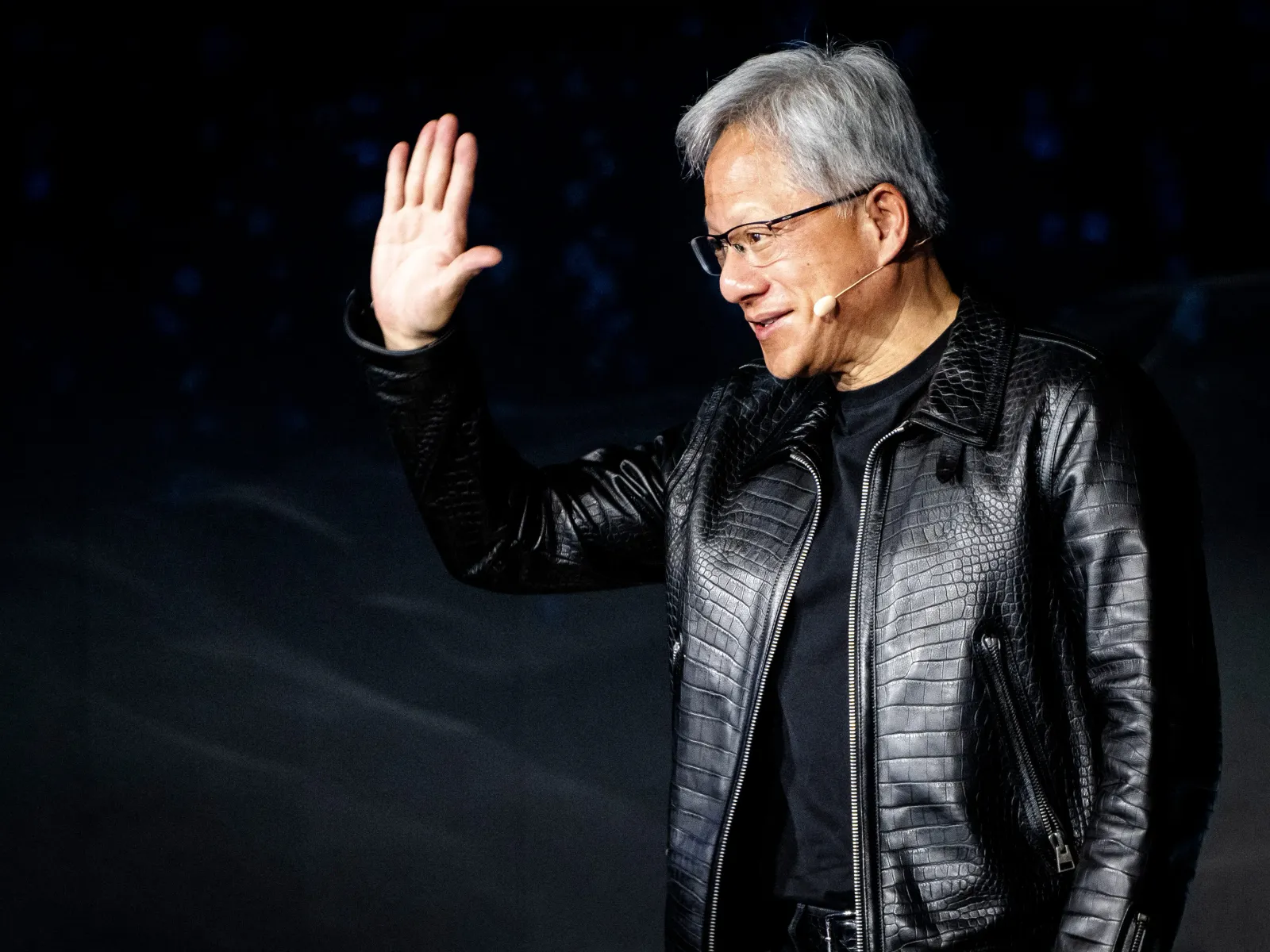
Jensen Huang resigned as Nvidia's CEO on Thursday after admitting to an affair, a second reported affair with a direct report, and a company investigation into whether he was the target of a foreign intelligence effort. Nvidia's $573 billion market-cap drop last week is now the clearest live test of key-man risk for every board that has tied its strategy and its story to a single founder.
Jensen Huang resigned on Thursday, and Nvidia's shareholders had already voted with their sell orders. The chipmaker's market capitalization tumbled $573 billion last week, a single-week wipeout bigger than the entire value of all but 18 companies in the S&P 500. That is the price the market put on one man. Huang was the AI boom's most recognizable evangelist, Nvidia's chief visionary and dealmaker, and the force behind its ascent to the most valuable company on the planet. Now the company has to prove it was never just him.
The collapse was fast and layered. A week ago, Huang admitted to an affair and apologized to his family. Nvidia then disclosed it was investigating whether he was the target of a foreign intelligence effort. The New York Times reported a second affair, this one with an Nvidia executive who was one of Huang's direct reports. He resigned on Thursday. Business Insider's Alistair Barr points to new reports casting doubt on the intelligence behind Huang's downfall, a thread that is unlikely to close quietly.
What Nvidia is now navigating has a name: key-man risk. As Business Insider's Sarah E. Needleman and Tim Paradis reported, when one leader is so closely identified with the strategy, the products, and the culture, their departure can create a vacuum that no org chart can immediately fill. Nvidia's org chart was itself a monument to the problem. The CEO had roughly 60 direct reports. And the company lacked a defined succession plan, which means the board is improvising in public, during the most consequential capital cycle in tech history.
Silicon Valley did not uniformly walk away. Venture capitalist Sarah Guo called Huang "one of the most extraordinary entrepreneurs of all time." Sequoia's Shaun Maguire said his "contributions to American innovation and AI leadership cannot be overstated." A petition to reinstate him as CEO circulated over the weekend and collected more than 100,000 signatures, including Elon Musk's and those of other prominent figures. The counterargument came from an unlikely quarter. "No one was a bigger defender of Jensen than I was but there are rules about sex with subordinates," CNBC's Jim Cramer wrote on X. "Just because someone is brilliant doesn't mean he can do what he wants."
There is precedent for survival. Steve Jobs at Apple and Travis Kalanick at Uber are the standard examples of seemingly irreplaceable CEOs whose companies still thrived under new leadership. But both cases involved boards that had time, a bench, and a story to tell investors. Nvidia has none of those things lined up right now, and the comparison cuts both ways: the market is not asking whether Nvidia can survive a founder's exit in the abstract. It is asking whether this company, at this valuation, can do it inside a single news cycle, with no named successor and no rehearsed answer for analysts.
Dick Costolo, the former Twitter CEO, floated the ending he expects. "Prediction: 3-4 years from now, [Nvidia] will miss a quarter or two, and they will bring Jensen back to run the company," he said. "Like fame, everybody is outraged for 15 minutes, and there is nothing Americans love more than the comeback story."
That prediction only makes sense if you accept how much of Nvidia's story was personal. Business Insider's Zak Jason argues the cult of the tech founder has become America's religion, and Huang was "its most convincing saint." Stephen Witt, who wrote a biography of Huang, framed the operational hole on CNBC: "It's like the Bulls without Jordan. I don't know how they are going to replace this guy."
For every board watching, the uncomfortable lesson is that key-man risk is not a disclosure line item, it is a valuation input. Companies that let one person own the strategy, the product roadmap, and the public narrative inherit a share price that reprices on personal news rather than quarterly results. The fix is unglamorous and mostly pre-crisis work: a named successor, a bench with real authority, and a governance structure where 60 people do not report to a single human bottleneck. Nvidia is now running that experiment live, with $573 billion as the opening bid on how much one person mattered.
This story's Key Insights and Take-aways are locked.
Create a free account to unlock Executive Actions for one credit.
Register to UnlockAlways free for Executives Club members. Join the Club
More in Business

GTA VI hauls $3.79bn in one day, out-earning every film ever made
Rockstar's own estimate covers a single Thursday plus a record 32.5m prerelease units, and it lands on every board weighing IP concentration, pricing power and launch risk.

FBI's crime database breached again, the second hack in months
CNN reports hackers hit the National Crime Information Center, the shared backbone of US policing, and the repeat timing is the part every security team should study.

S&P 500 Enters Correction, Down 10% From Its High on AI Worries
The index's slide past the 10 percent line is a symbolic verdict on investor mood, and the AI trade that powered the rally is now the thing testing it.