
Jensen Huang resigns at Nvidia after spy-linked affair, $430B wipeout
The board accepted his resignation on November 11 and handed the world's most valuable chipmaker to CFO Colette Kress on an interim basis, with next week's earnings call now the highest-stakes in company history.
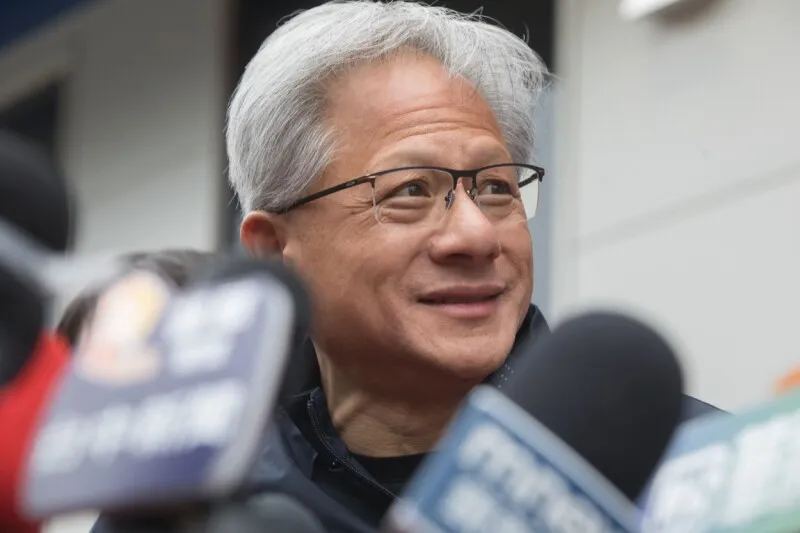
Nvidia CEO Jensen Huang resigned on November 11 after a board investigation into an affair with a woman US intelligence suspected of being a Chinese spy, plus a second alleged relationship with an employee; CFO Colette Kress takes over as interim CEO. For decision-makers, the roughly $430 billion two-day market value wipeout and next week's earnings call make Nvidia's leadership crisis a live stress test of the entire AI capital cycle.
Jensen Huang has resigned as CEO of Nvidia. The board accepted the resignation of the man it identified in its filing as Jen-Hsun Huang on November 11, effective immediately, according to a Form 8-K the GPU maker lodged with the US Securities and Exchange Commission. Chief financial officer Colette Kress takes over as interim leader while the board searches for a permanent chief executive. The market had already rendered its verdict: Nvidia shares fell 4.3 percent on November 9 and another 5.5 percent the following day, wiping roughly $430 billion off its market value as speculation about his future ran hot.
The collapse took two weeks. News of the scandal first surfaced on October 29, when claims emerged that Huang had been the target of an espionage plot involving a Chinese businesswoman working for Megaspeed, a Singapore-based company that was an Nvidia customer. According to the New York Times, US intelligence had reason to believe the woman, Alice Huang, was recruited to gather information about Nvidia and its operations for the Beijing government. Megaspeed separately faces claims it was illicitly shipping Nvidia products to China in violation of US export controls. Beijing rejects the spying allegations, describing them as part of a smear campaign against China.
Shortly after the board announced its investigation, Huang emailed Nvidia staff to apologize and confess to an affair, though he did not explicitly name Alice Huang in that public apology. For a moment it looked like the leather-jacketed founder might survive; after all, it was difficult to imagine anyone else leading the company after all this time. Then the second claim landed: a relationship with an Nvidia employee who reported to him, reported by the New York Times as Kimberly Powell, the company's vice president of health care. Huang resigned the same day that story broke.
What he leaves behind is the most consequential company in the AI economy. Huang founded Nvidia in 1993 and served as president, CEO, and a member of the board of directors ever since, steering the GPU maker to a peak market value above $5.5 trillion earlier this year. That run rested on an early bet: that the number-crunching power of graphics processors could be pointed at accelerating AI processing. Nvidia's position today as the leading AI hardware firm is the payoff on that wager. Any successor inherits both the franchise and the question of whether the franchise was ever separable from the founder.
The board reached for continuity. "In the near term, the board did the sensible thing and reached for a steward. Colette Kress knows every number in that order book," said Mark Malek, CIO at financial services firm Siebert Financial. But he was blunt about what the move does not fix: "It does NOT settle the stock. Interim means the real decision is still ahead, the investigations are still open, and next week's earnings call just became the most important in the company's history." That is the near-term calendar every Nvidia customer, supplier, and shareholder is now circling.
The stakes extend well past one boardroom. "The sudden resignation of Jensen Huang is about more than succession at the world's most important AI chipmaker, Nvidia's leadership crisis is a stress test for the AI boom," said Stephanie Balaouras, VP and group research director at Forrester. If Nvidia stabilizes quickly under new leadership, she adds, the AI infrastructure boom will have demonstrated resilience. If its stock or financing relationships remain under sustained pressure, that would add evidence to the fragility of the AI bubble. In other words, the market's read on Nvidia is the market's read on the entire AI capital cycle.
There is a regulatory layer too. Washington has spent years trying to keep advanced AI technology out of China's hands, citing security concerns and the risk of military use. A sitting CEO allegedly entangled with a woman US intelligence suspected of working for Beijing, at a company whose products sit at the center of that export-control regime, turns a personal scandal into a national-security question. Megaspeed's alleged shipments already put Nvidia's customer and distributor oversight under a microscope. Expect lawmakers and regulators to ask what the company knew, when it knew it, and what its compliance function flagged.
For peers in the C-suite, the lesson is about speed and disclosure. A founder-CEO with three decades of tenure can look immovable right up until the moment he is not, and boards that wait for a second revelation to act pay for it in market value. The open questions now are who the board picks, how quickly the investigations close, and whether Kress can hold the order book together through an earnings call that just became the most scrutinized in the company's history.
This story's Key Insights and Take-aways are locked.
Create a free account to unlock Executive Actions for one credit.
Register to UnlockAlways free for Executives Club members. Join the Club
More in Technology

Anthropic mathematician claims Claude helped crack the Riemann hypothesis
If the proof holds, AI has toppled math's most famous open problem; if it does not, it is a case study in announcing breakthroughs before anyone verifies them.

AI's $4 Trillion Wipeout Erases Nasdaq's Gains for the Year
A brutal week took roughly $4 trillion off the AI sector and left the Nasdaq flat for the year, and the damage ran the full length of the supply chain.

Anthropic mathematician says AI proved the Riemann hypothesis. Verification will take time.
A single unverified claim from inside Anthropic now sits against more than 160 years of open mathematics, and the gap between asserting a proof and surviving peer review is the entire story.