

Lammy says Labour’s first Gaza response under Starmer was 'problematic'
The deputy PM warns Labour’s early stance toward the Gaza conflict needed work, with wider political and regulatory implications.
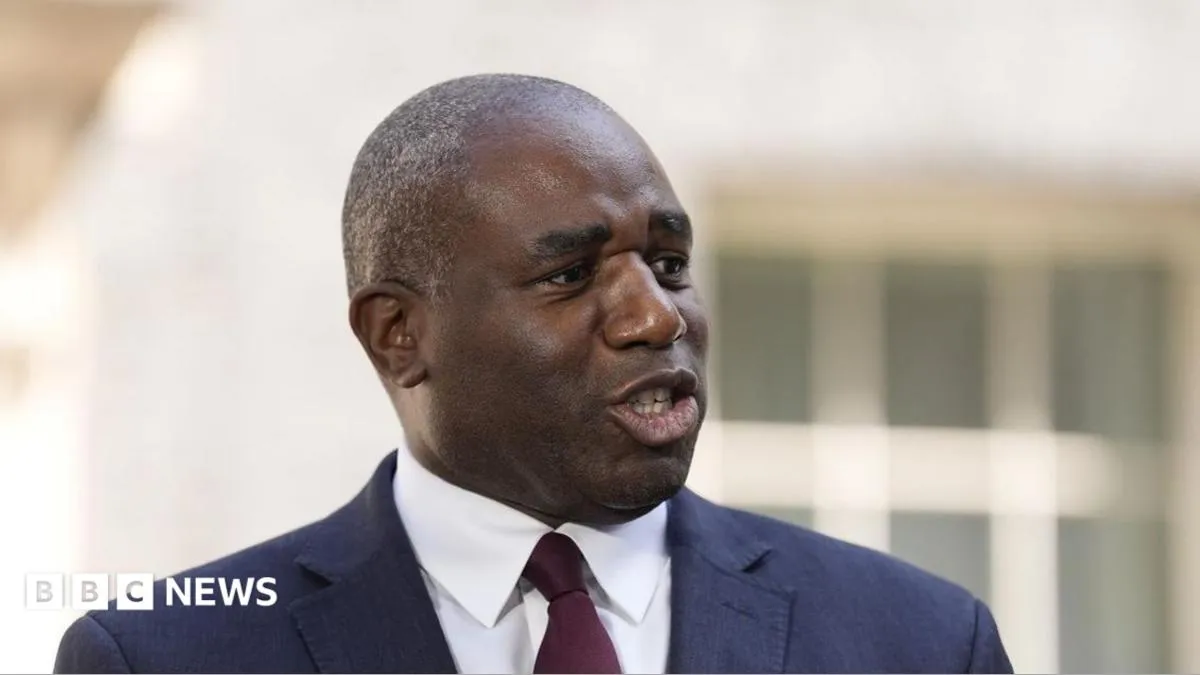
Speaking to the BBC, deputy prime minister David Lammy said Labour’s initial response to the Gaza conflict under Sir Keir Starmer was 'problematic'. The comment puts pressure on Labour’s leadership to tighten messaging and decision-making quickly, ahead of mounting scrutiny.
David Lammy, the deputy prime minister, told the BBC that Labour’s initial response to the Gaza conflict under Sir Keir Starmer was “problematic”. In plain terms: Lammy is saying the first moves were the wrong kind of wrong, at least in how they were understood and received. That matters because the early phase of any high-stakes crisis is when narratives form and credibility hardens. Get it wrong up front, and you do not get to “fix it later” without paying a political and institutional price.
Lammy’s critique is not happening in a vacuum. Gaza is not just another foreign policy headline that cycles through the news and disappears. It pulls on questions about what Labour stands for, how quickly it can respond to moral and security pressures, and how it handles internal debate when the outside world is watching every sentence. When the deputy prime minister publicly calls an initial response “problematic”, it is effectively an accountability signal. It suggests that even inside the government, leaders are comparing what was done early against what should have been done early.
If you zoom out, this is how political trust works under stress. Voters, allies, opponents, and institutions all evaluate leadership in two timeframes at once. There is the immediate “what did you do today?” test, and then the longer “what does this say about your governance process?” test. “Problematic” hits the second one. It implies the issue is not merely outcomes, but the process, the timing, and possibly the coordination that produced Labour’s first response.
Now bring in the perspective executives recognize: incentive alignment and decision velocity. Crisis communication is not only about correctness. It is about cadence, consistency, and the ability to translate complex developments into messages that hold up over time. When the top team is perceived as scrambling or being slow to lock in a coherent line, it triggers a broader risk response from stakeholders. That can include media scrutiny, political opposition pressure, and pressure on ministers and civil servants to tighten guidance.
There is also a governance angle that business leaders will recognize from regulated environments. In sectors where rule-following is existential, early missteps can cascade because compliance systems are built around assumptions: who approves what, when signals get escalated, and how internal disagreement is handled. Politics is not a regulatory framework in the same way, but the logic rhymes. If a leadership team cannot rapidly converge on a stable position, the rest of the organization ends up firefighting, and the cost shows up later as reputational drag.
Lammy’s comment is also a spotlight on internal board dynamics, even if “board” is not the right metaphor. The deputy prime minister is, in effect, weighing in on a leadership chapter attributed to Starmer’s tenure. That kind of public calibration can mean one of two things: either the leadership process is adjusting in real time, or the early response created a credibility gap that later leaders now feel compelled to acknowledge. Either way, the phrase “problematic” signals that the initial messaging did not meet the standard for clarity or appropriateness expected by senior figures.
The second-order implication is that this becomes a template for how the government is likely to handle other sensitive issues. If Labour’s first Gaza response is now being characterized as “problematic”, it raises the stakes for subsequent decisions. Senior officials may face more pressure to ensure that internal reviews happen earlier, that spokespeople are coordinated, and that ministerial statements do not drift away from the leadership line. For anyone watching government performance, including journalists, political parties, and civil society groups, it sets an expectation that shortcomings will be surfaced, and perhaps corrected, rather than quietly absorbed.
For decision-makers who operate in high-visibility roles, the lesson is blunt: the first response is rarely the final response, but it often becomes the reference point. Lammy’s BBC comments, focused on Labour’s initial stance, underline that leadership is judged not only on what it eventually concludes, but on how it earned (or lost) trust at the start. In a conflict like Gaza, where global attention and moral stakes are constant, a “problematic” beginning can become a long-running audit of judgment, coordination, and credibility. Today’s line is not just rhetoric. It is governance in public view.
This story's Key Insights and Take-aways are locked.
Create a free account to unlock Executive Actions for one credit.
Register to UnlockAlways free for Executives Club members. Join the Club
More in Politics

Glacial collapse, not rain, killed 180 in Nepal's Himalayan flood
The Himalaya's extreme geography hid the true cause of Nepal's catastrophic flood, a glacial collapse that turned a geological battleground into a mass-casualty zone.

Iran’s Esmail Baghaei says Oman talks start shipping via Hormuz, not US talks yet
Temporary route plans with Oman aim to restart commerce while Tehran says Washington dialogue is not on the table.

Standards watchdog opens probe into Reform UK deputy leader Richard Tice over interests
The parliamentary standards commissioner says it began an investigation on 28 July into a possible undeclared interest.