
Man Utd captain Bruno Fernandes pauses new deal: 'not the right time'
Manchester United's captain has an offer on the table and has chosen to leave it there, a deferral that hands him leverage and hands the club a succession problem.
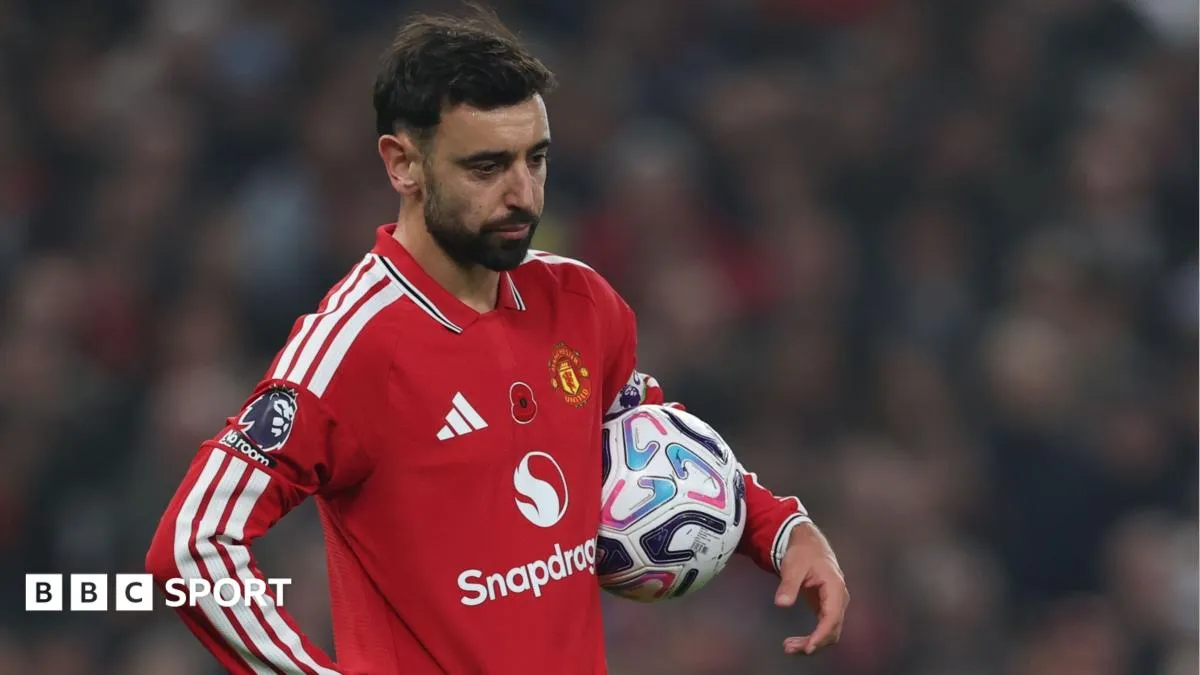
Manchester United captain Bruno Fernandes says the club has offered him a new contract but that it is "not the right time" to discuss his future. The deferral, rather than a rejection, leaves the club planning around a leader whose commitment is unresolved and gives the player optionality heading into the next registration window.
Manchester United captain Bruno Fernandes says the club has offered him a new contract, and he has decided it is "not the right time" to discuss his future. That is the whole of the disclosure: no figure, no deadline, no explanation, no indication of which side moved first. It is also, in the hands of a club captain, one of the most loaded sentences in professional sport.
Notice what the line does not say. Fernandes does not say he rejected the offer. He does not say he wants out. He says the timing is wrong. In football's negotiating grammar, that is not a door slamming. It is a door held deliberately ajar, with the club on the other side, waiting. The captain of one of the most scrutinised teams in world football has just told his employer that the calendar, not the money, is the problem. That is a bargaining position wearing the costume of a scheduling note.
Why does the captaincy amplify it? Because a captain is not just a name on a teamsheet. He is the on-field voice of the manager, the locker-room thermostat, and, at a club of United's commercial scale, one of the faces a sponsor sees in the deck. When that person parks talks, the club loses something it cannot buy back quickly: certainty. Recruitment planning, wage structure, and the message sent to the rest of the squad all run through the captain's future. A deferred conversation is a deferred decision, and deferred decisions compound.
For context on how these standoffs usually work: since the 1995 Bosman ruling at the European Court of Justice, players in the European Union have been able to move freely once their contracts expire, which handed a large share of leverage to the player as a deal runs down. Clubs responded by tying talent to longer deals earlier, and by leaning on registration periods, the two transfer windows FIFA's rules typically allow each year, as the moments when leverage flips. Historically, that means the value of a public "not now" depends entirely on where the clock sits. If a player has years left, the club can wait him out. If the clock is short, the player can.
The source of this story gives no reason for the pause, and that silence is itself the story. Fernandes has not framed it as a dispute over money, ambition, or the direction of the team. He has framed it as timing. That framing is useful to both sides. It lets the club say publicly that an offer is on the table, which signals to fans and to the market that it is doing its job. It lets the player keep every option open without ever having to say the word "no". Both parties get to look reasonable while nothing gets resolved.
The second-order risk for United is structural, not sentimental. A captain's contract is a keystone. It shapes the wage ceiling other agents will point to in negotiations, it shapes which players the club can sell without gutting the dressing room, and it shapes the story a new signing hears on the phone. Uncertainty at the top of the roster tends to travel downward fast. Historically, clubs that let a captain's situation drift into a transfer window have found themselves negotiating from a weaker chair, because every counterparty can see the clock too.
There is a commercial layer as well. Elite clubs monetise their captains: matchday marketing, partner activations, the kind of content that travels globally. That value is not contractual in the way a shirt deal is, but it is real, and it is fragile. A captain who is visibly unresolved becomes a question mark in every brand conversation, and question marks are what sponsors pay agencies to avoid.
Zoom out, and the lesson travels well beyond football. Any organisation with a high-performing, high-visibility leader faces the same fork: an offer on the table, a decision deferred, and a public that has now been told about it. The difference between a rejected offer and a deferred one is enormous, and it is almost entirely about time. A rejection forces a plan. A deferral lets everyone pretend a plan is not yet needed. That is precisely why deferrals are so expensive.
What to watch next is narrow and specific. Whether talks resume, and when. Whether the club's public posture stays warm. Whether the next registration window passes quietly or becomes the moment the deferral turns into a decision. Fernandes has not closed a door. He has simply reminded everyone that he is the one holding the handle.
This story's Key Insights and Take-aways are locked.
Create a free account to unlock Executive Actions for one credit.
Register to UnlockAlways free for Executives Club members. Join the Club
More in Entertainment

Star Trek's next movie is Crimson Tide meets Training Day, directors say
Jonathan Goldstein and John Francis Daley tell Inverse their Starfleet thriller fuses submarine-siege pressure with dirty-cop morality, and it is the only Trek film currently in development.

Mahershala Ali's Two Oscars Buy Him Nothing: 'There Are Not Roles for Me'
The two-time Oscar winner told the 7PM in Brooklyn podcast that his trophies do not unlock work in 'the vast majority of projects,' a blunt read on what Hollywood's franchise economy actually rewards.

Robert Pattinson Is 007: Amazon's Bond Pick Sends a Divisive Film Surging
Amazon confirmed Pattinson as Bond under Denis Villeneuve, and within days the franchise's most controversial entry started climbing the streaming charts, a reminder that casting is catalog strategy.