

Mitch McConnell’s monthlong absence triggers health questions and Senate deadline pressure
From Kean’s missing months to Feinstein’s shielded decline, Congress keeps opacity high, even as votes cannot wait.
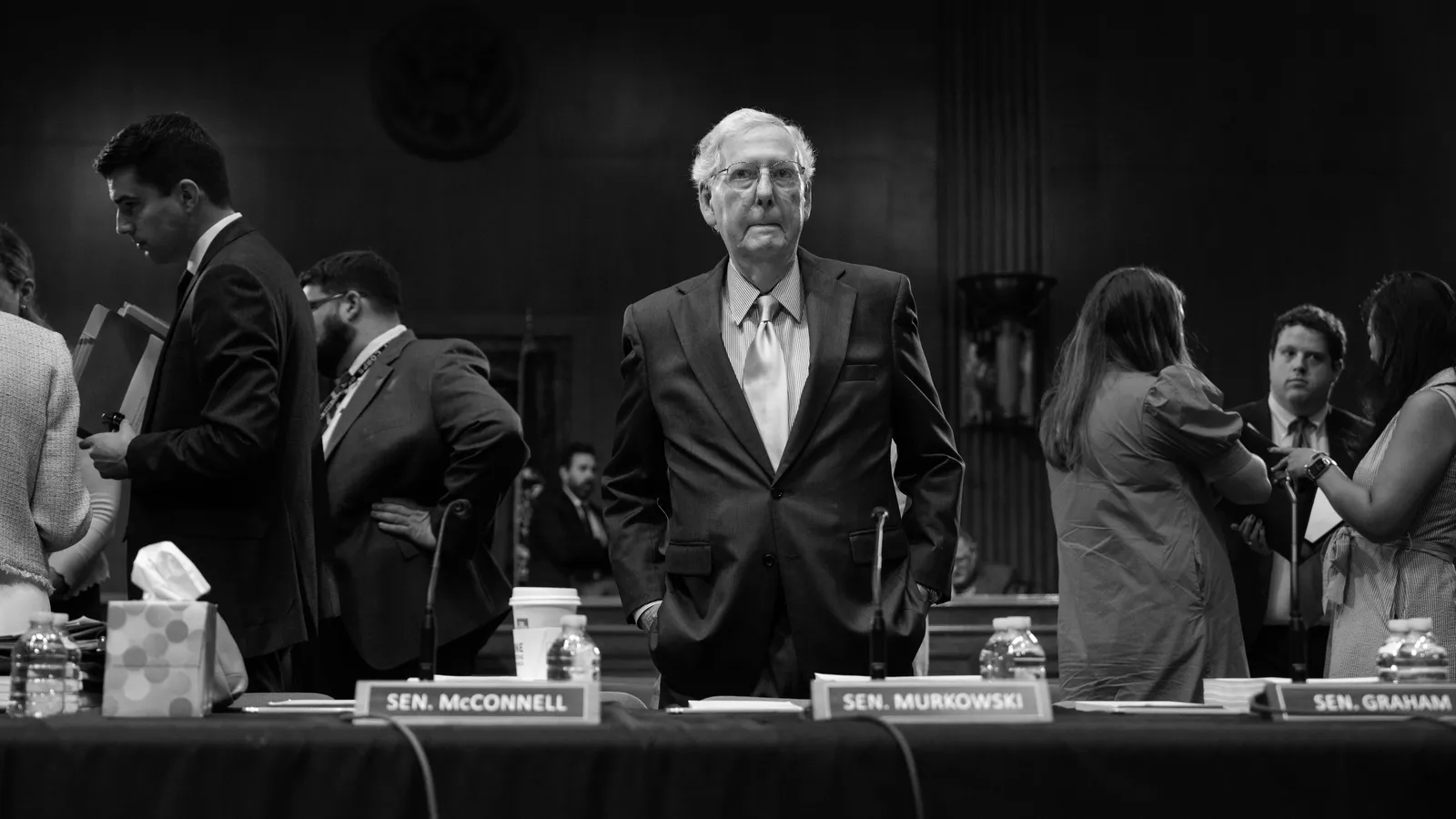
Sen. Mitch McConnell has not been seen in public for almost a month after being hospitalized June 14, and his staff will not provide details. The resulting uncertainty collides with Congress returning from recess on Monday and the Senate’s late-September government funding deadline.
Sen. Mitch McConnell has not been seen in public in almost a month. He was hospitalized on June 14, and his staff has declined to elaborate, recycling the same line: “The Senator continues to improve, and is working closely with his staff on Kentucky and Senate matters while the Senate is out of session.” The message is steady. The silence around it is not. Speculation has filled the void this week, and McConnell’s allies say they have recently spoken with him, but those assurances have not stopped questions from multiplying.
While the staff message stays the same, two public actions underlined how fast “privacy” becomes “governance” when a senator’s seat and schedule stop matching up. Yesterday, the Kentucky governor sent a formal letter requesting a health update. And President Trump told reporters he had “no idea” how McConnell was doing. McConnell’s absence lands right when Congress needs visible operators, not rumors: the Senate returns from recess on Monday, and if his absence continues, it could complicate the Senate’s business, especially the late-September deadline to fund the government for the next fiscal year. McConnell is not just any lawmaker. He sits on the powerful Appropriations Committee and leads the Defense Appropriations Subcommittee, the panel responsible for military spending.
This is not the first time Congress has gone opaque about a member’s health. Representative Tom Kean Jr. of New Jersey disappeared for nearly four months this year and missed 142 House roll-call votes before resurfacing in late June. Kean explained that he had been receiving treatment for depression. In 2024, then-Representative Kay Granger of Texas was absent from Congress for months before The Dallas Express reported she was living in “a local memory care and assisted living home for some time after having been found wandering lost and confused.” And Senator Dianne Feinstein of California, who died in 2023, remained in office as her health rapidly deteriorated, while staff downplayed her condition. The recurring pattern is simple: staff and aides shield details, the public notices the gaps, and the gap becomes a battleground.
There is a reason the battleground keeps resurfacing. While a seat in Congress comes with baseline expectations that the member is on the job when the House or Senate is in session, there are no formal rules governing disclosure of medical conditions for lawmakers. There are also no official procedures for declaring a member medically incapacitated and removing them. As a result, the norm on the Hill has long been to fiercely shield and protect legislators’ private lives, especially on matters as sensitive as mental or physical health. But when majorities are shifting and often thin, absences stop being background noise. Key votes happen. Someone is missing. Constituents notice. Opponents notice. Social media notices, loudly.
McConnell’s absence has spawned a flood of memes, some involving Ouija boards, AI-generated Mitch-zombies, and Weekend at Bernie’s-inspired scenes, along with reports that the kid from The Sixth Sense reached the senator. Hasan Piker, a leftist Twitch streamer, challenged McConnell to publicly deny that he and McConnell were engaged in a romantic tryst. Scott Jennings, a Republican pundit, tried to blunt the speculation by sharing that he had spoken with McConnell “for just shy of 20 minutes” about issues including Iran and Ukraine. That post, predictably, became a Mad Libs template for reporting fake conversations. CNN mistakenly ran a screenshot of a parody account claiming to have spoken with McConnell. The memes are a distraction, but the underlying tension is real: representation is not a vibe.
The deeper question is whether any of this ever forces structural change. In 1980, Maryland voters elected Gladys Spellman to a fourth term in the House, but she had suffered a heart attack days before Election Day, survived, then fell into a coma and never regained consciousness. Through a first-of-its-kind House resolution passed in February 1981, her seat was declared vacant. That is the rare modern example of House members taking action to formally remove and replace a colleague unable to perform the job due to a medical crisis. Outside of cases like Spellman’s, Congress has largely relied on staff shielding, internal knowledge, and political tolerance for ambiguity.
Longtime observers say McConnell’s and Kean’s recent absences are not unprecedented, just newly headlining. Jim Manley, a longtime aide to Harry Reid, told The Atlantic that this is a story as old as Congress itself. He pointed to historical examples: Senator Carter Glass spent his last four years absent from public view due to illness before dying in 1946 and did not answer a single Senate roll call after 1942. Senator Karl Mundt suffered a stroke in 1969 and did not appear on the Senate floor for almost three years before deciding not to seek reelection in 1972. John F. Kennedy hid his diagnosis of Addison’s disease, an adrenal insufficiency, from voters. Numerous lawmakers in more recent years stuck to offices even as they grew visibly frail or as mental capacity was questioned, and aides demurred or denied that anything was amiss. There was always a rationale: protect privacy. There was always an cost: constituents and institutions operate with incomplete information.
Whether McConnell’s current situation becomes a turning point is uncertain. But the incentives around opacity are powerful. “Each seat is extraordinarily valuable, as is each vote in the House and Senate,” Princeton historian Julian Zelizer told The Atlantic. “This leads to keeping these issues as secret as possible.” Even when reform is discussed, it bumps into staffing risk: Manley said staff jobs are on the line in part because, “As long as God created staff, there’s always going to be folks that are going to try and do what they can to keep this stuff out of the media.” Still, academics and reform advocates see a practical fix. Steven Smith, a social-sciences professor at Arizona State University who studies Congress, said there should be a rule obligating members’ chiefs of staff or others to report their bosses’ absences, since they are employees of taxpayers. He added that it could still be vague, but there ought to be a requirement indicating whether someone is literally not on the job. Scott Tillman of U.S. Term Limits argued that the cases involving McConnell and Kean make the representation problem more salient: people are deprived of representation when they elected someone to be there but the person is not being represented.
For executives, investors, or anyone who follows how institutions actually run, the second-order lesson is uncomfortable. Governance depends on signals. When official signals get replaced by staff statements, rumor economies rush in, and operational continuity becomes harder to verify. In this case, continuity is not theoretical. McConnell’s role in defense appropriations means his absence can create friction around committee work and the broader schedule, as Congress heads back into a late-September funding deadline. The privacy-versus-transparency tradeoff might be inevitable in Congress. But the mounting pressure suggests it is not costless. For the Senate, time is a constraint. For colleagues watching thin majorities, it is also a precedent.
This story's Key Insights and Take-aways are locked.
Create a free account to unlock Executive Actions for one credit.
Register to UnlockAlways free for Executives Club members. Join the Club
More in Politics

Glacial collapse, not rain, killed 180 in Nepal's Himalayan flood
The Himalaya's extreme geography hid the true cause of Nepal's catastrophic flood, a glacial collapse that turned a geological battleground into a mass-casualty zone.

Iran’s Esmail Baghaei says Oman talks start shipping via Hormuz, not US talks yet
Temporary route plans with Oman aim to restart commerce while Tehran says Washington dialogue is not on the table.

Standards watchdog opens probe into Reform UK deputy leader Richard Tice over interests
The parliamentary standards commissioner says it began an investigation on 28 July into a possible undeclared interest.