
NASA takes 15% of Japan's Mars moon samples in mission launching Monday
JAXA's MMX spacecraft lifts off Oct. 19 to settle whether Phobos and Deimos are impact debris or captured asteroids, with NASA instruments riding along.
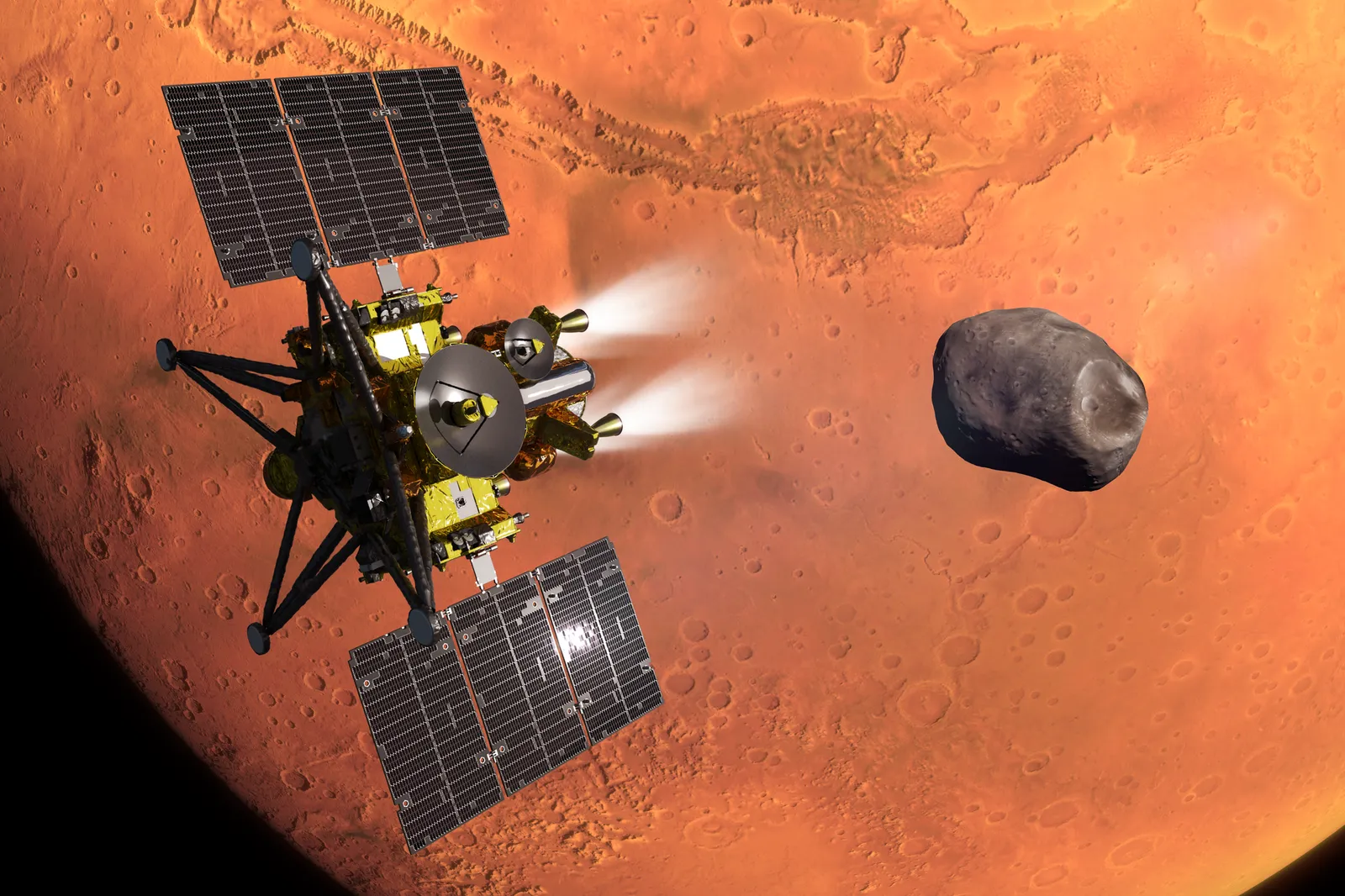
NASA's Nicky Fox is spotlighting the agency's partnership with JAXA on the MMX mission, which launches Monday and will return samples from Mars' moon Phobos to Earth. The mission's 15% sample-share arrangement gives U.S. scientists decades of access to material that could rewrite the early history of the inner solar system.
NASA is set to take a 15% share of the samples returned from a Martian moon, and the spacecraft carrying that scientific payday launches Monday. JAXA's MMX mission is targeting liftoff from Tanegashima Space Center in Japan at 3:41 p.m. EDT on Oct. 19, beginning a years-long journey that includes surveying Mars' two moons, landing on Phobos, collecting surface material, and delivering it to Earth in 2031. NASA will obtain and curate about 15% of the total returned sample at Johnson Space Center in Houston, making it available for research for decades. That allocation is not a handshake; it is part of a formal NASA-JAXA sample curation partnership tied to specific hardware and science support.
The mission's core scientific question is one of the oldest unresolved puzzles in planetary science: where did Phobos and Deimos actually come from? Tom Statler, MMX program executive and program scientist at NASA Headquarters, laid out the two leading theories: the moons may be the remains of a massive impact on Mars that sent material into orbit, or they could be ancient asteroids captured by Mars' gravity billions of years ago. "Having the answer will help illuminate that early era when Earth and the other inner planets may have been acquiring much of their water and organic compounds," Statler said. That framing matters well beyond Mars, because the same dynamical processes may have shaped the delivery of water and organics to Earth. For decision-makers, this is a reminder that a single sample-return mission can test theories that have persisted for generations.
NASA's hardware contribution is focused but critical. The MEGANE spectrograph, pronounced meh-GAH-nay and meaning eyeglasses in Japanese, will measure neutrons and gamma rays emitted from Phobos' surface to determine its chemical elemental composition. That data will provide important clues about the moon's origin. The instrument was developed by the Johns Hopkins Applied Physics Laboratory. Also mounted on the spacecraft is NASA's P-Sampler, a pneumatic sampler technology demonstration that gathers surface material using bursts of high-pressure nitrogen gas. It complements JAXA's C-Sampler, which will extract cores from a few inches deeper. Notably, Honeybee Robotics, a Blue Origin company, developed the pneumatic sampler mechanism, linking this public science mission to a private space contractor.
The curation arrangement is where the partnership becomes a long-term asset. NASA-supported researchers are already working alongside international colleagues on the MMX science team, and the agency will use mission data and returned samples to uncover new clues about Phobos' origin and the evolution of the Mars system. NASA's Associate Administrator for Science, Nicky Fox, called the NASA-JAXA sample curation partnership extremely valuable. "The samples from MMX will bring forth paradigm-shifting science on the Mars system for generations to come, especially as NASA prepares to send the first humans to Mars," Fox said. That human-Mars link is not rhetorical flourish; understanding Phobos and Deimos is part of understanding the broader Mars environment that future crews will operate in.
The mission timeline tests patience, which is normal for deep-space science. After launch, MMX will arrive at Mars in August 2027 to begin its survey of the Red Planet's two moons. After surveying Phobos in detail, the spacecraft will collect a sample of the moon's surface no earlier than December 2028, then deliver it to Earth in 2031. For a generation of researchers now in graduate school, this mission will define their early careers; the samples they study could still be yielding discoveries decades later. NASA's contributions were developed under the agency's Discovery Program, managed by Marshall Space Flight Center in Huntsville, Alabama, for the Science Mission Directorate in Washington. NASA is also providing communications and navigation support through its Deep Space Network, plus funding for U.S. scientists on the science team.
For executives and operators watching from outside planetary science, MMX offers a useful model of how small, targeted contributions can secure access to world-class scientific returns. NASA is not building the mission; it is supplying instruments, a sampler, network bandwidth, and 15% of the eventual samples. That structure lets the U.S. agency share in a major international mission without owning the full cost or schedule risk. It also shows how government agencies increasingly use partnership stakes rather than full ownership to extend their reach. The commercial angle is real too: Honeybee Robotics, now part of Blue Origin, gets a flight-proven sampling mechanism, which could become a reference for future lunar or Martian sampling contracts.
The real strategic stake, though, is knowledge. If Phobos and Deimos turn out to be captured asteroids, they could be pristine remnants of the early solar system; if they are impact debris, they hold a different record of Mars' violent past. Either answer will ripple into how scientists model the inner planets' formation and how future Mars missions are planned. The launch window opens Monday, and the scientific payoff will land in Houston and Tokyo years later. For anyone whose business depends on long-horizon bets, that is the shape of patient capital: modest upfront participation, disciplined operations, and a payout measured not in quarters but in generations.
This story's Key Insights and Take-aways are locked.
Create a free account to unlock Executive Actions for one credit.
Register to UnlockAlways free for Executives Club members. Join the Club
More in Science

France euthanized Félicette, the first cat in space, two months after her flight
Félicette's 1963 flight made France a space-race player, but her euthanasia and a crowdfunded statue reveal how high-risk programs are remembered.
Ultracold atoms just created a 'fractional Fermi sea' that breaks quantum rules
A new quantum state challenges decades of theory and hints at 'super-Fermions,' with real stakes for quantum computing and materials science.

Bangladesh's 202,000 measles cases are a 'real warning' to other nations
The world's worst measles outbreak is spreading as routine vaccination falters. Here is why every country's immunization program should pay attention.