
NASA Tested Planetary Defense. Europe Is Sending a Probe Back to Inspect.
The follow-up mission will audit the aftermath of NASA's asteroid-deterrence test, and its findings decide whether the world can actually stop a dangerous space rock.
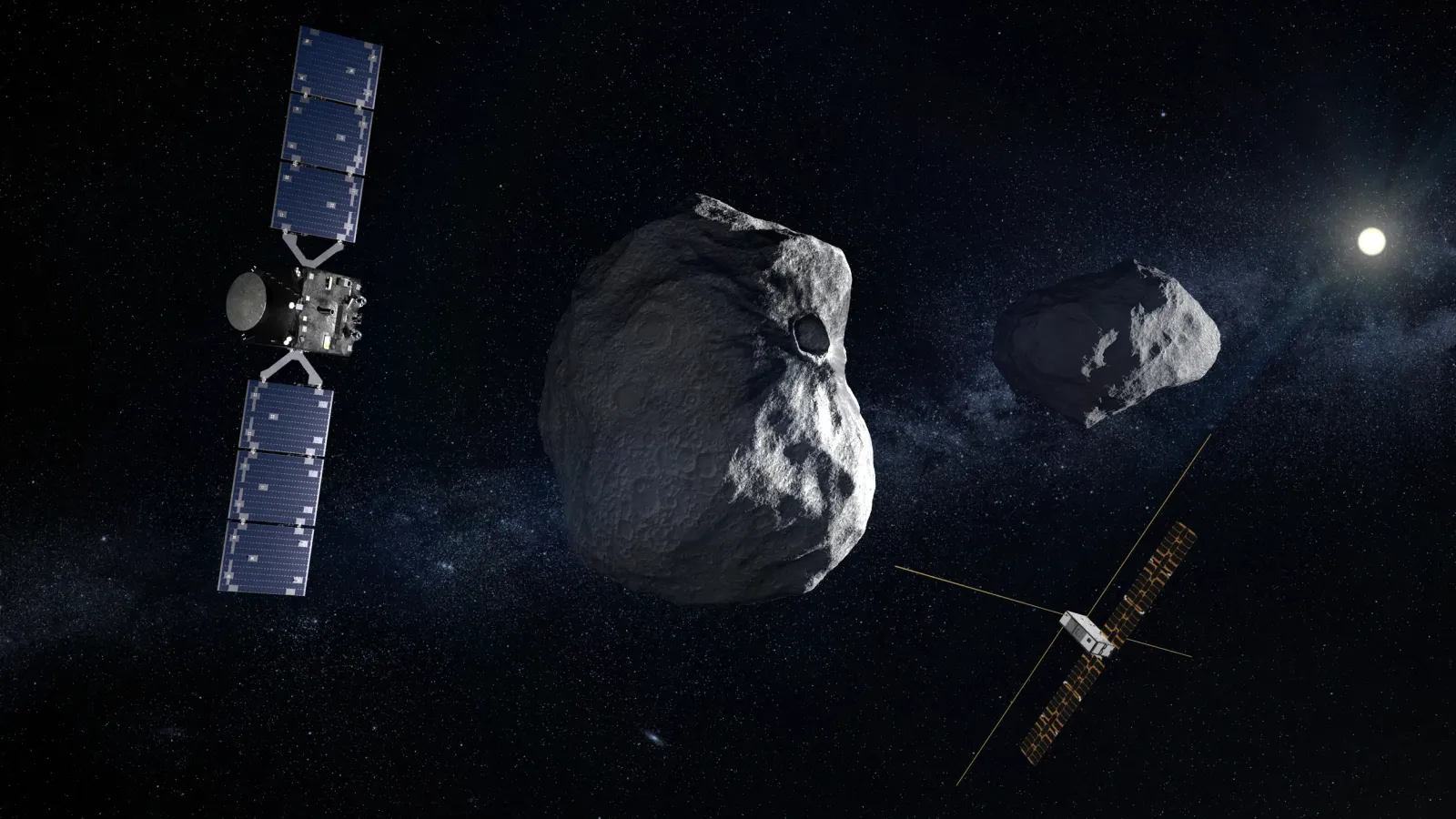
Several years after NASA tested systems for deterring dangerous space rocks, the European Space Agency is sending a probe back to the same asteroids to investigate what the test actually did. For decision-makers, that return trip is the difference between a one-off demonstration and a repeatable capability, with direct implications for how governments and satellite-dependent businesses price the risk of a strike.
The test happened years ago. The audit is happening now. NASA once ran a test of systems designed to deter dangerous space rocks, and the European Space Agency is now sending a probe back to the same asteroids to investigate what that test actually accomplished. Two agencies, one target, two completely different jobs: NASA ran the experiment, and Europe is going back to check the work. That return trip is the part worth watching, because a deflection test with no follow-up is a headline, not a capability.
Here is the gap the probe closes. When you hit an object in deep space, you get one set of readings from telescopes on and around Earth: a bright flash, a change in brightness, a rough sense that something moved. What you do not get is the ground truth. Mass, internal structure, how much material flew off, and whether the object stayed in one piece or shattered into a debris field are the variables that decide whether a technique works once or works every time. The follow-up probe is how a single dramatic result becomes evidence a government can plan around. If the numbers hold, planetary defense graduates from theory to engineering discipline. If they do not, the world learns that hitting something is not the same as moving it.
For context, planetary defense has historically been a detection problem first. Survey telescopes catalog near-Earth objects, astronomers rank them by size and trajectory, and the catalog grows year by year. Deflection is the harder half of the job, and it is where the physics gets unforgiving. Nudging a rock in space depends on how massive it is, how it is put together, how fast it is spinning, and how it responds to whatever you throw at it. Those are not properties you can read off a light curve with confidence. You have to go look.
The division of labor between the two agencies is not accidental. Deep-space missions are expensive, slow, and politically exposed, so agencies typically specialize. NASA built and ran the deterrence test. The European Space Agency is running the inspection. That split matters beyond the science: verification is a form of power. Whoever measures the result writes the record that everyone else cites, and the record is what future missions, budgets, and treaties get built on.
What the probe is really auditing are the structural questions. Did the object's path change by the amount the models predicted? Did it stay intact, or did it fragment in ways that would make a real deflection attempt unpredictable? Would the same approach work on a rock with a different composition, a different spin, a different shape? A single success is a proof of concept. A second, independent measurement is what turns a proof of concept into something a space agency can put in a plan and a legislature can fund.
The second-order implications reach well past astronomy. Planetary defense sits at the intersection of science budgets, national security, and commercial space. Satellite constellations now underpin communications, navigation, timing, and payments, which means orbital infrastructure is a systemic exposure rather than a niche one. The credibility of a deflection program is therefore a quiet input into how operators, governments, and risk carriers think about tail events. None of that requires a rock to show up. The value is in the option, and options get priced.
Then there is the governance layer, which typically lags the technical one by years. Who decides to act on a threatening object? Who pays for the mission? Who is liable if a deflection attempt makes things worse? A test plus an inspection answers the engineering question. It does not answer the political one, and the political one is where most planetary defense proposals have historically stalled.
For founders, operators, and investors watching the space sector, the signal is straightforward: follow-up science is where credibility gets built, and credibility is what converts into contracts. For everyone else, the takeaway is simpler. The world's ability to stop a dangerous asteroid is being stress-tested in public, and the results will show up in budgets, procurement, and risk models long before any rock shows up on a screen.
This story's Key Insights and Take-aways are locked.
Create a free account to unlock Executive Actions for one credit.
Register to UnlockAlways free for Executives Club members. Join the Club
More in Technology

Anthropic mathematician claims Claude helped crack the Riemann hypothesis
If the proof holds, AI has toppled math's most famous open problem; if it does not, it is a case study in announcing breakthroughs before anyone verifies them.

AI's $4 Trillion Wipeout Erases Nasdaq's Gains for the Year
A brutal week took roughly $4 trillion off the AI sector and left the Nasdaq flat for the year, and the damage ran the full length of the supply chain.

Anthropic mathematician says AI proved the Riemann hypothesis. Verification will take time.
A single unverified claim from inside Anthropic now sits against more than 160 years of open mathematics, and the gap between asserting a proof and surviving peer review is the entire story.