
NASA upgrades Cold Atom Lab to create a fifth state of matter in space
The ISS gets a redesigned mini-fridge quantum lab that can probe ultracold atoms for measurements Earth cannot match.
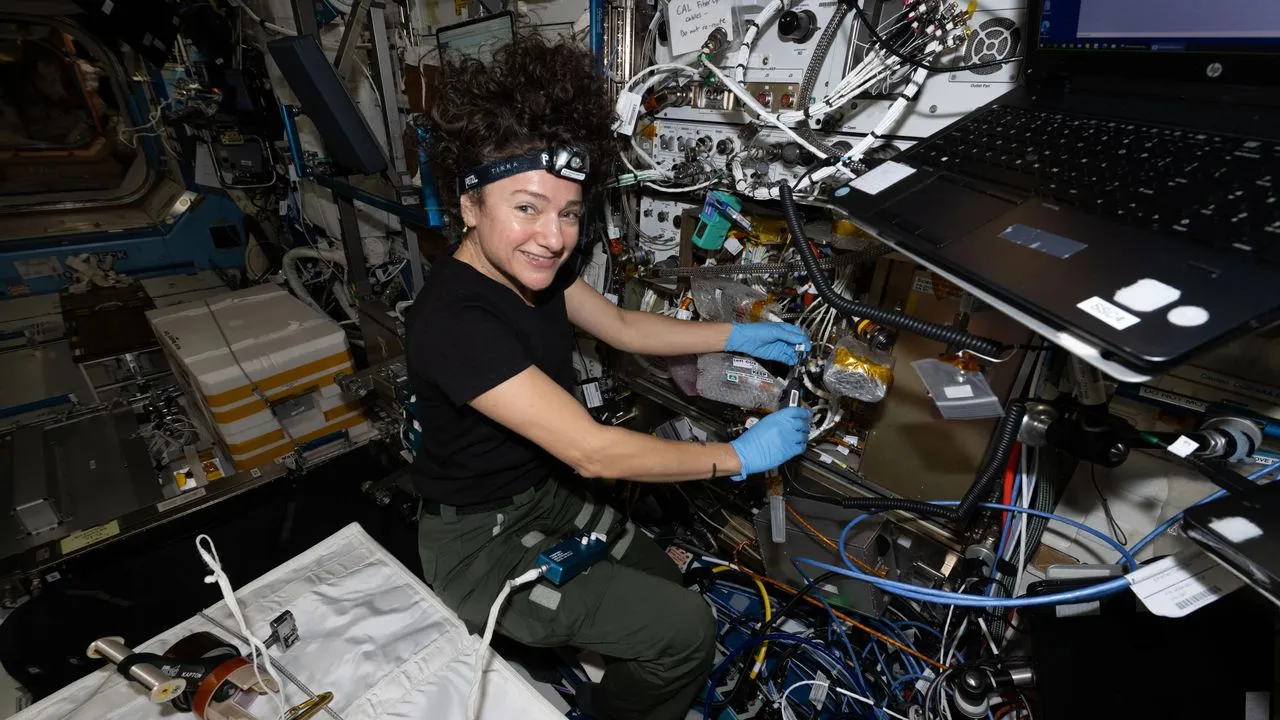
NASA is expanding the International Space Station's Cold Atom Laboratory with a fourth major upgrade, launched in April 2026. The upgrade lets scientists run advanced “Quantum 2.0” experiments on ultracold atoms in near zero gravity to improve precision quantum technologies for navigation, timing, and gravity sensing.
NASA says it has upgraded the International Space Station's mini-fridge-sized Cold Atom Laboratory so scientists can probe quantum behavior at the coldest possible temperatures while the lab floats in near zero gravity. The goal is to study clouds of atoms at temperatures close to absolute zero, minus 459.67 degrees Fahrenheit (minus 273.15 degrees Celsius), where matter behaves drastically differently. NASA frames the work as part of a new phase of quantum capability: not just studying small quantum systems, but directly manipulating large quantum states.
At the Cold Atom Laboratory, atoms are cooled with lasers using rubidium and potassium until they reach a Bose-Einstein condensate, a state of matter where many atoms act like a single quantum wave. In space, the reduced gravity lets the condensate matter waves expand and evolve undisturbed for much longer than they would on Earth, making certain measurements far more precise. Jason Williams, project scientist for the Cold Atom Lab at NASA’s Jet Propulsion Laboratory in Southern California, said that “At the coldest temperatures, matter behaves drastically different from anything we have experienced.” He added that the wavelike nature of matter dominates and that ultracold matter enables extremely precise measurements of time, gravity, and motion.
If you're thinking, “Okay, but why do executives care about atoms acting weird at -273.15 C?”, here’s the business logic. Quantum experiments like these are hard because the signals are fragile. Atoms are tiny. If an atom were the size of a golf ball, then the distance to the moon would roughly match the height of a human teeing one off. Even when you can control the temperature, isolating quantum behavior in typical environments is difficult because heat and gravity disturb it. The ISS approach sidesteps a major part of that problem: the laboratory combines ultracold atom physics with the near zero-gravity conditions of low Earth orbit, creating an environment “impossible to replicate on Earth,” in NASA's framing.
NASA also stresses that observing quantum phenomena is not just scientific curiosity. Measurements of ultracold effects can demonstrate future, space-based, highly precise quantum technologies tied to positioning, navigation, timing, and gravity sensing. The source points to potential downstream missions that feel immediate to mission planners and adjacent industries: enabling astronauts to navigate on the moon without GPS, and producing high-precision maps of Earth’s gravity. Those are classic “you only notice when it fails” capabilities. If you can improve timing and navigation performance in space, you can also improve the reliability of systems that depend on them, from deep-space operations to Earth observation programs.
This latest push is also the fourth major upgrade to the Cold Atom Laboratory since it arrived on the ISS in 2018. NASA says the significant improvements in this most recent upgrade include a redesigned magnetic trap to contain the cloud of atoms, improved atom sources, and better measurement capabilities. In other words, the lab isn't merely running a new experiment. It is improving the machinery that holds the atoms steady, generates the right starting conditions, and reads out measurements with higher quality. Those are the unglamorous engineering details that usually determine whether “promising” quantum results turn into repeatable performance.
The upgrades were launched to the ISS in April 2026 and, according to NASA, they have since been installed, switched on, and started making state-of-the-art measurements. That matters because it ties the timeline to when new data can actually start flowing, not just when a project is announced. NASA also quotes Ethan Elliott, deputy project scientist at NASA’s Jet Propulsion Laboratory in California, who compared the current era to a previous quantum leap: “In the previous century, there was a quantum revolution that led to lasers, cellphones, and MRIs for medical imaging.” He then described the ISS work as “Quantum 2.0 - direct manipulation of large quantum states - and we hope for similar gains in quantum technology by advancing this science in orbit.”
For boards and executives watching emerging technology, the second-order implication is straightforward: space-based quantum measurement capability can compress timelines between fundamental research and system-level demonstrations. On Earth, quantum experiments often fight background noise and environmental disturbance; in orbit, the ISS platform is designed to remove some of those constraints. If NASA can reliably show improved measurement performance tied to quantum states, it can strengthen the case for government and commercial partners to fund the next layer of translation: ruggedized quantum sensors, precision clocks, navigation aids, and gravity mapping systems that work under real mission constraints.
This story's Key Insights and Take-aways are locked.
Create a free account to unlock Executive Actions for one credit.
Register to UnlockAlways free for Executives Club members. Join the Club
More in Science

Alaska's 1,580-foot tsunami had warning signs. Scientists just found them.
Rapid glacier retreat, heavy rainfall, and thousands of tiny tremors preceded Alaska's 1,580-foot tsunami, a warning for every coastal community in a warming world.

The rare mutation that lets high-risk brains dodge Alzheimer's
Scientists found a natural defense against protein buildup, opening a new path to preventive treatments.

3,000 steps a day may halve Alzheimer's decline, study finds
New research links a modest daily walk to less tau buildup and nearly half the cognitive and functional decline, even for those with early signs.