

Nature finds humanoid robots can do laparoscopic surgery via teleoperation, with major hurdles
A systematic in vivo feasibility evaluation maps what works today and what must be solved before any clinical deployment is plausible.
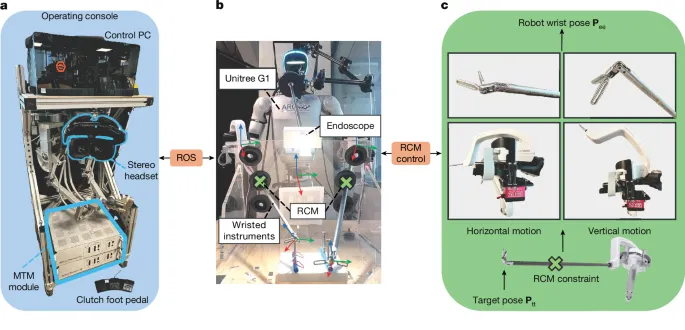
Nature reports a systematic evaluation showing contemporary humanoid robots can perform laparoscopic surgical tasks through teleoperation in vivo. The finding matters for decision-makers because it narrows the “can it work?” question while making the “what breaks next?” technical and deployment challenges unavoidable.
Nature published online 08 July 2026 (doi:10.1038/s41586-026-10796-x) a focused feasibility study: an in vivo evaluation of humanoid robots performing laparoscopic surgical tasks via teleoperation. The paper’s headline claim is straightforward, and it is the kind of step that changes how boards think. It is not a demo video. It is a systematic assessment that contemporary humanoid robots can execute laparoscopic surgical tasks when an operator controls them remotely.
That matters because it addresses the first practical barrier to clinical ambition. For humanoid surgical systems, the question has usually been theoretical, or confined to simulation. Here, the “yes” has a boundary condition: teleoperation. Contemporary humanoids can do the job, but not autonomously in the study’s framing. Even so, the implication is immediate for anyone budgeting for robotics in healthcare. If the platform can reliably execute laparoscopic task primitives under remote control, teams can now plan engineering work around the gaps that remain, rather than starting from scratch on whether the robot can physically participate in surgery.
What this study highlights, and what Nature emphasizes, is the split between promise and readiness. “Promise” is the demonstration that humanoid forms and locomotion do not automatically disqualify a system from surgical work. “Key technical challenges” are the other half of the equation: the hurdles that stand between a feasibility signal and a clinical-grade product. The source describes the evaluation as systematic and designed to surface not just outcomes, but the constraints that would matter before clinical deployment. For executives, that is the difference between a shiny headline and an investable roadmap.
Zoom out to how surgical robotics typically enters the market. Regulatory approval and clinical adoption are not only about raw performance. They hinge on reproducibility, safety margins, failure modes, and workflows that integrate with operating rooms. Teleoperation adds another layer. It implies dependence on reliable communications, latency management, user interface design, and operator training. Even if the robot can do laparoscopic tasks, the system must still operate inside the realities of surgical practice. That includes handling unexpected events, maintaining safe instrument behavior, and ensuring that the human operator can intervene quickly when conditions change.
In that sense, teleoperation is both an enabler and a proof-of-everything test. It is an enabler because it lets teams leverage clinician skill while the robot closes gaps in autonomy, perception, and control. It is a proof-of-everything test because it forces the entire chain, from controls to instruments to operator experience, to work under time pressure. If the study concludes that contemporary humanoids can perform the tasks through teleoperation, then the engineering attention naturally shifts to the technical challenges Nature flags. For boards, that means diligence should focus on specific system bottlenecks that can block translation: control stability, instrument dexterity under load, repeatability across trials, and the practicalities of running a teleoperated device in a regulated environment.
There is also a strategic chess move here for companies, investors, and hospital partners. Humanoid robots are competing for attention in a crowded robotics landscape. Many platforms promise general-purpose dexterity, but healthcare adoption is brutally narrow at the beginning. Laparoscopic surgery is a constrained arena where performance can be evaluated by task execution and operational behavior. By showing a credible in vivo feasibility pathway, Nature gives robotics teams a more grounded wedge: prove competence in surgical tasks under teleoperation first, then expand capability as technical challenges are resolved.
The second-order implication is about timing and sequencing. Clinical deployment is usually a multi-year process with iterative validation, documentation, and systems engineering. A feasibility result that is “in vivo” and “systematic” compresses early uncertainty but does not compress the hard work. It shifts the risk profile from speculative to developmental. That is the sweet spot where governance matters. Boards can ask better questions now because the feasibility boundary is clearer: the robot can perform laparoscopic tasks through teleoperation; now leadership must translate technical challenges into a prioritized program with measurable milestones suitable for clinical and regulatory scrutiny.
For peers in similar roles, the strategic stakes are simple. If you are funding or building humanoid surgical systems, Nature’s finding suggests you should double down on the surgical task pipeline and the teleoperation stack, because that is where the near-term “can work” evidence lives. If you are assessing competitors, it suggests you should scrutinize claims of autonomy differently, because this paper’s demonstrated pathway is through remote human control. Either way, the paper turns a vague promise into a concrete engineering agenda, and it forces every ambitious team to plan for the moment when feasibility must become safety, reliability, and deployment readiness.
This story's Key Insights and Take-aways are locked.
Create a free account to unlock Executive Actions for one credit.
Register to UnlockAlways free for Executives Club members. Join the Club
More in Science

Alaska's 1,580-foot tsunami had warning signs. Scientists just found them.
Rapid glacier retreat, heavy rainfall, and thousands of tiny tremors preceded Alaska's 1,580-foot tsunami, a warning for every coastal community in a warming world.

The rare mutation that lets high-risk brains dodge Alzheimer's
Scientists found a natural defense against protein buildup, opening a new path to preventive treatments.

3,000 steps a day may halve Alzheimer's decline, study finds
New research links a modest daily walk to less tau buildup and nearly half the cognitive and functional decline, even for those with early signs.