
No Starship had ever come back from orbit. SpaceX just caught one.
The upper stage slid between the launch tower's chopsticks at Starbase about 22 and a half hours after lift-off, turning orbital recovery from a salvage job into a precision maneuver.
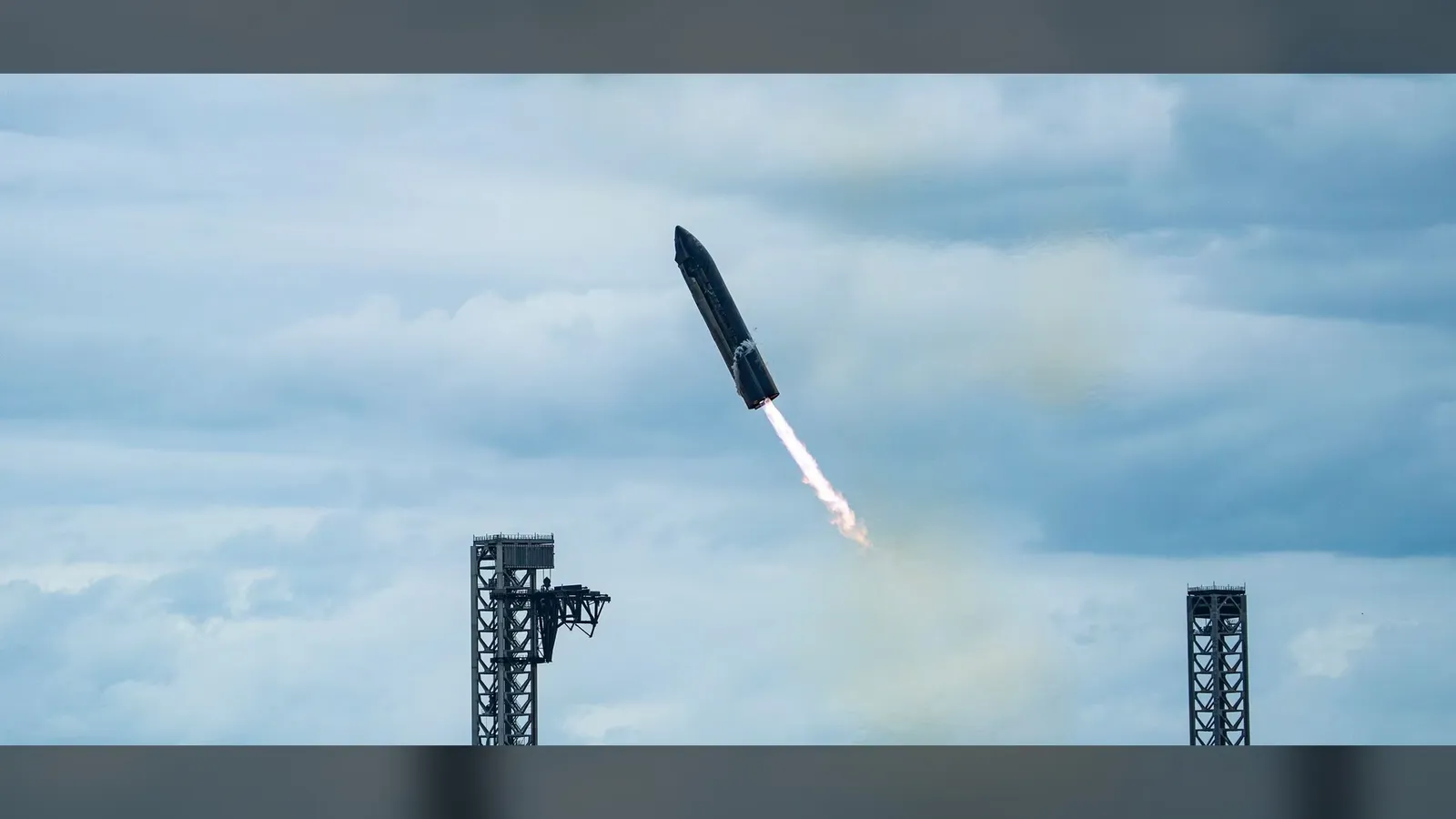
SpaceX caught the upper stage of its Starship rocket with the mechanical arms of its launch tower on Saturday, the first time any Starship has returned from orbit and been caught, roughly 22 and a half hours after lift-off at Starbase, Texas. The catch moves orbital hardware recovery from a retrieve-and-refurbish expense toward a repeatable, tower-side operation, which is the number that governs launch cadence and cost per kilogram for everyone buying access to orbit.
SpaceX caught the upper stage of its Starship rocket with the mechanical arms of its launch tower on Saturday, and no Starship had ever come back from orbit and been caught before. The ship returned to Starbase, Texas, about 22 and a half hours after lift-off and slid between the tower's arms, which the company nicknames the chopsticks. That is the story in one sentence, and it is worth slowing down on: a vehicle that had been to orbit was back on the ground, held by the structure it launched from, less than a day later. No droneship. No parachute. No salvage crew.
Getting anything back from orbit is normally a two-part problem with a bill attached to each part. The first part is surviving reentry, which is a heat-shield and trajectory question. The second is ending up somewhere useful, which is a control and logistics question. Historically, most orbital hardware that came home handled the first part well and the second part expensively: capsules splashed into the ocean and were fished out, winged vehicles landed on runways and were towed to hangars. Catching the stage directly at the launch tower is an attempt to collapse that second part almost entirely. The vehicle stops moving where the next flight begins.
The hardware doing the catching is the tower's pair of mechanical arms, part of the launch infrastructure at Starbase. The arms are the same structure that supports the vehicle on the ground, and using them for recovery means the ship comes back to the exact piece of equipment that launches it. That is the quiet efficiency in the maneuver: every separate recovery step that does not exist, no recovery vessel, no port call, no crane fleet, no long road trip, is a cost that does not exist. Reusability programs have historically leaked money in the seams between operations rather than in the rocket itself.
The 22 and a half hours matter as much as the catch. A launch provider's real capacity is set by how long hardware sits on the ground between flights, not by how many vehicles it can build from scratch. A catch completed inside a single day is a different operating model from a recovery campaign measured in weeks or months, where a booster or capsule has to be retrieved, inspected and rebuilt before it earns again. The strategic question is no longer whether SpaceX can do this once. It is how fast the caught stage can be turned around, and what a second catch in quick succession would prove.
Why should anyone outside the space industry care? Because launch cost is effectively a tax on everything built above the atmosphere. Communications constellations, Earth observation, defense sensing and the growing set of businesses that assume cheap access to orbit all inherit that tax. SpaceX built its launch business on landing and reusing the first stage of its Falcon rockets, and a reusable upper stage goes after what is left of the cost stack. Once recovery becomes routine, the marginal price of putting mass in orbit gets argued about in entirely different terms, and so does every business plan that depends on it.
None of this runs without regulators and neighbors onside. Commercial launches from US soil operate under FAA license, and Starbase operations have been subject to environmental review and licensing conditions as launch activity has climbed. Every additional flight and every additional catch adds to that record. For a company whose business case rests on flying more often than anyone else, the paperwork is not a side quest. It is a gating item, and it scales with exactly the kind of milestone SpaceX just pulled off.
For executives outside aerospace, the useful read is the pattern rather than the rocket. A company took a step that the industry treated as an unavoidable cost, recovering hardware after a trip to orbit, and redesigned its infrastructure so that the cost stops existing. That is the same move as designing a factory around the product instead of bolting automation onto an old line. The catch is a headline today. The turnaround time on the caught stage is the number that decides how much of the industry it changes, and for peers and rivals alike, the question is no longer whether orbital recovery is technically possible. It is whether their cost models assume it.
This story's Key Insights and Take-aways are locked.
Create a free account to unlock Executive Actions for one credit.
Register to UnlockAlways free for Executives Club members. Join the Club
More in Technology

Anthropic mathematician claims Claude helped crack the Riemann hypothesis
If the proof holds, AI has toppled math's most famous open problem; if it does not, it is a case study in announcing breakthroughs before anyone verifies them.

AI's $4 Trillion Wipeout Erases Nasdaq's Gains for the Year
A brutal week took roughly $4 trillion off the AI sector and left the Nasdaq flat for the year, and the damage ran the full length of the supply chain.

Anthropic mathematician says AI proved the Riemann hypothesis. Verification will take time.
A single unverified claim from inside Anthropic now sits against more than 160 years of open mathematics, and the gap between asserting a proof and surviving peer review is the entire story.