
Nvidia hit $5.8T with no successor for Jensen Huang. Ex-CEOs: 'preposterous'
Colette Kress steps in as interim CEO with no P&L experience, and three former Fortune 500 chiefs say the missing succession plan is a governance failure of the highest order.
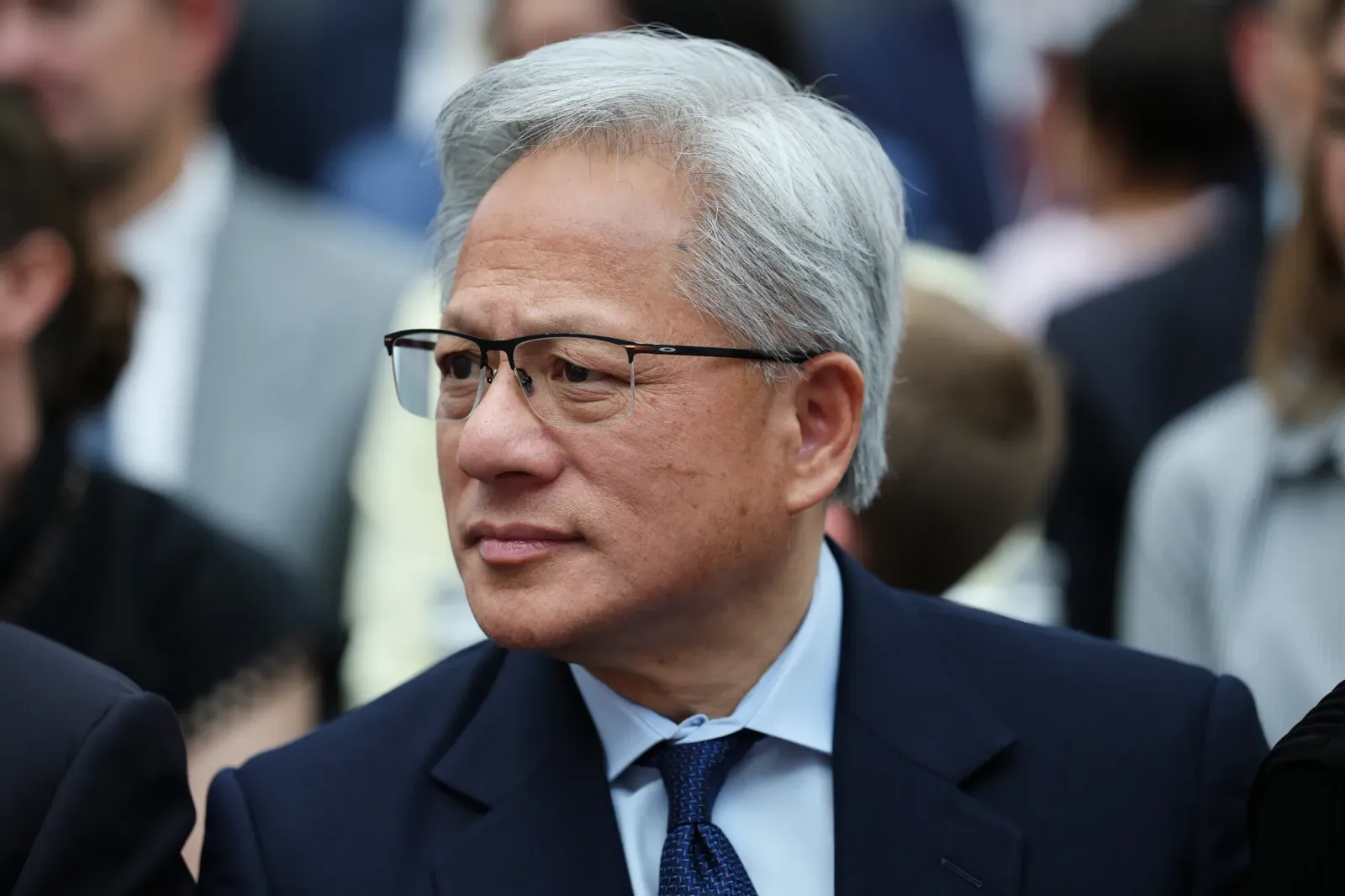
Nvidia's board named longtime CFO Colette Kress interim CEO on November 12 after Jensen Huang resigned, leaving the world's second-most-valuable company with no groomed heir. Three former Fortune 500 CEOs and a leading consultant tell Fortune the gap is a governance failure that every board should read as a warning about its own bench.
Nvidia's board announced on November 12 that Jensen Huang was resigning, and named longtime CFO Colette Kress as interim CEO effective immediately. Directors said they would search for a permanent chief executive and would consider internal and external candidates. That is the headline. The problem is what came next: nobody obvious. Kress has spent a quarter century in Big Tech finance roles, including thirteen years at Microsoft, before joining Nvidia in 2013. Her resume on Nvidia's website lists no job where she ran a business or owned a P&L. The read from people who have actually sat in the chair is that she is a placeholder, not an heir. Fortune interviewed three former Fortune 500 CEOs, each now serving on prominent corporate boards, plus a leading consultant. Their verdict on how a company that peaked at a $5.8 trillion valuation, the highest summit ever reached, could have no one ready: "preposterous."
The scale is what makes it sting. Nvidia has been in business 33 years and public for 27. It is the world's second-most-valuable company. Huang hiked its valuation by well over $5 trillion in just four years to that $5.8 trillion peak in early October, a run never equaled. He turns 64 in February and is already the oldest CEO by far in the Mag Seven. "It seems like a knee-jerk, panic reaction where the board's saying, 'We've got to name someone!'" says ex-CEO 3. "You've got to ask why a tech company would go with a financial person." It is not clear whether Nvidia had an emergency succession plan that put Kress in the chair, or no plan at all. One retired CEO says it is the latter.
Red flag one is the success problem. Huang's feat intoxicated investors so thoroughly that they never installed the safeguards that should protect a company when its ultimate "key man" walks out in a crisis. "No one peeled back the layers on how Nvidia was run because they were so successful," says ex-CEO 1. "No one looked behind the curtain. Their success lulled people into a false sense of security." The same observer argues Huang's obsession with center stage, with casting himself as the leather-jacketed face of AI, and his slick salesmanship should have stirred doubts long before November. "This is preposterous," this person says. "When you have a celebrity CEO, that person merits a closer look, especially when you have a leader who's always putting on a show."
Red flag two is the board. Unlike Elon Musk at SpaceX, Sergey Brin and Larry Page at Alphabet, or Mark Zuckerberg at Meta Platforms, Huang did not own a special class of supermajority stock giving him control of the board. Nvidia has a single category of Class A shares, each carrying one vote. Its ownership looks like a typical Fortune 500 cap table: Blackstone leads at 8.1%, then Vanguard at 6.5%, State Street at 4.2%, Fidelity at 3.9%, and Morgan Stanley, T. Rowe Price and J.P. Morgan together at around 5%. Huang holds "just" 3.5%. Yet it appears he totally controlled the board. "In any company that runs well over time," says ex-CEO 2, "you'll find the board has lots of current or retired CEOs, and credible outside senior executives. When you see a board that looks like a lot of old friends and people who've been there for decades, it flashes danger." Of the seven directors besides Huang, none has served as CEO of a Fortune 500 company, and four have been mainstays for between 13 and 29 years. "The board wasn't paying attention to how the company was run," ex-CEO 2 says. "When you have a CEO leave and everybody is asking what is the succession plan, the directors aren't doing their job."
Ex-CEO 2 is blunt about the hierarchy of duties: preparing a successor is "the most important thing the board does by a mile." The ground has to be plowed, candidates rotated through roles that test them, the bench below the bench mapped out. Boards prefer to talk about M&A and exotic strategy, but those pale beside succession. Ex-CEO 3 frames it as one of two jobs that matter: "Boards have all kinds of governance rules but just two major responsibilities. First, don't do a deal that kills you, and second, have the right person running the place and a backup plan to replace them. Nvidia's board failed on one of the two big items."
Red flag three is the org chart. Huang talked proudly about overseeing around 60 "direct reports," extolling the virtues of a "flat" organization. That extreme division of responsibility may be exactly why no lieutenant was ready. "It's highly possible that none of those lieutenants had enough responsibility to have actually been tested," says ex-CEO 3. Ex-CEO 1 puts the optimal span at 8 to 12. "The presence of 60 direct reports that Huang was making a big deal about tells you the board wasn't doing its job." The consultant agrees: "The downside of having a very high number of direct reports is that none have been exposed to top roles in a deep and meaningful way. So it's hard to imagine anyone internally who is ready to take over."
Red flag four is the scramble itself. The consultant says training an insider now means telescoping years of development into months. Going outside is the other option, and ex-CEO 3 expects Nvidia to skip a veteran in their early 60s for a "young tiger" in their 40s or early 50s, someone around 50 who "wants to show the world something." Ex-CEO 2's closing judgment is the one every board should tape to the wall: "If Nvidia hadn't been performing well, it would have been exhibit A for an activist attack."
The lesson travels well beyond Santa Clara. "The lesson from Nvidia is that emergencies happen more often than you think and it's a big mistake to have a structure and mindset that assumes they won't happen to you," the consultant says. "That Nvidia has no obvious successor imposes a real cost." For every founder-led or celebrity-CEO company, the arithmetic is the same. A board's cheapest insurance policy is a named, tested successor, and the price of skipping it gets paid in a single afternoon, at the worst possible moment, in public.
This story's Key Insights and Take-aways are locked.
Create a free account to unlock Executive Actions for one credit.
Register to UnlockAlways free for Executives Club members. Join the Club
More in Business

GTA VI hauls $3.79bn in one day, out-earning every film ever made
Rockstar's own estimate covers a single Thursday plus a record 32.5m prerelease units, and it lands on every board weighing IP concentration, pricing power and launch risk.

FBI's crime database breached again, the second hack in months
CNN reports hackers hit the National Crime Information Center, the shared backbone of US policing, and the repeat timing is the part every security team should study.

S&P 500 Enters Correction, Down 10% From Its High on AI Worries
The index's slide past the 10 percent line is a symbolic verdict on investor mood, and the AI trade that powered the rally is now the thing testing it.