
Nvidia hunts a new CEO after Huang's affair admission; Arm's Haas already approached
The board tapped CFO Colette Kress as interim chief, but the shortlist already runs from Arm's Rene Haas to Tim Cook, and prediction markets are betting on an internal engineer.
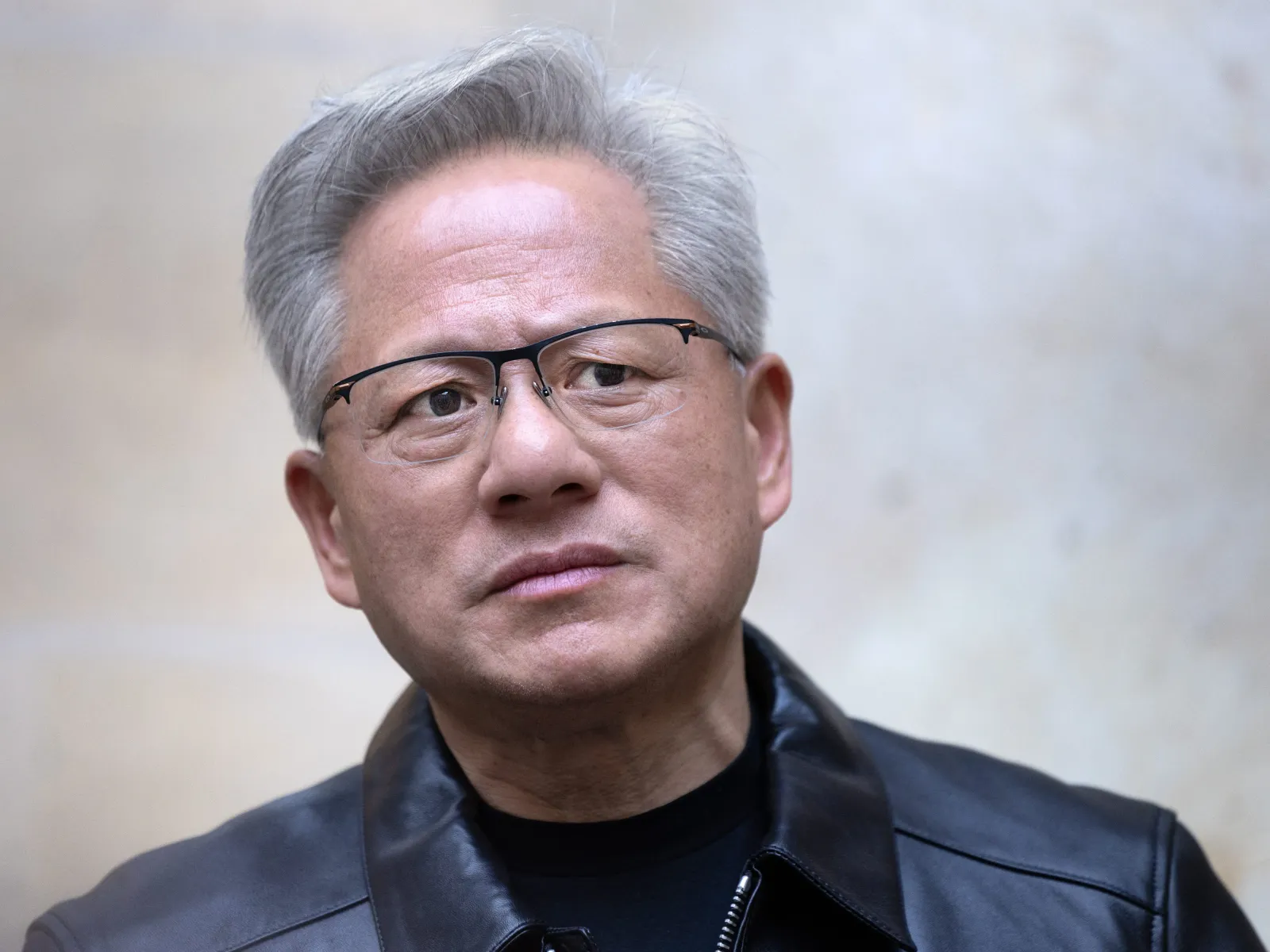
Nvidia's board announced Wednesday that founder and CEO Jensen Huang resigned effective immediately, three days after he admitted to an affair, and named CFO Colette Kress interim CEO while it investigates whether Huang was the target of a foreign intelligence effort. The succession race now spans Arm CEO Rene Haas, internal VP Ian Buck, and outside names including Tim Cook, and the outcome will decide who controls the most strategic compute supply chain in AI.
Nvidia's board announced Wednesday that founder and CEO Jensen Huang resigned effective immediately, ending one of the most consequential runs in the history of semiconductors. The resignation came three days after Huang admitted to having an affair, and the board opened an investigation into whether he was the "target of a foreign intelligence effort." Executive vice president and chief financial officer Colette Kress was named interim CEO until a permanent successor is found.
The succession race started the same day. The Financial Times reported Wednesday that Nvidia has approached Rene Haas, the CEO of Arm Holdings, about the job. Sources told the outlet it is not guaranteed Haas will be offered the role or accept it. Haas is no stranger to the building: he spent seven years as vice president and general manager of Nvidia's computing products business unit before taking the top job at Arm, the chip designer whose architecture underpins most of the world's mobile processors and a growing share of data center silicon.
Inside the company, the name analysts keep returning to is Ian Buck, Nvidia's vice president of hyperscale and high-performance computing. Reuters reported that analysts and investors view Buck as a possible candidate, and prediction market users are banking on him: he sits at the top of the list on both Kalshi and Polymarket. Josh Gilbert, a lead analyst at eToro, framed the logic bluntly. "The permanent job is a different story, though, because Nvidia's edge comes from its technology, and the board would likely want an engineer in the chair," Gilbert told Reuters. "Someone like Ian Buck, who led the software platform that keeps developers tied to Nvidia's chips, is the sort of internal name you'd expect to come up."
Kress is more than a placeholder. Reuters reported that analysts and investors also view the interim CEO as someone who could hold the job long term. Armina Rosenberg, a cofounder at Minotaur Capital, which owns Nvidia stock, told the outlet that a fast permanent hire is unlikely. "The more realistic route is an interim leader from the long-serving inner circle, possibly as a co-CEO structure: one leader to steady the business and the finances, such as Colette Kress, alongside a product and technology leader, such as Ian Buck," Rosenberg said.
Then there are the outside names. President Donald Trump weighed in on Thursday with a Truth Social post recommending former Apple CEO Tim Cook, who stepped down as CEO in September but remains executive chairman. "NOW THAT Nvidia CEO JENSEN HUANG, who has done a fantastic job, has resigned, there is only one man to take his place - TIM COOK of Apple. A Legend replaces a Legend!" Trump wrote. Dan Ives, a partner and senior managing director at Yorkville Ives & Co., offered his own list in an interview with Fortune, naming Google Cloud CEO Thomas Kurian, who joined Google in 2019 after working at Oracle and McKinsey. Ives also flagged Palo Alto Networks CEO Nikesh Arora, a name an Nvidia shareholder separately floated to The Economic Times. And Semafor reported that Johny Srouji, Apple's senior vice president of hardware technology, is being considered, according to a person familiar with the matter.
The shortlist tells you what the board thinks it is buying. Nvidia's position rests on a software and hardware stack that developers have spent years building against, and switching costs are the moat. That is why the internal engineering bench matters, and why a chip-design veteran like Haas or Srouji reads as a natural fit. It is also why a pure operator or finance profile, however strong, may be a harder sell for the permanent role, even as Kress steadies the numbers in the interim.
The circumstances of the exit add a layer most CEO searches never carry. The board is simultaneously running a succession process and an investigation into whether Huang was the target of a foreign intelligence effort, a question that touches national security given Nvidia's centrality to AI compute. Interim leadership plus an active investigation is a combination that invites scrutiny from investors, regulators, and customers who need multi-year supply commitments before they sign.
For every board watching, the lesson is about bench depth. Companies that treat succession as a one-name plan discover the gap in public, and they discover it at the worst possible moment. Nvidia now has to reassure hyperscalers, developers, and shareholders at the exact point its leadership is least settled. Whoever ends up in the chair inherits a company whose products the entire AI buildout is priced against, and the market will judge the pick fast.
This story's Key Insights and Take-aways are locked.
Create a free account to unlock Executive Actions for one credit.
Register to UnlockAlways free for Executives Club members. Join the Club
More in Technology

Anthropic mathematician claims Claude helped crack the Riemann hypothesis
If the proof holds, AI has toppled math's most famous open problem; if it does not, it is a case study in announcing breakthroughs before anyone verifies them.

AI's $4 Trillion Wipeout Erases Nasdaq's Gains for the Year
A brutal week took roughly $4 trillion off the AI sector and left the Nasdaq flat for the year, and the damage ran the full length of the supply chain.

Anthropic mathematician says AI proved the Riemann hypothesis. Verification will take time.
A single unverified claim from inside Anthropic now sits against more than 160 years of open mathematics, and the gap between asserting a proof and surviving peer review is the entire story.