
Prime Video VP Gaurav Gandhi maps APAC beyond streaming at APOS conference session
Prime Video’s APAC and ANZ VP lays out an ecosystem strategy aimed at turning Prime Video into a unified entertainment destination.
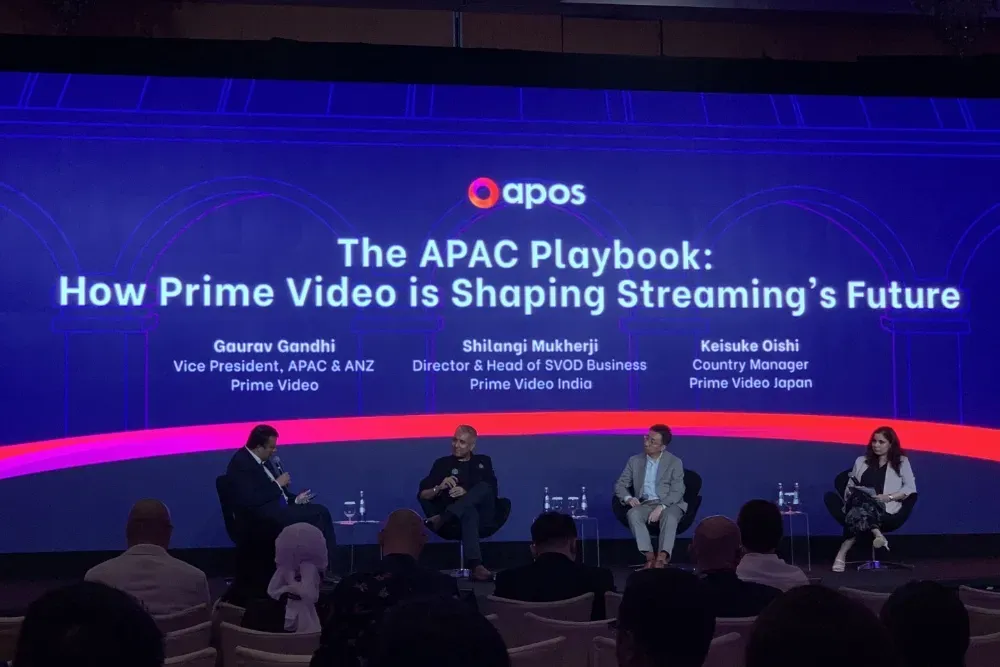
Gaurav Gandhi, VP of APAC and ANZ at Prime Video, discussed the company’s ambition to build a unified entertainment destination across Asia-Pacific during APOS. The message for decision-makers: Prime Video is treating streaming as a gateway, not the destination.
Prime Video is making a very specific pitch at APOS: streaming is not the endgame, it is the starting point for an “ecosystem” designed to become a unified entertainment destination across Asia-Pacific. In the APOS conference session titled “The APAC Playbook: How Prime Video Is Shaping Streaming’s Future,” Gaurav Gandhi, VP of APAC and ANZ at Prime Video, framed the region as a place where entertainment platforms can expand from content libraries into broader consumer experiences.
Gandhi’s focus was not just on more shows, but on the strategy behind bundling experiences into something stickier. The core idea, as described in the session coverage, is that Prime Video’s expanding ecosystem approach is the mechanism for that expansion. Instead of thinking of Prime Video as a single app people open for a title, the company wants viewers to experience a connected entertainment journey across devices, genres, and formats. That matters because in APAC, attention is fragmented, tastes vary country by country, and competitors can win simply by being the easiest “next click.” An ecosystem strategy is an attempt to reduce that churn by making Prime Video feel like a home base.
To understand why this is a big deal, it helps to zoom out on how streaming businesses typically scale. Most start with content acquisition and subscription growth. Then, when growth pressure hits or content costs rise, the industry shifts toward differentiation: originals, bundling, ad tiers, and partnerships. Prime Video, according to the session framing, is adding another layer to this playbook. The company is pushing beyond streaming into a broader entertainment destination model, which is essentially about controlling more of the consumer journey.
Asia-Pacific is the obvious battleground for that approach. The region is large, diverse, and still in a phase where digital entertainment consumption is expanding while payment behaviors, bandwidth realities, and device access patterns vary widely. In that environment, “one size fits all” programming is not enough. Platforms that can coordinate offers, services, and discovery across multiple markets have a structural advantage. Prime Video’s executive messaging at APOS suggests it is designing around that reality, with the ecosystem strategy serving as a unifying operating concept across the region.
There is also a regulatory and policy dimension, even when executives do not foreground it. APAC markets increasingly expect clearer boundaries around content licensing, platform responsibilities, and data practices, and those expectations can influence how easily a platform can integrate new products into its core service. Expanding beyond streaming to adjacent entertainment offerings often means more partnerships, more content rights complexity, and more negotiation with local stakeholders. When Prime Video positions its strategy as an “APAC playbook,” it is implicitly acknowledging that ecosystem building is not plug-and-play across borders. You have to design differently for different market rules and different distribution ecosystems.
From a corporate strategy standpoint, ecosystem framing is also a capital allocation signal. Content spending is expensive, and executives face tough questions about whether incremental content investment will produce incremental retention. An ecosystem strategy can rebalance that equation by putting more emphasis on engagement and cross-experience value, rather than treating every dollar as a straight line into titles. It can also change how partnerships get evaluated. If a platform is aiming to be a destination, then partnerships become building blocks, not just one-off additions.
Boards and investors watching Prime Video will likely read this as a response to a broader industry pattern: streaming is maturing, and differentiation is increasingly about distribution of attention and consumer habit formation. The session coverage highlights Prime Video’s ambition to become a unified entertainment destination across Asia-Pacific, and it ties that ambition directly to an ecosystem strategy. For decision-makers, that implies the company is not limiting itself to the traditional streaming KPI stack. It is trying to build defensible value around where consumers spend their time, what they do next, and how easily they switch.
So what is the strategic stake for peers in similar roles? If Prime Video succeeds in executing an ecosystem model in APAC, it could reshape competitive pressure for other entertainment platforms. Competitors that rely heavily on catalog size or seasonal originals may find it harder to win mindshare if Prime Video is bundling discovery, viewing, and adjacent entertainment experiences into a single, recognizable destination. In other words, the fight could move from “who has the best title” to “who owns the most valuable journey.”
This story's Key Insights and Take-aways are locked.
Create a free account to unlock Executive Actions for one credit.
Register to UnlockAlways free for Executives Club members. Join the Club
More in Entertainment

Russell Brand's accuser 'bewildered and confused' as he denies 7 sex charges
The criminal case against the comedian is a live test of how media companies manage talent risk when serious allegations go public.

'It's a Magic Trick': Ballet Experts Say Rosalía's SNL Pose Is Impossible
Three ballet experts tell Rolling Stone Rosalía's gravity-defying SNL stillness shouldn't be possible - and why the debate is now part of the show.

Activision CMO: GTA 6 Will Boost Call of Duty, Not Bury It
Activision's top marketer says Rockstar's blockbuster will drive players back to consoles and into Modern Warfare 4, even as the company admits its recent strategy failed.