
Robots can do everything but grip: hands are AI's last job moat
Inside Amazon's Luton fulfilment centre, the human at the end of the conveyor belt is still there for one reason: nobody has built a hand that can match ours.
Amazon's Luton fulfilment centre, which the company has opened to controlled public tours for a decade, still ends its automated conveyor lines with a human stacking boxes, because robotic dexterity remains the unsolved bottleneck in automation. For operators and boards, the timeline on which engineers crack the human hand is now the single biggest variable in warehouse labour costs, headcount planning and the political risk that comes with them.
Just outside Luton, in an Amazon warehouse the size of four football pitches, the future of work is stuck at a workstation. Yellow shelving units pirouette in a digitally choreographed dance. Tubs holding a Lego Spider-Man kit, then dishwasher tablets, then a pouch of muscle-building protein powder whiz along conveyor belts and arrive in front of a human being, whose job is to stack the shelving unit that has stopped in front of them. Amazon calls this the "symphony of people and technology" to which it owes its success. The reason a person is still standing there, and not a machine, is not intelligence. It is hands.
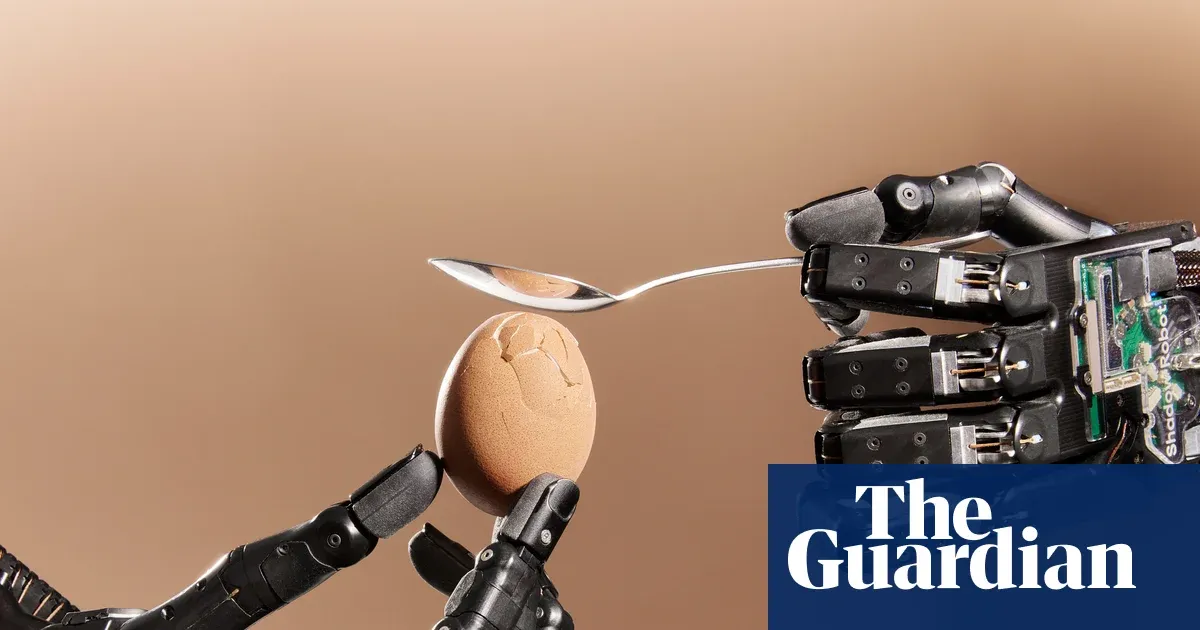
That is the argument at the centre of the Guardian's reporting on robotics: dexterity is the one thing stopping AI from taking over the world, or at least everyone's jobs. Human hands are anatomical marvels that engineers have struggled for years to replicate, and experts are racing to change that. Read that twice, because it inverts the story most people tell about automation. The threat to warehouse work, logistics work, lab work, food prep and care work was never going to arrive as a chatbot. It arrives as a gripper.
Grasping is a brutal engineering problem, and it is worth understanding why before assuming it falls this year. The human hand crams dozens of bones, muscles, tendons and nerve endings into a package that fits in a pocket, and it does something no warehouse robot has managed at scale: it picks up an object it has never seen before, of unknown weight and unknown squishiness, and does not crush it. For context, the automation already deployed in modern fulfilment centres is mostly about moving things, not manipulating them. The pirouetting shelves are the easy part. The tub of Lego is the hard part.
Amazon has been showing off the human half of that symphony for a decade. After a barrage of negative publicity about working practices, the company began opening its fulfilment centres to carefully controlled free public tours. On the Luton tour, the guide talks up competitive rates of pay, pensions, dental cover and options for flexible working. The Guardian's correspondent notes that her delivery is somewhat robotic. That detail is the whole story in miniature: the script is polished, the choreography is real, and the person at the end of the conveyor belt is the part nobody has yet automated.
The economics all point one way. Every task a robot can do is a task that does not need a shift pattern, a pension contribution or dental cover. Historically, the constraint on warehouse automation has been capability rather than cost. Once a machine can reliably pick a Lego kit, a pack of dishwasher tablets and a bag of protein powder off the same line without crushing any of them, the case for the human at the workstation stops being a technology question and becomes arithmetic. That is why a robotics lab result that sounds like a niche engineering milestone is really a labour-market event.
For the people inside those buildings, the timeline is the entire ballgame. Warehousing and logistics employ millions of people across the UK, Europe and the US, and the roles most exposed are precisely the ones that combine movement with manipulation: pick, pack, sort, stack. The "symphony of people and technology" framing is doing double duty. It is marketing to shoppers who want to believe the robots are helpers, and it is a hedge against the day the music changes. If dexterity falls, the human in the symphony becomes optional, and the political fight over retraining, wage floors and unionisation arrives with it.
There is a counterintuitive second-order effect worth flagging to any board modelling supply chains. Countries and regions that spent decades winning assembly work because their labour was cheap may find that advantage evaporates when the labour is a machine that can be built anywhere and shipped anywhere. Reshoring arguments that once rested on tariffs or freight costs start to rest on robotics instead. And the winners in that world may not be the companies with the best AI models. They may be the ones with the best hands.
So watch the tours. The tell is not a press release about a new robot. The tell is a warehouse where the guide stops pointing at the person at the end of the line. Until that day, the most advanced thing in the building near Luton is not the shelving unit doing pirouettes. It is the pair of hands stacking the box.
This story's Key Insights and Take-aways are locked.
Create a free account to unlock Executive Actions for one credit.
Register to UnlockAlways free for Executives Club members. Join the Club
More in Technology

Anthropic mathematician claims Claude helped crack the Riemann hypothesis
If the proof holds, AI has toppled math's most famous open problem; if it does not, it is a case study in announcing breakthroughs before anyone verifies them.

AI's $4 Trillion Wipeout Erases Nasdaq's Gains for the Year
A brutal week took roughly $4 trillion off the AI sector and left the Nasdaq flat for the year, and the damage ran the full length of the supply chain.

Anthropic mathematician says AI proved the Riemann hypothesis. Verification will take time.
A single unverified claim from inside Anthropic now sits against more than 160 years of open mathematics, and the gap between asserting a proof and surviving peer review is the entire story.