

Scott Bessent’s $1 Trump coin moves forward, even as living portraits stay federally barred
A $1 coin tied to America’s 250th birthday will feature Trump’s face, using a 2020 law Treasury says allows exceptions.
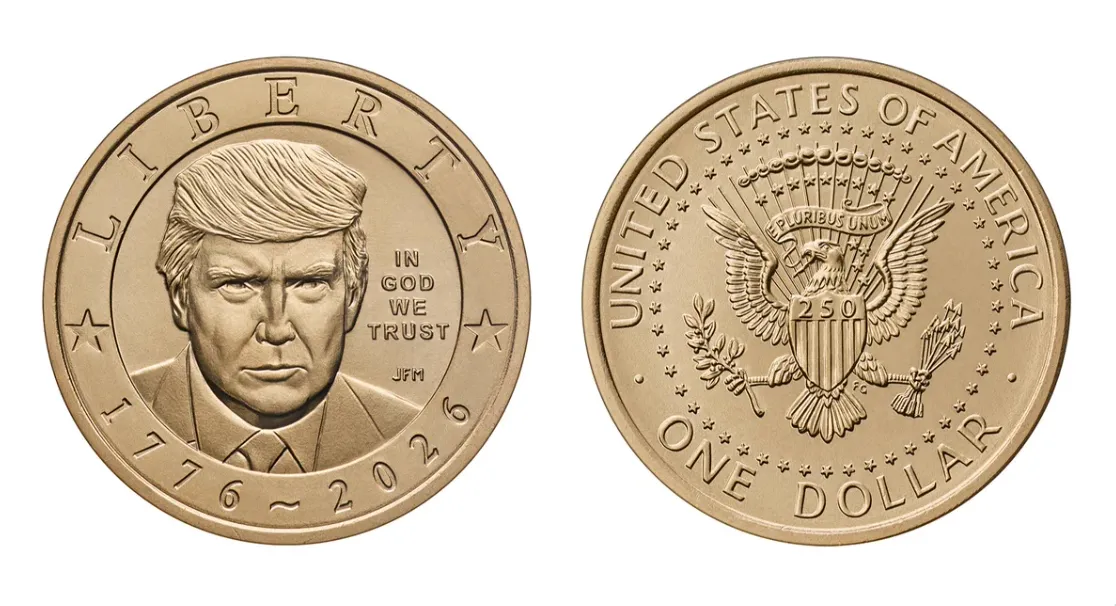
Treasury Secretary Scott Bessent announced the U.S. Mint will begin striking a new $1 gold coin in fall 2026 featuring President Donald Trump’s face. The move spotlights how Treasury is relying on the Circulating Collectible Coin Redesign Act of 2020 to justify putting a living person’s portrait on currency.
Treasury Secretary Scott Bessent said the U.S. Mint will start striking a new $1 gold coin in fall 2026 featuring President Donald Trump’s face, as part of America’s 250th birthday celebrations. Bessent framed it as “a lasting symbol of patriotism” and “honor[ing] the enduring legacy of liberty,” announcing the final design on X. For anyone watching U.S. currency rules, that headline should set off an alarm bell immediately: federal law has barred portraits of living people from appearing on U.S. currency. Treasury’s answer is that a 2020 law gives the administration room to make exceptions for the semiquincentennial.
The coin details matter because they show exactly how Treasury is threading the needle. The U.S. Mint’s coin is not solid gold, it instead carries a gold finish, and its design was approved earlier this year by the U.S. Commission of Fine Arts, a panel whose members were appointed by Trump. The version unveiled Wednesday differs slightly from what was cleared. The coin’s front shows Trump in a suit and tie. “LIBERTY” arcs across the top, “1776-2026” sits across the bottom, and “IN GOD WE TRUST” sits in the center.
Bessent also tied the symbolism to the broader storyline of the 250th anniversary, saying the Mint will strike the new $1 gold coin “to honor the enduring legacy of liberty” and as “a lasting symbol of patriotism.” He added that it features President Trump and celebrates “the strength of American values” and “the promise of a nation dedicated to preserving freedom for all.” Those are the words Treasury chose publicly. But the operational question executives and board members should care about is simpler: what changed in the legal basis, and how broad is the exception?
The answer Treasury has provided is anchored in the Circulating Collectible Coin Redesign Act of 2020, signed during Trump’s first term. The source notes that Treasury has argued this statute gives “room to make exceptions for the semiquincentennial.” That matters because it turns a symbolic change into a compliance and precedent question. Once a living person’s portrait is justified under a specific redesign statute, the next question becomes whether future commemorative or “collectible” programs can stretch the same reasoning.
This isn’t the only currency move in the same direction, and the combo is part of why this is getting attention. Treasury also announced in March that new bills would carry Trump’s signature alongside Bessent’s, replacing the treasurer’s signature that has appeared on U.S. currency for roughly 165 years. The first $100 notes carrying Trump’s signature began rolling out around the Fourth of July. Like the coin, this has legal friction because federal law bars a living person’s portrait from appearing on U.S. currency. In parallel, the coin story now adds a new factual layer to the debate: the portrait is appearing, but through a coin redesign framework Treasury says permits exceptions.
A legal challenge is already in motion. In late March, James Rickher, an Oregon resident acting without a lawyer, filed suit in U.S. District Court in Oregon seeking to block Trump, Bessent, and other officials from letting the Bureau of Engraving and Printing issue currency bearing a sitting president’s image. The case turns partly on Title 31 of the U.S. Code, which spells out what the Treasury secretary can and can’t do with coin design. The law gives the secretary latitude over imagery, but it requires certain inscriptions on the front: “In God We Trust” and “Liberty.” It also requires on the back: “United States of America,” “E Pluribus Unum,” and the denomination. In other words, Treasury is operating inside a box defined by statutory inscriptions while pushing against the portrait constraint.
For executives who are not in the currency business, the operational takeaway is still relevant because it is a live case study in how governments adapt rules during politically sensitive moments. Congress has weighed in too. Rep. Jimmy Gomez introduced legislation that would bar a sitting president’s signature from appearing on currency or securities, but it would need to pass both chambers and be signed into law to actually stop the change. Separately, Sens. Elizabeth Warren and Jeff Merkley pressed Bessent in an April letter over the rationale for the signature change. Public opinion has leaned skeptical as well. An Economist/YouGov poll conducted in April found 59% of adults disapproved of replacing the treasurer’s signature with Trump’s, versus 24% who approved and 18% undecided.
Even the U.S. Mint’s usual rhythm is a reminder of what is different here. The story points out that new coin designs typically do not dominate public attention, especially for a normally quiet government operation. Yet earlier this year, for example, attention focused on a separate dime design change involving dropping the olive branch. Put together with the bill-signature shift and now the Trump portrait coin, the pattern is that symbolic design decisions can quickly become regulatory and political flashpoints.
Strategically, the stakes extend beyond numismatics. If Treasury’s legal interpretation of the 2020 coin redesign act survives challenge, it can serve as a roadmap for future administrations seeking flexibility on commemorative imagery. If it doesn’t, it can trigger rework, legal risk, and reputational blowback. Either way, this is a real-time demonstration of how statutes, design rules, and public sentiment collide when a sitting president becomes the subject of U.S. money. For boards and senior operators, the lesson is that compliance is not just about “what is permitted today,” it is also about what precedent is being set while the design is still warm and the controversy is still new.
This story's Key Insights and Take-aways are locked.
Create a free account to unlock Executive Actions for one credit.
Register to UnlockAlways free for Executives Club members. Join the Club
More in Politics

LA County: DOJ's 20,000 'noncitizen' voter list is 'unreliable,' includes U.S.-born
Preliminary review by Los Angeles County election officials finds errors in the federal list, raising the stakes for voter roll integrity ahead of November.

Trump's $1.5B Pentagon chip investment lands in North Carolina
A $1.5 billion defense infusion for North Carolina chipmaking signals a new era of Pentagon-backed reshoring - here's what it means for the industry.

Nigeria confirms first Ebola case in Abuja, a woman just off a Uganda flight
Health Minister Muhammad Ali Pate says the patient flew in from Uganda, putting Africa's latest outbreak on Nigeria's doorstep.