
SDSS J110546.07+145202.4 brightened 20x in radio, showing a Big Bang-like black hole
A nearby galaxy’s supermassive black hole is feeding at rates only seen in the early universe, and it keeps going.
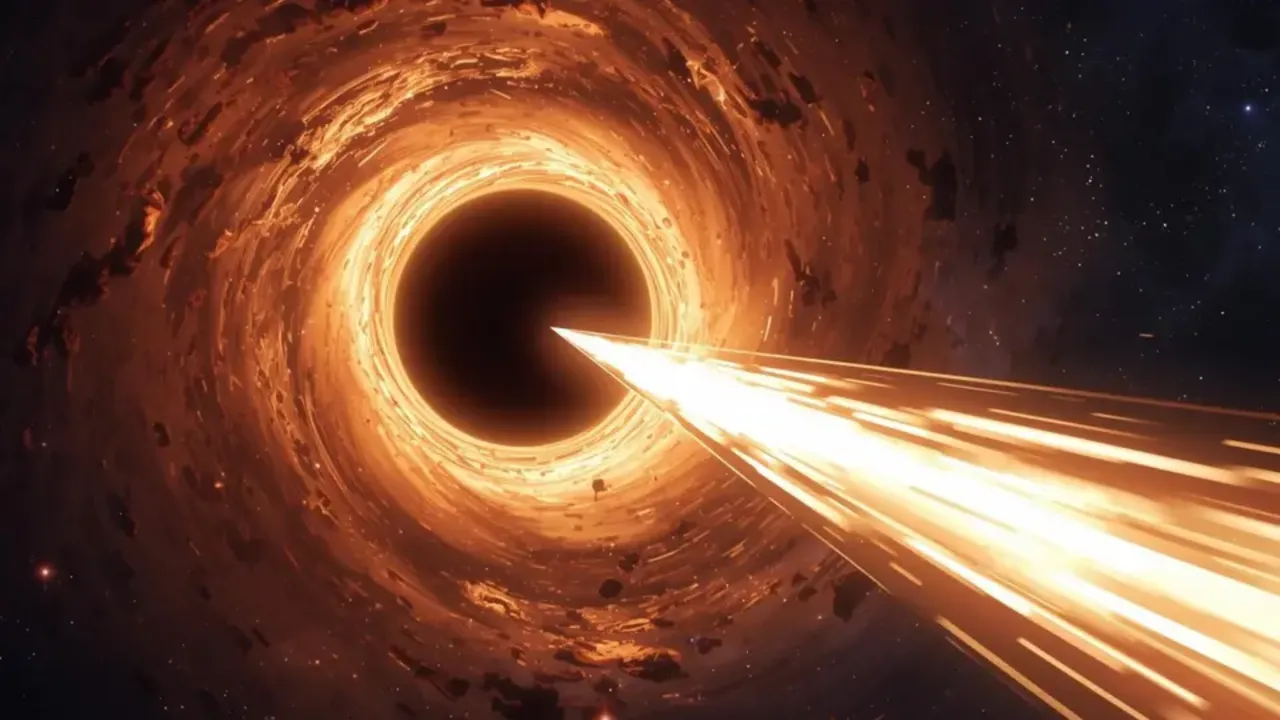
Astronomers studying the galaxy SDSS J110546.07+145202.4, 1.8 billion light-years away, report a supermassive black hole behaving like the ravenous titans from just after the Big Bang. The radio signal from this galaxy jumped 20-fold roughly 8 years ago and has not dimmed, revealing sustained jet-driven accretion activity.
A supermassive black hole in a nearby galaxy has been doing something researchers usually only spot in the universe’s youth: it is feeding fast enough to light up like an early-universe monster. The galaxy is SDSS J110546.07+145202.4, located 1.8 billion light-years away, and its central black hole has shown intense accretion activity for years. The key evidence is observational and it is specific: its radio waves underwent a 20-fold increase in brightness over a short period around 8 years ago, and the galaxy has not shown any sign of dimming.
Why do astronomers care about a 20x radio brightening? Because it is a smoking gun for how matter is rushing into the black hole and then being reorganized into jets and outbursts, the kind of high-energy behavior scientists have only ever seen in the earliest supermassive black holes. In this case, radio emissions acted as the trail marker pointing directly to the central black hole’s feeding habits, offering a rare chance to study a process that is typically hard to observe in detail because early-universe black holes are far away and faint.
Here’s the basic setup. Like other large galaxies, SDSS J110546.07+145202.4 has a supermassive black hole at its center with a mass in the millions to billions of Suns. But not every supermassive black hole is hungry. Some, like Sagittarius A* at the heart of the Milky Way, consume so little gas and dust that the comparison in the article lands with surprising clarity: if it were a person, it would be eating one grain of rice every million years. That is the opposite of what the team is seeing here.
When a supermassive black hole is surrounded by copious gas and dust, gravity forces that material into a flattened, swirling structure called an accretion disk. The disk glows across the electromagnetic spectrum, from low-energy radio waves up through high-energy X-rays. But supermassive black holes are famously messy eaters. Some of the infalling matter is channeled toward the poles, where it is blasted out as jets of plasma traveling at speeds approaching the speed of light. Those jets, in turn, are responsible for bright emissions, including radio signals.
In SDSS J110546.07+145202.4, the radio brightening was not a small blip. It increased to around 10 quadrillion times the intensity of the radio brightness of the sun. The researchers connect the timing to a likely change in the black hole’s appetite: the brightening began because the rate of matter falling into the black hole increased, which then triggered plasma jet generation. And the crucial part for anyone trying to learn the “how” behind early-universe growth is persistence. The galaxy has remained in that bright, active state, with no sign of dimming.
This is where the story stops being just astronomy trivia and starts sounding like a dataset builders dream. The research team describes SDSS J110546.07+145202.4 as the prototype of a new class of galaxies that undergo rapid changes in radio emission. Team member Phil Edwards of CSIRO, Australia’s national science agency, said the situation involves “the prototype of a new class of galaxies that undergo rapid changes in radio emission,” adding that the radio-bright state is rapid and long-lived. Team leader Stefanie Komossa of the Max-Planck-Institute for Extraterrestrial Physics in Garching, Germany, adds another hard boundary: luminous radio radiation from rapidly growing, lightweight black holes is rare to begin with, and their transition into a long-lasting, radio-bright state has never been observed before.
So what does “Big Bang-like” actually mean here? The researchers argue that the intensity and accretion behavior demonstrated by this supermassive black hole is something scientists have only ever seen in the earliest supermassive black holes. Translation: this nearby system may be acting as a local proxy for processes that otherwise are only accessible when you look deep into space and back in time. That matters because it changes the observational equation. Instead of only inferring early-universe black hole growth from very distant snapshots, astronomers can now target a nearer laboratory where the same physics appears to be playing out.
And the stakes extend into the next wave of telescope strategy. The team’s research, published in May in The Astrophysical Journal, points to practical follow-on work: with sensitive facilities like the incoming SKA telescopes, astronomers should be able to identify similar radio transients in future sky surveys. Komossa frames that as filling gaps in understanding the early universe. For decision-makers watching the science ecosystem, the second-order implication is straightforward: if a rare behavior is repeatable and detectable, the survey pipeline, observing time allocation, and instrument development priorities tend to shift. You do not just get a new object. You potentially get a new class of targets.
For executives and board members in adjacent tech and data fields, the underlying signal is the same one found across frontier science: sustained, high-energy astrophysical events produce clean, measurable triggers. Here it is a 20-fold radio increase around 8 years ago and a brightness level that kept climbing to around 10 quadrillion times the sun’s radio intensity. In the long run, that can influence what gets funded, what gets instrumented, and how quickly teams can turn transient detections into deeper physical insight. In other words, SDSS J110546.07+145202.4 is not just a black hole sighting. It is a potential roadmap for finding more early-universe-like behavior closer to home, right when next-generation radio surveys are gearing up.
This story's Key Insights and Take-aways are locked.
Create a free account to unlock Executive Actions for one credit.
Register to UnlockAlways free for Executives Club members. Join the Club
More in Science

Alaska's 1,580-foot tsunami had warning signs. Scientists just found them.
Rapid glacier retreat, heavy rainfall, and thousands of tiny tremors preceded Alaska's 1,580-foot tsunami, a warning for every coastal community in a warming world.

The rare mutation that lets high-risk brains dodge Alzheimer's
Scientists found a natural defense against protein buildup, opening a new path to preventive treatments.

3,000 steps a day may halve Alzheimer's decline, study finds
New research links a modest daily walk to less tau buildup and nearly half the cognitive and functional decline, even for those with early signs.