
Six Republican Senate seats are in play as Democrats stay competitive but fall short
A new Times/Siena snapshot shows Democrats competitive across six states, but not leading enough to seize control.
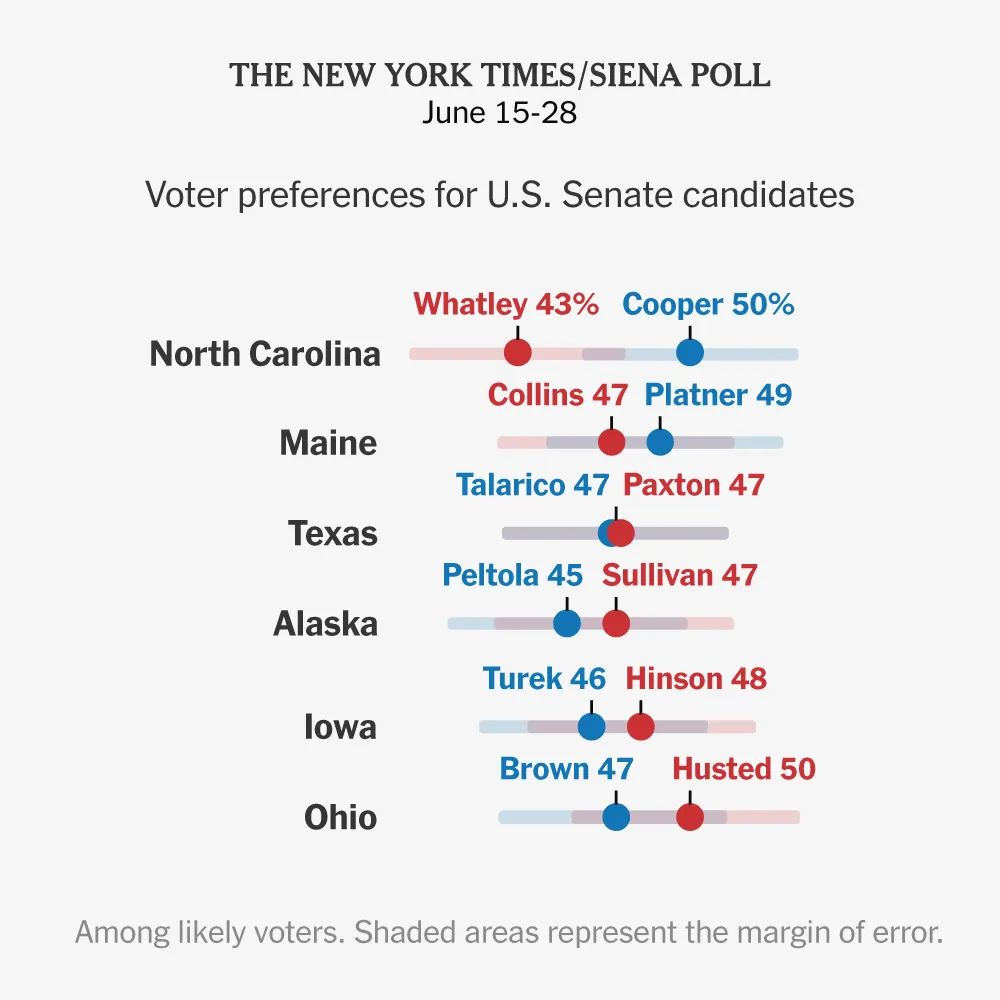
Republicans are defending Senate seats in Alaska, Iowa, Maine, North Carolina, Ohio, and Texas to maintain their majority, while Democrats are competitive in all six states. The consequence is a likely Senate tug-of-war where close races do not automatically flip power.
Republicans are defending Senate seats in Alaska, Iowa, Maine, North Carolina, Ohio and Texas, as they try to maintain their majority, according to the New York Times and Times/Siena polls. In other words, the map is not just a scoreboard for ideology. It is a stress test for control of the chamber.
The headline problem for Democrats is equally specific: Democrats are competitive in all six states, but they are not leading in enough of them to take the chamber. That distinction matters because “competitive” can feel like momentum, but in Senate control math, momentum that does not translate into leading positions often turns into more of the same, just with higher volatility.
Why this is such a big deal for decision-makers is that Senate control is the difference between a legislature that can move faster and one that constantly negotiates with the brakes on. The Senate’s role in confirming nominees, shaping legislation, and influencing the tempo of national policy means that even when elections are tight, the party that can actually claim leadership of the chamber gets outsized control over what gets prioritized, how quickly it advances, and how much room negotiators have to compromise.
From the poll snapshot, the political incentives are straightforward. Republicans are defending the burden of incumbency and continuity in six specific states, which creates pressure to avoid complacency while also protecting the majority they already hold. For Democrats, the challenge is that being competitive across the board is not enough if the polls show them not leading in enough states. That is a classic political bind: you can be close in every direction and still lose the center of the contest.
Consider how that interacts with the way elections are typically fought in a Senate context. Senate races often hinge on turnout, local candidate strength, and state-specific issues, but the overarching campaign logic is national control. If polls suggest Democrats are not leading enough to win the chamber, parties usually have to decide where to spend scarce resources: double down in marginal districts or attempt late persuasion statewide. The Times/Siena framing implies that Democrats see winnability, but the numbers are not yet describing a clean path to Senate control.
There is also a regulatory second-order implication here, even though this particular story is about election competitiveness rather than a specific bill. When the control question stays narrow and unsettled, industries that depend on federal policy can face longer timelines for decisions that require Senate action. Delays do not always come from inaction alone. They can come from the Senate requiring broader coalitions or more bargaining power when the majority party feels threatened.
That dynamic can show up in how companies plan around confirmations and legislative windows. Leadership changes can shift priorities quickly, but if the Senate leadership remains with Republicans or remains contested without a clear flip, the practical effect can be slower movement through the parts of government that businesses and investors watch closely. Think of it as political uncertainty that does not have to be apocalyptic to matter. Even moderate uncertainty about which party can set the agenda affects expectations, lobbying intensity, and the willingness to commit to long horizon bets.
At the state level, the six names in the poll coverage also signal something else: the contests are spread across a wide range of political geographies. Alaska, Iowa, Maine, North Carolina, Ohio and Texas are not interchangeable. Each one has its own electorate profile, and that means “competitive” does not mean identical dynamics. For executives and boards tracking policy risk, it means the story is not only about who wins statewide races. It is about how the coalition that sustains Senate control may change, depending on which incumbents hold and which challengers close the gap.
So the strategic stakes are clear. For Republicans, the objective is to defend enough of these seats to keep control. For Democrats, the objective is tougher than “stay competitive.” They need to convert competitiveness into actual leading positions in enough of these states to take the chamber. In Senate terms, that is the line between influence and power: not merely being close, but being ahead where it counts.
This story's Key Insights and Take-aways are locked.
Create a free account to unlock Executive Actions for one credit.
Register to UnlockAlways free for Executives Club members. Join the Club
More in Politics

Glacial collapse, not rain, killed 180 in Nepal's Himalayan flood
The Himalaya's extreme geography hid the true cause of Nepal's catastrophic flood, a glacial collapse that turned a geological battleground into a mass-casualty zone.

Iran’s Esmail Baghaei says Oman talks start shipping via Hormuz, not US talks yet
Temporary route plans with Oman aim to restart commerce while Tehran says Washington dialogue is not on the table.

Standards watchdog opens probe into Reform UK deputy leader Richard Tice over interests
The parliamentary standards commissioner says it began an investigation on 28 July into a possible undeclared interest.