
SpaceX Catches a Falling Rocket Out of the Sky, a First for Reusability
The catch turns the launch tower itself into the landing pad, and it puts cost per kilogram to orbit, not spectacle, at the center of the next phase of the space race.
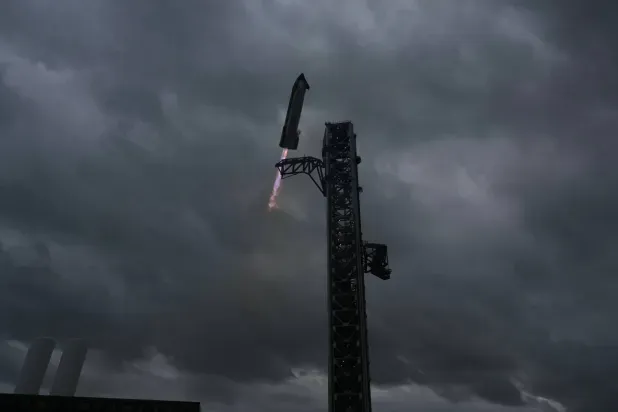
SpaceX has pulled off the first-ever catch of a returning spacecraft, snagging the vehicle out of the air with hardware on its launch tower rather than letting it splash down or land on legs, according to Asharq Al-Awsat. The milestone matters because full reusability is the lever that decides launch cost, launch cadence, and who controls access to orbit for satellites, defense payloads, and crewed missions over the next decade.
SpaceX has done something nobody else has done: it caught a returning spacecraft out of the sky. Asharq Al-Awsat reported the milestone as a first-ever "catch," meaning the vehicle did not parachute into the ocean and did not settle onto landing legs. It was intercepted and held by hardware mounted on the launch tower itself. That single mechanical act is the dividing line between a rocket you throw away and a rocket you fly again, and it is the exact problem the commercial space industry has been grinding on for years. For anyone who has watched launch prices fall over the past decade, this is the moment the curve gets steeper.
Start with what a catch actually is, because the phrase undersells the engineering. A booster returning from the edge of space is falling fast, carrying residual propellant, and generating enormous heat and aerodynamic load. Historically, the safe answer was to let it hit water far from anything expensive. Landing legs were the next step up, but legs are dead weight on every flight, and they still require a flat, prepared surface. Catching the vehicle with the tower removes both problems at once: no legs to carry, no separate landing pad to maintain. The trade is brutal precision. The vehicle has to arrive at a specific point in space and time, at a survivable speed, aligned with hardware that has exactly one chance to close around it. Miss by a little and you lose the vehicle; miss by a lot and you damage the tower you need for the next launch.
For context, the industry spent its first sixty years treating rockets as disposable. Every launch was a one-way trip, and the hardware was the single largest line item in the budget. SpaceX changed the math with its earlier booster landings, which normalized the idea that the most expensive part of a rocket could fly, land, and fly again. That shift is why launch prices fell and why satellite constellations became economically viable at all. The catch reported by Asharq Al-Awsat is the next rung on the same ladder: pushing reuse from the booster into the full stack, and pushing the recovery method from a soft touchdown into a precision grab.
The economics are the reason this is a business story and not just an engineering flex. If a vehicle can be recovered, inspected, refueled, and reflown quickly, the cost per kilogram to orbit falls, and falling cost per kilogram changes what gets launched. Cheap, frequent access to orbit is what makes broadband constellations, Earth-imaging fleets, and government payloads pencil out. It is also what makes a crewed lunar architecture plausible, since NASA has publicly contracted SpaceX to adapt a version of its vehicle as a lunar lander for the Artemis program. A catch that works reliably is a catch that can be repeated on a schedule, and schedule reliability is what customers actually buy.
That is where the competitive pressure lands. Rival launch providers, including established government contractors and newer entrants in the United States, Europe, and China, are all racing toward some version of reuse. If SpaceX can demonstrate that catching a returning vehicle is routine rather than a stunt, the gap widens in the two places competitors cannot easily close: cadence and unit cost. A competitor can match a payload capacity on paper. Matching a turnaround pipeline that reuses flight-proven hardware is a capital and operations problem that takes years to build.
Regulatory framing matters here too. Every step up in launch cadence runs through launch licensing and environmental review, and the sites that support this kind of recovery are coastal and ecologically sensitive. Historically, expanding flight rates has meant negotiating with regulators over airspace closures, debris analysis, and wildlife impact, and those reviews set the real ceiling on how many times a year a company can fly. A recovery method that keeps hardware on the pad instead of in the water may ease some debris concerns, but it concentrates risk at the launch site, which is exactly the kind of trade regulators will scrutinize.
The strategic stakes for peers are straightforward. Boards evaluating space exposure, whether through direct investment, supplier contracts, or satellite-dependent operations, should read this as a signal about the cost floor, not a headline about a cool video. If reuse keeps compounding, the winners will be the operators who can buy launch capacity cheaply and the suppliers who sell into a higher flight rate. The losers will be anyone whose business model assumed launch stayed expensive. The catch is one moment. The compounding is the story.
This story's Key Insights and Take-aways are locked.
Create a free account to unlock Executive Actions for one credit.
Register to UnlockAlways free for Executives Club members. Join the Club
More in Business

GTA VI hauls $3.79bn in one day, out-earning every film ever made
Rockstar's own estimate covers a single Thursday plus a record 32.5m prerelease units, and it lands on every board weighing IP concentration, pricing power and launch risk.

FBI's crime database breached again, the second hack in months
CNN reports hackers hit the National Crime Information Center, the shared backbone of US policing, and the repeat timing is the part every security team should study.

S&P 500 Enters Correction, Down 10% From Its High on AI Worries
The index's slide past the 10 percent line is a symbolic verdict on investor mood, and the AI trade that powered the rally is now the thing testing it.