

SpaceX catches Starship midair for the first time: 'now everything changes'
Ship 42 dropped out of orbit and into Mechazilla's chopstick arms 22.5 hours after launch, the milestone SpaceX says unlocks rapid reuse, Starlink V3 and a million-satellite Starmind.
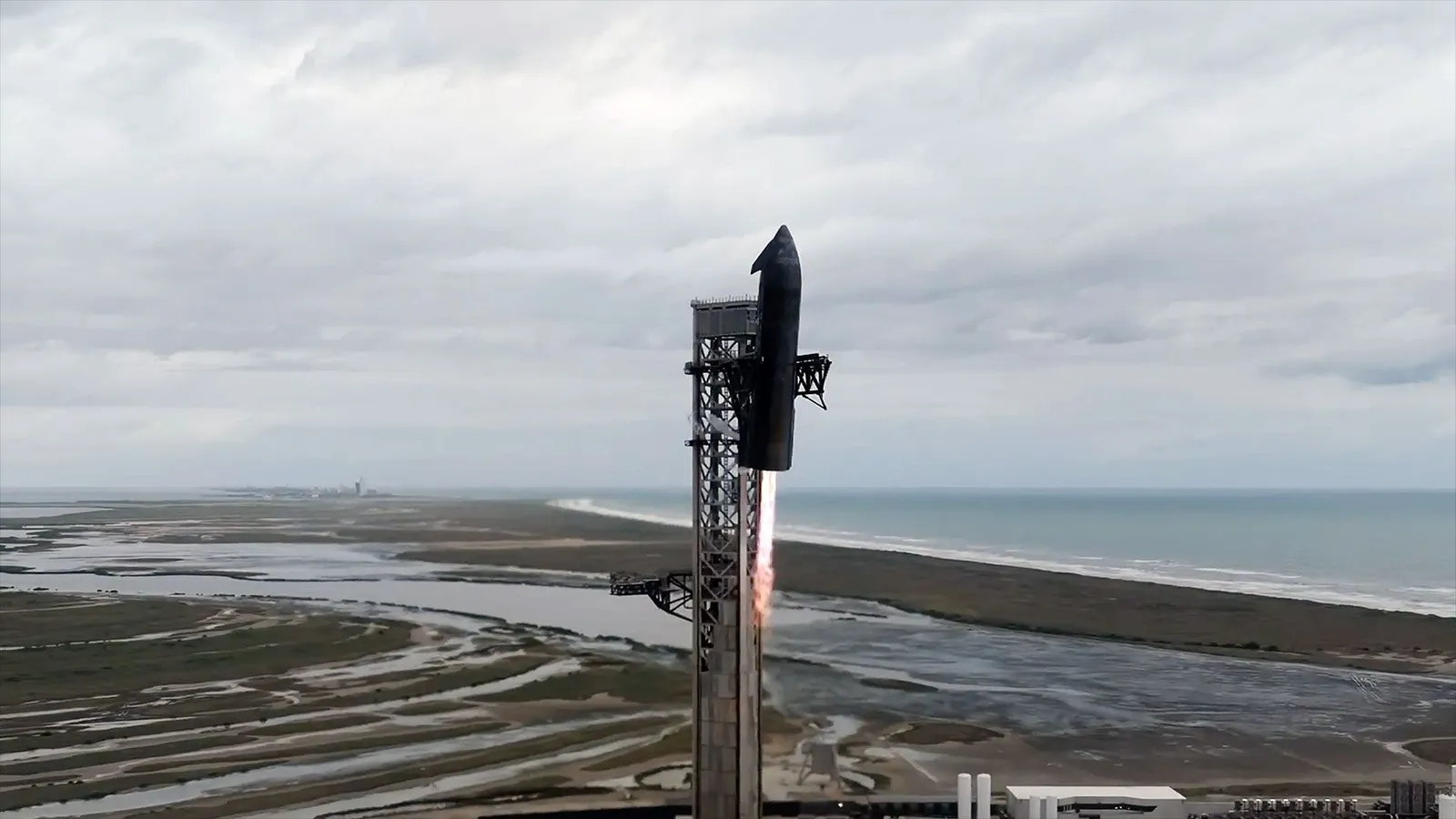
SpaceX caught the upper stage of its Starship megarocket for the first time on Nov. 14, snatching Ship 42 out of the air with the chopstick arms of its Starbase launch tower roughly 22.5 hours after Flight 15 lifted off. The catch closes the harder half of full rocket reuse, the capability that underpins SpaceX's plans for a 100,000-satellite Starlink V3 constellation and Elon Musk's million-spacecraft Starmind orbital data-center network.
SpaceX caught the upper stage of its Starship megarocket for the first time on Nov. 14, plucking Ship 42 out of the sky with the chopstick arms of its Starbase launch tower, which the company calls Mechazilla. The catch happened at 4:20 p.m. EST (2120 GMT, 3:20 p.m. local Texas time), roughly 22.5 hours after Flight 15 lifted off from South Texas on the evening of Nov. 13. "That was the missing link," SpaceX's Dan Huot said on the company's landing webcast, his voice thick with emotion. "That was the holy grail of spaceflight, plummeting through fire to be snatched out of the air by steel. We caught a Starship, and now everything changes."
The 22.5-hour figure matters because of what came back: not a booster lobbed a short distance downrange, but an upper stage that had flown all the way to orbit and returned. SpaceX had already caught Super Heavy three times on earlier test flights. It had never tried with Ship, which flies higher, farther and faster, making it a tougher target. Flight 15's plan called for catching both stages, an unprecedented total recovery of an orbital rocket. That did not happen. Super Heavy diverted to a splashdown in the Gulf of Mexico on Nov. 13 after experiencing a low-fuel alarm. Ship still delivered.
Flight 15 was not only a catching drill. The mission also put Ship into orbit, something that had happened on just one previous Starship launch, Flight 14 on Sept. 28. Ship deployed 26 of SpaceX's next-generation Starlink V3 broadband satellites in low Earth orbit, repeating the feat from Flight 14. Those 52 spacecraft are the first members of a constellation that will eventually consist of 100,000 satellites if all goes according to SpaceX's plan. Some of those satellites turned their cameras on Ship 42's heat shield to check its health ahead of the landing attempt. Combined with ground-based cameras, the images found the vehicle in good shape and ready for its big moment.
Then there is the bigger prize. SpaceX plans to use Starship to build Starmind, an AI data-center constellation that Elon Musk says will harbor a million spacecraft, a network far larger than the Starlink V3 system. For scale, SpaceX's current-generation Starlink network employs about 11,000 satellites. Assembling megaconstellations at that size requires an incredible launch cadence, and cadence is exactly what the chopstick catch is meant to unlock.
SpaceX says the catch enables quicker inspection, refurbishment and reflight of Starship. That is the whole ballgame. Historically, the expensive part of a rocket has been the hardware you throw away, and the launch industry's economics have long been defined by expendable stages that fly once and end up in the ocean. Recovering a booster helped change that math. Recovering the upper stage, the part that actually delivers payloads to orbit, is the harder half of the problem because it reenters at far higher energy. Catching it with a tower rather than landing legs also strips mass from the vehicle, mass that can go to payload instead.
The scene at Starbase underlined what was at stake. Many SpaceX employees went outside to watch Ship 42 descend through the clouds toward Mechazilla, and "Baby Come Back" played over the landing webcast as the vehicle nestled gently into the tower's waiting arms. "This is so incredible to see," SpaceX's Jessie Anderson said during the livestream. "One of the most incredible and historic engineering feats of all time has just happened right in front of our eyes."
Expect a repeat attempt soon. SpaceX will doubtless try the maneuver again, probably on the next Starship flight, which the company has signaled is not too far down the road. The double catch, booster and Ship on the same mission, remains the full demonstration, and Flight 15 showed how close the company got: one stage caught, one stage lost to a fuel alarm and a splashdown.
For executives watching from outside aerospace, the strategic read is about cost curves and capacity. If upper-stage reuse works at cadence, the constraint on orbital infrastructure shifts from how many rockets you can build to how fast you can turn them around, which changes the math for satellite broadband, Earth observation and the newly fashionable idea of putting compute in orbit. Other launch providers and satellite operators are chasing those same markets, but SpaceX is now the only one that has caught both halves of an orbital rocket. That is the gap the rest of the industry has to close, and Nov. 14 is the date it opened.
This story's Key Insights and Take-aways are locked.
Create a free account to unlock Executive Actions for one credit.
Register to UnlockAlways free for Executives Club members. Join the Club
More in Technology

Anthropic mathematician claims Claude helped crack the Riemann hypothesis
If the proof holds, AI has toppled math's most famous open problem; if it does not, it is a case study in announcing breakthroughs before anyone verifies them.

AI's $4 Trillion Wipeout Erases Nasdaq's Gains for the Year
A brutal week took roughly $4 trillion off the AI sector and left the Nasdaq flat for the year, and the damage ran the full length of the supply chain.

Anthropic mathematician says AI proved the Riemann hypothesis. Verification will take time.
A single unverified claim from inside Anthropic now sits against more than 160 years of open mathematics, and the gap between asserting a proof and surviving peer review is the entire story.