
SpaceX's 11th-flight booster just launched a payload the Space Force won't name
USSF-317 lifted off from Vandenberg at 11:20 p.m. EST, landed its booster 8.5 minutes later, and left experts guessing whether Starshield satellites are aboard.
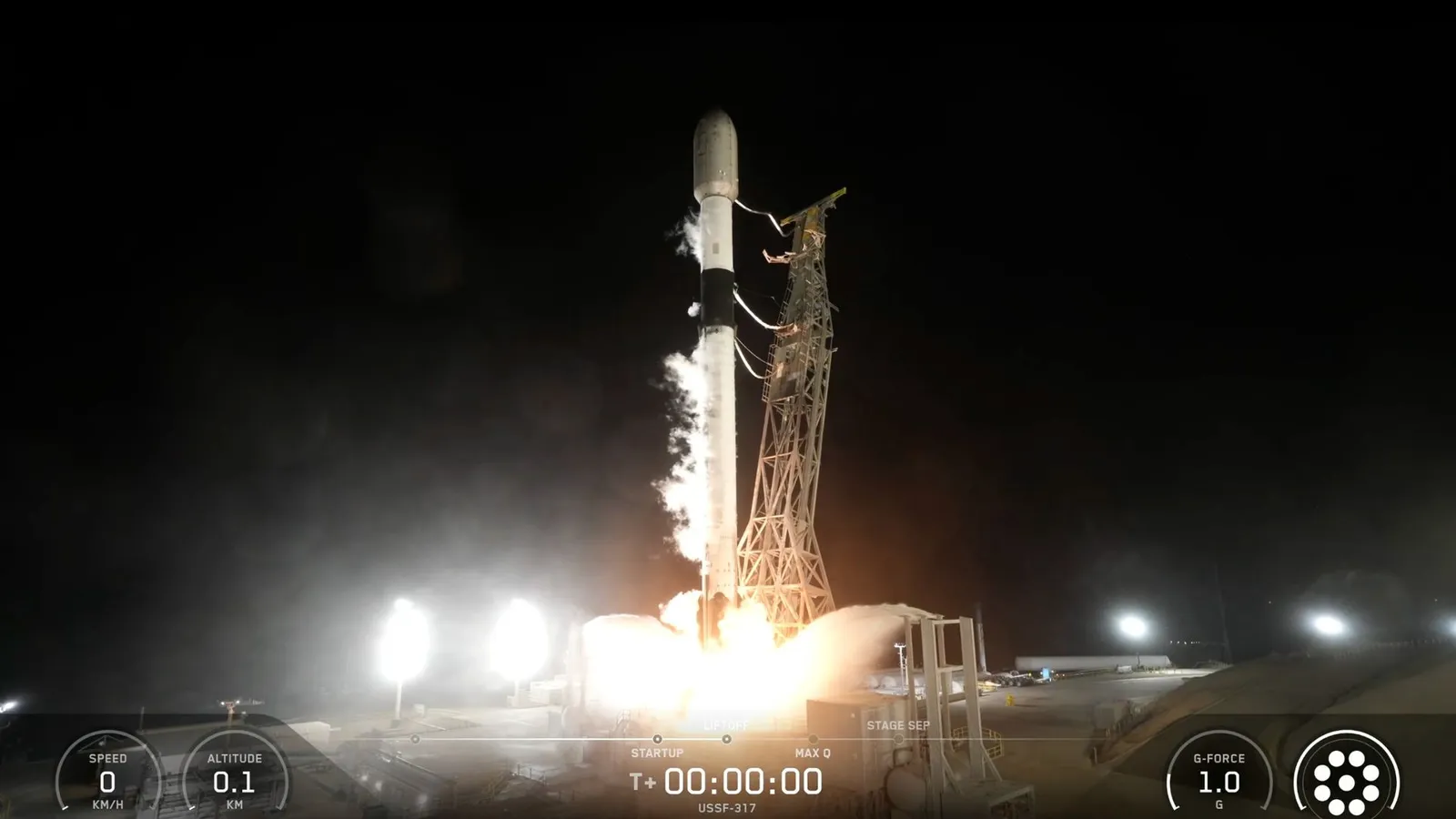
SpaceX launched the classified USSF-317 mission for the U.S. Space Force from Vandenberg Space Force Base on Nov. 20, recovering booster B1100 for the 11th time while declining to say what the rocket carried. For defense and space executives, the launch underscores a market where one provider flies most national security missions, its Starshield satellites may be the payload, and its workhorse Falcon 9 is already scheduled for retirement.
SpaceX launched a classified mission for the U.S. Space Force on Nov. 20, and the company cut its own webcast before anyone outside the government could see where the payload was headed. A Falcon 9 lifted off from Vandenberg Space Force Base on California's central coast at 11:20 p.m. EST (8:20 p.m. local California time; 0420 GMT on Nov. 21) on a mission designated USSF-317. About 8.5 minutes later, the rocket's first stage came back to Earth, touching down in the Pacific Ocean atop the SpaceX drone ship "Of Course I Still Love You." It was the 11th launch and landing for this particular booster, designated B1100, a reuse record that says as much about SpaceX's cadence as it does about the rocket itself.
That is where the public record stops. SpaceX ended its launch webcast just after the touchdown, so there was no view of the Falcon 9's upper stage powering its way to orbit. USSF-317 is classified, which means no payload description and no destination. The best available read comes from outside experts, who think USSF-317 may be hauling a batch of SpaceX's Starshield satellites to low Earth orbit for the Space Force's Space Based Sensing and Targeting portfolio, the program that helps the military keep tabs on potential targets around the world. If that is right, the mission is less about a single launch and more about who builds and flies the sensors a superpower relies on.
Starshield is the government-facing side of SpaceX's satellite business, historically described as Starlink technology adapted for defense and national security customers. That is the blur worth watching. The same company that operates more than 11,000 Starlink satellites for consumers and enterprises also builds hardware that may end up inside a sensing and targeting architecture, and launches both on the same rocket line from the same pads. For the Space Force, that is efficiency. For competitors and policymakers, it is concentration: one vendor, one launch provider, one supply chain, and a classified manifest the public cannot audit.
The numbers behind USSF-317 show how routine that concentration has become. The mission was the 121st Falcon 9 launch of 2026 and the third SpaceX flew for the Space Force in November alone. The vast majority of this year's Falcon 9 flights, roughly 70%, have been devoted to building out Starlink, the low Earth orbit internet constellation that now counts more than 11,000 satellites. Falcon 9 flew a whopping 165 times in 2025. Booster B1100's own history reads like a cross-section of the manifest: NROL-105, USSF-385, and eight Starlink missions before this one, mixing national security payloads with commercial broadband on the same hardware.
All of that is happening on a rocket that is on its way out. SpaceX plans to retire both Falcon 9 and Falcon Heavy in favor of Starship, its fully reusable megarocket, which deployed 26 of SpaceX's next-gen Starlink V3 satellites on its most recent two test flights. For commercial customers, the transition is a scheduling question. For classified customers, it is a risk question: the vehicle with 165 flights in a single year, and a booster on its 11th trip, is being phased out while its replacement is still proving itself in test campaigns. Defense buyers typically want heritage and predictability, and the heritage vehicle now has an end date.
Reuse is the reason the math works at all. Landing a first stage on a drone ship 8.5 minutes after liftoff, then flying it again, is what turned Falcon 9 into the workhorse that can absorb a national security launch and eight commercial broadband missions on the same booster. Every recovered stage is a stage SpaceX does not have to build, and every stage it does not have to build is capacity it can sell. That flywheel is why a classified Space Force mission and a Starlink batch can share a rocket family, a launch site, and a recovery fleet without either one waiting in line.
The strategic stakes for anyone adjacent to space, defense, or telecom are straightforward. Watch the Starshield line, because it is where commercial satellite economics meet military sensing requirements, and where the customer cannot say out loud what it bought. Watch the Starship transition, because the reliability record that made Falcon 9 the default for national security launches does not transfer automatically to a new vehicle. And watch the manifest concentration, because when roughly 70% of a rocket's flights serve the launch provider's own constellation, the remaining capacity is what everyone else, including the U.S. government, is bidding for. USSF-317 lifted off and landed on schedule. What it carried is the part the Space Force would rather you not think about.
This story's Key Insights and Take-aways are locked.
Create a free account to unlock Executive Actions for one credit.
Register to UnlockAlways free for Executives Club members. Join the Club
More in Technology

Anthropic mathematician claims Claude helped crack the Riemann hypothesis
If the proof holds, AI has toppled math's most famous open problem; if it does not, it is a case study in announcing breakthroughs before anyone verifies them.

AI's $4 Trillion Wipeout Erases Nasdaq's Gains for the Year
A brutal week took roughly $4 trillion off the AI sector and left the Nasdaq flat for the year, and the damage ran the full length of the supply chain.

Anthropic mathematician says AI proved the Riemann hypothesis. Verification will take time.
A single unverified claim from inside Anthropic now sits against more than 160 years of open mathematics, and the gap between asserting a proof and surviving peer review is the entire story.