
Amazon Tells NYC Shoppers a Bill Could Add $5 to Every Order
The Delivery Protection Act would force Amazon to put its contractor delivery fleet on its own payroll, and the company is using its own home screen to fight back before lawmakers vote.
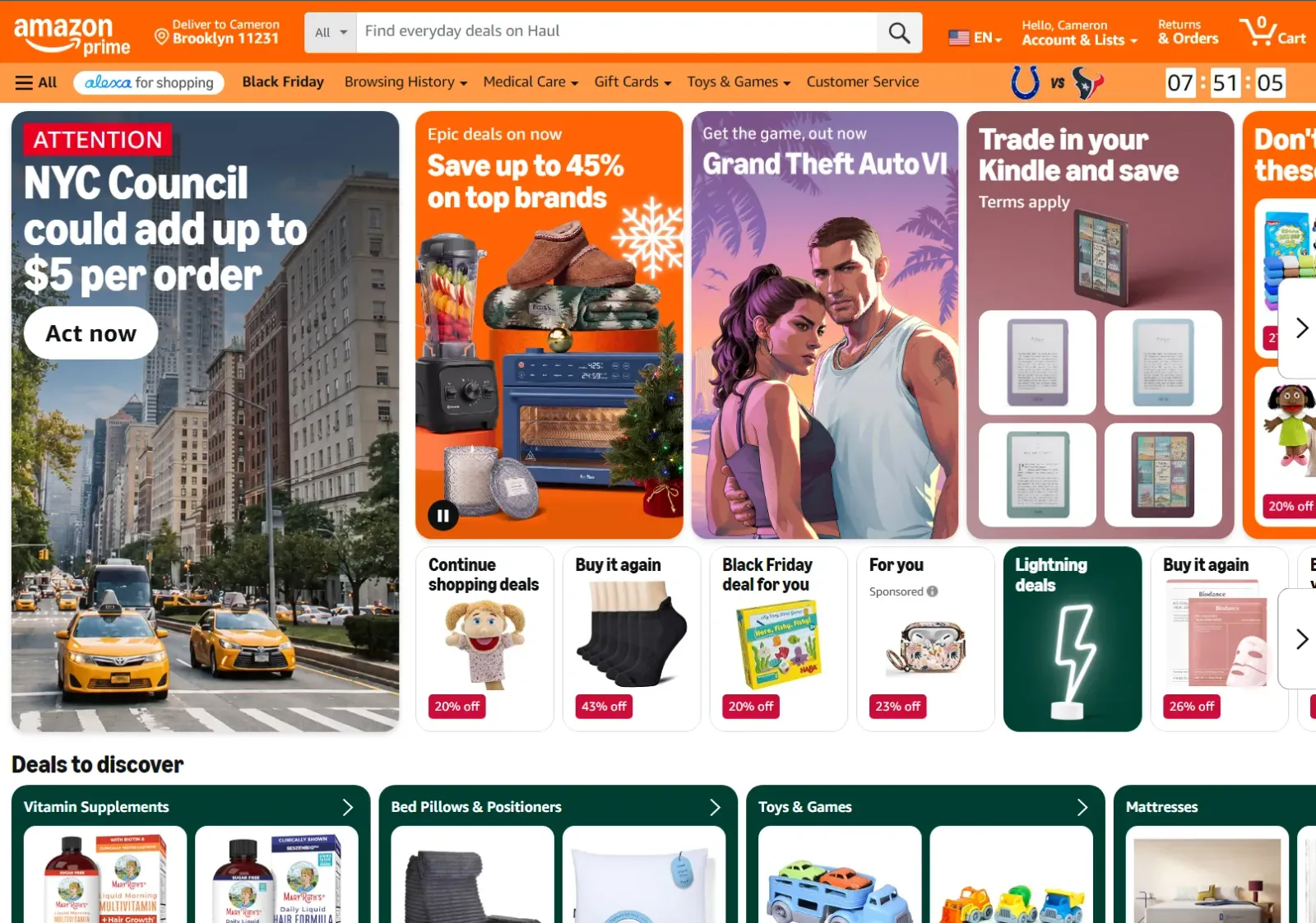
Amazon is pushing notifications and homepage banners to some New York City shoppers warning that the Delivery Protection Act, backed by Mayor Zohran Mamdani and labor groups including the Teamsters, could add up to $5 per order by forcing the company to directly employ its third-party delivery contractors. For operators and boards, it is a live case study in using owned consumer channels as regulatory leverage, and a preview of how last-mile labor costs may get repriced city by city.
Amazon is using its own storefront as a political megaphone in New York City. The company is serving push notifications to shoppers' phones and running banners on its homepage warning that a new bill could add as much as $5 per order for customers in the city. The bill is the Delivery Protection Act, and it targets the exact structure Amazon's delivery machine is built around: it would require the retailer to directly employ the fleet of third-party delivery contractors that currently carries its packages. The alerts are going to some users, not all, which is how these campaigns usually start - targeted, testable, and easy to scale up if the message lands.
What the bill actually does is narrow and consequential. It is backed by Mayor Zohran Mamdani and a number of labor groups, including the Teamsters. Right now, Amazon turns to a network of small delivery companies that often work exclusively with the retailer. That is the reason your package is sometimes dropped off by a guy in a Toyota Camry rather than an Amazon-branded truck. Those small firms hold the employment relationship with the driver; Amazon holds the route, the app, the volume, and the standards. The Delivery Protection Act would collapse that gap by requiring Amazon to employ those last-mile workers directly.
For context on why Amazon is fighting so hard, the contractor model is not an accident of logistics - it is the load-bearing wall of the economics. Historically, retailers have leaned on networks of small delivery firms because they let a company scale capacity up and down with demand, avoid owning a fleet of vans, and keep labor costs variable rather than fixed. The small companies bid for routes, hire the drivers, and absorb the employment obligations. From Amazon's side of the ledger, the person at your door works for a company you have never heard of, even though the package, the deadline, and the route all came from Amazon.
Amazon's alerts put a hard number on the change: up to $5 per order. Whether that estimate holds up under scrutiny is a separate question from whether it works, and the framing is deliberate. It converts a labor-classification fight into a grocery-bill problem for the person holding the phone. That is the tell here. Amazon is not running this argument through a lobbying shop or an op-ed page; it is running it through the home page and the lock screen, two surfaces no advocacy group, union, or city council member can buy at any price. When you own the checkout flow, you also own the last word before the vote.
The politics behind it are just as pointed. Mamdani and the Teamsters are applying pressure at the exact chokepoint where the contractor model is most visible to ordinary people: the doorstep. New York has long functioned as a laboratory for labor rules that later travel, and a win here would hand organizers a template they can carry into other dense delivery markets. For Amazon, the risk is not one city's surcharge. It is the precedent that a city can reach into its routing model and rewrite who is on payroll.
The second-order effects run past Amazon. Any retailer that leans on contractor or franchise networks for last-mile delivery is now watching a bill that would define those workers as employees of the brand at the top of the chain, not the small firm at the bottom. If the bill passes as written, Amazon's options are the familiar ones: absorb the cost and reprice, restructure how routes and entities are organized, or challenge the law. Each path carries its own price, and each one gets decided in public, in front of customers who are being told the number in advance.
For executives and boards, the strategic lesson is bigger than delivery. Amazon has demonstrated that a consumer platform can be converted into a policy instrument overnight, with a dollar figure attached to the ask. That cuts both ways. The same channel that lets a company shape a vote also invites regulators, unions, and rivals to hold it responsible for the message. Companies with large last-mile exposure should assume their labor model is now a public-facing cost line, not a back-office arrangement, and should model what a per-order surcharge looks like on their own checkout before someone else does it for them. The vote in New York is the near-term event. The precedent is the thing worth watching.
This story's Key Insights and Take-aways are locked.
Create a free account to unlock Executive Actions for one credit.
Register to UnlockAlways free for Executives Club members. Join the Club
More in Technology

Anthropic mathematician claims Claude helped crack the Riemann hypothesis
If the proof holds, AI has toppled math's most famous open problem; if it does not, it is a case study in announcing breakthroughs before anyone verifies them.

AI's $4 Trillion Wipeout Erases Nasdaq's Gains for the Year
A brutal week took roughly $4 trillion off the AI sector and left the Nasdaq flat for the year, and the damage ran the full length of the supply chain.

Anthropic mathematician says AI proved the Riemann hypothesis. Verification will take time.
A single unverified claim from inside Anthropic now sits against more than 160 years of open mathematics, and the gap between asserting a proof and surviving peer review is the entire story.