
Anthropic debuts at $2tn as protesters arrested outside Nasdaq
The AI lab's record listing put a two-trillion-dollar price tag on frontier AI and a protest on the same morning, a pairing boards heading to market should read as signal, not noise.
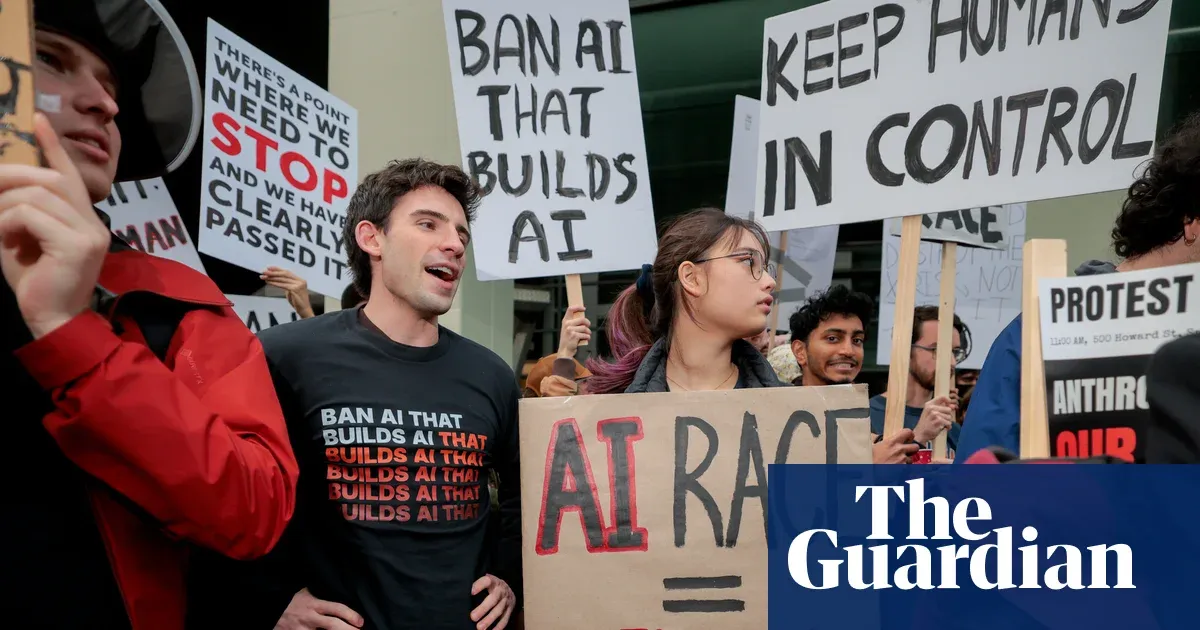
Anthropic debuted on the US stock market on Thursday at a $2tn valuation while anti-AI protesters rallied outside the Nasdaq exchange in Times Square and the company's San Francisco headquarters, with several arrests in New York. For executives, the same-day pairing shows that capital and public consent now move on one clock, and that a listing hands critics a ticker, a shareholder meeting, and a disclosure record to organize around.
Anthropic debuted on the US stock market on Thursday at a $2tn valuation, and the backlash arrived on the same morning. Protesters from anti-AI groups rallied in front of the Nasdaq exchange at its New York City headquarters in Times Square, and several were arrested. Roughly 30 people demonstrated in New York, carrying flags reading "STOP TECH OLIGARCHS" and "FREEZE AI: END ICE, END WAR". "I think people are starting to get that there's something wrong," said Jose Gonzalez, 46, one of the protesters.
Similar demonstrations took place outside Anthropic's San Francisco headquarters, meaning the company's listing day played out on both coasts at once. That is the detail worth sitting with. The $2tn figure is what made the protest legible: an eye-popping number turns an abstract debate about machine intelligence into a concrete story about who gets rich and who gets a say. On Thursday, the market answered one question and the street answered another, and neither answer cancelled the other out.
What a $2tn debut actually does. A listing at that level puts Anthropic in the top tier of the world's most valuable public companies, a group small enough to count on two hands. IPOs of that size typically pull in index funds and large asset managers as automatic buyers, whether or not those managers have a view on the company's products, and they reset the benchmark against which every other AI company's valuation gets marked. It also converts a private story into a permanent public record. A $2tn valuation is not a statement about what the company earned last year; it is a claim about what investors expect it to earn in the years ahead. That gap between present and future is exactly where criticism tends to land.
The slogans tell you where the criticism is heading. "STOP TECH OLIGARCHS" is a message about concentration of power. "FREEZE AI: END ICE, END WAR" ties artificial intelligence to immigration enforcement and to warfare, two areas where automated systems have already drawn scrutiny. For most of the past few years, US debate about AI split into two camps: people worried about existential risk and people worried about jobs. These flags point somewhere else, at AI as an instrument of state power and corporate leverage. That is a harder argument to answer with a safety blog post.
Regulators are moving in the same direction, more slowly. In recent years, lawmakers in the European Union and in several US states have pushed AI rules from white papers toward actual statute, and procurement has become a quiet lever: governments that buy AI systems can set conditions on how they are built and audited. None of that has produced a single global rulebook, and it may not for years. But the direction of travel is clear enough that a newly public AI company should expect its compliance posture to be examined by investors and activists with equal interest.
What changes for Anthropic now is the audience. A private lab can argue with its critics in blog posts and model cards. A public one files quarterly, answers to a shareholder base, and gives every claim a permanent, searchable address. Its safety commitments will be read against its growth numbers, and any gap between the two will be treated as news. It also hands organisers something they did not have before: a ticker symbol, a shareholder meeting, and a set of disclosure obligations that turn abstract objections into concrete questions with deadlines attached.
For founders and boards watching, the Anthropic debut is a template as much as a milestone. The company proved that a frontier AI lab can reach public markets at a scale that would have sounded absurd a few years ago. It also proved that valuation and visibility arrive as a package. Protesters who might once have picketed a research lab now have a listed company to target, and the timing of the Times Square rally, on day one, suggests the pressure will not wait for a bad quarter. Scrutiny of this kind tends to harden once the novelty of a listing fades.
The strategic read is not that AI is in trouble, or that Anthropic mispriced itself. It is that the two things boards usually track separately, capital and consent, are now moving on the same clock. Several arrests outside the Nasdaq exchange and a $2tn valuation on the same Thursday is a pairing that will be cited for years, by both sides. Executives who treat only the number as signal, and the flags as noise, will be the ones surprised when the noise shows up in a proxy fight, a regulatory hearing, or a hiring conversation.
This story's Key Insights and Take-aways are locked.
Create a free account to unlock Executive Actions for one credit.
Register to UnlockAlways free for Executives Club members. Join the Club
More in Technology

Anthropic mathematician claims Claude helped crack the Riemann hypothesis
If the proof holds, AI has toppled math's most famous open problem; if it does not, it is a case study in announcing breakthroughs before anyone verifies them.

AI's $4 Trillion Wipeout Erases Nasdaq's Gains for the Year
A brutal week took roughly $4 trillion off the AI sector and left the Nasdaq flat for the year, and the damage ran the full length of the supply chain.

Anthropic mathematician says AI proved the Riemann hypothesis. Verification will take time.
A single unverified claim from inside Anthropic now sits against more than 160 years of open mathematics, and the gap between asserting a proof and surviving peer review is the entire story.