
Anthropic Lands on Wall Street at $2 Trillion, First AI Lab to List
The San Francisco lab behind Claude becomes the first major AI company to trade publicly, handing private rivals a $2 trillion benchmark they will now have to defend against.
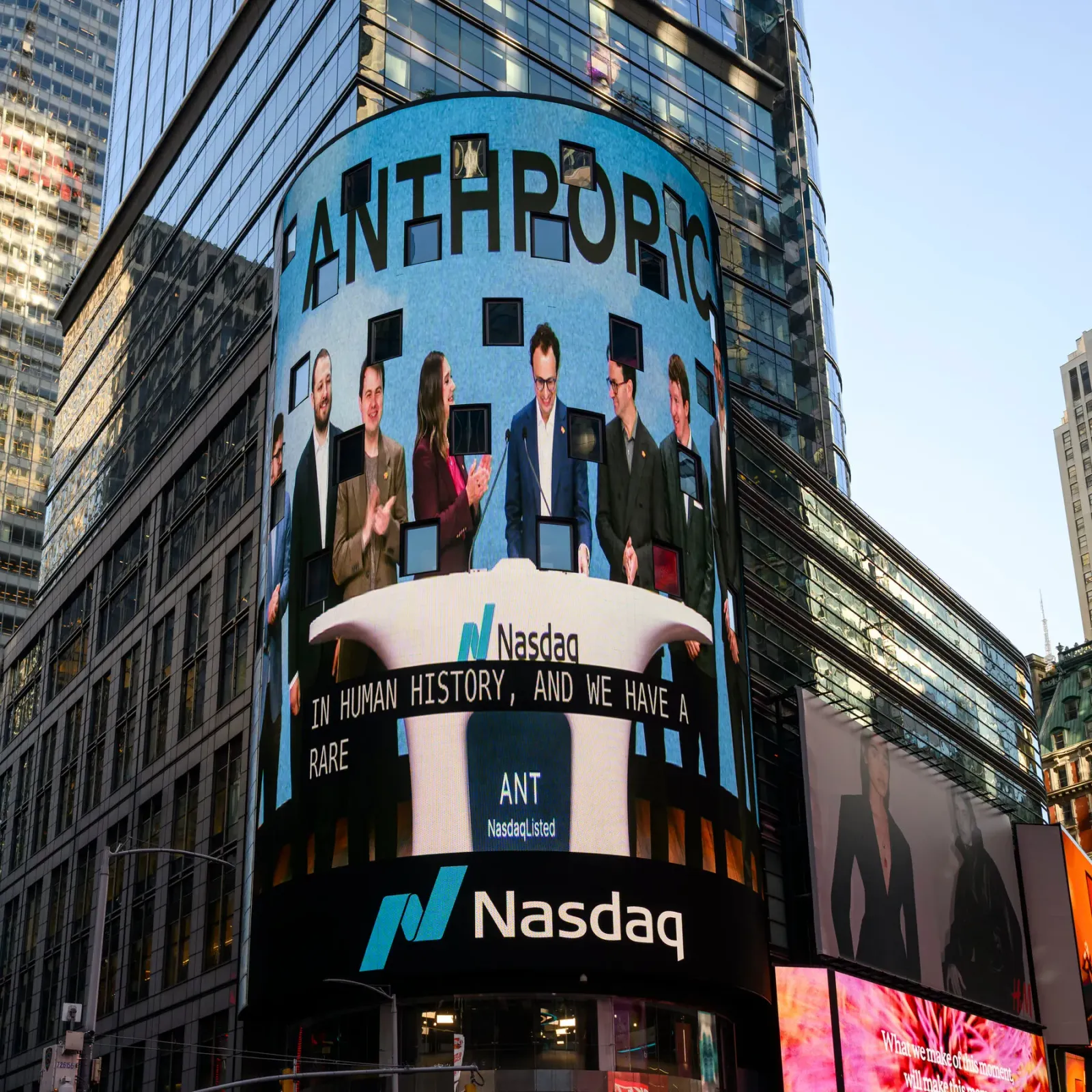
Anthropic, the San Francisco AI lab behind Claude, debuted on Wall Street as a $2 trillion company, making it the first major AI lab to go public. Its listing hands every private AI rival a public valuation benchmark, plus a disclosure standard that boards across the sector will soon be pressured to match.
Anthropic is public. The San Francisco AI lab debuted on Wall Street as a $2 trillion company, according to The New York Times, becoming the first major AI lab to go public in a moment the tech industry has been anticipating for years. There is no low-key version of this. A company best known for Claude, its family of AI models, now carries a public ticker, a public share price, and a public clock that resets every quarter. The debut answers a question Silicon Valley has argued about privately for a long time, and it answers with a number.
Two trillion dollars is the figure to sit with. Historically, only a handful of companies have ever traded at or above that mark, and they are almost all decades-old businesses with enormous, predictable cash flows. Anthropic is neither decades old nor predictable in that sense. It is a young research lab that turned itself into a product company inside a category that barely existed commercially a few years ago. That gap is the whole story. The market has now published its opinion of what a frontier AI lab is worth, and that opinion immediately becomes the benchmark every private rival gets measured against at its next raise, its next hire, and its next board meeting.
Being first is a privilege with a bill attached. Competitors, including OpenAI, remain private, which means they can choose what to disclose and when. Anthropic just gave that up. As a public company it will typically report revenue, losses, spending on computing power, and the concentration of its customer base on a fixed schedule, in documents anyone can read, including rivals, regulators, and plaintiffs' lawyers. Every strategic wobble that would once have stayed inside a boardroom becomes a headline by the following morning.
The background matters here. Anthropic was founded by former OpenAI researchers and has drawn backing from deep-pocketed partners including Amazon and Google, a structure that let it spend heavily on compute while keeping its financials private. That is how frontier AI has historically been financed: private capital funding enormous upfront costs in exchange for patience. Public markets are a different animal. They price the next four quarters as heavily as the next decade, and they tend to punish companies that cannot explain, in plain language, when the spending turns into profit.
So expect the first earnings call to be a referendum on a handful of questions. How fast is revenue growing, and from how few customers? What does gross margin look like after the cost of chips, data centers, and power? How large are the multiyear compute commitments, and who sits on the other side of them? Anthropic has built much of its public identity around AI safety, and investors will now test whether that positioning is a durable commercial advantage or a cost line. Those are not philosophical questions on a public market. They are line items.
Regulators are watching too. AI labs already face growing scrutiny from policymakers in Washington and Brussels over competition, data, and model risk, and a listed company hands them a continuous stream of disclosure to work with. Historically, going public has pulled young technology companies deeper into the political system, not further out of it. For Anthropic, that means its safety commitments, its cloud partnerships, and its pricing decisions all become matters of public record and, eventually, public argument.
The second-order effects land on everyone else. A $2 trillion public comparable resets how investors value OpenAI, xAI, Mistral, and every other well-funded lab still sitting on a private cap table. It gives Anthropic a currency for acquisitions and a liquid stock for recruiting, which raises the price of senior talent across the sector. And it cracks open an IPO window other AI companies have been waiting on, because the hardest question for any listing, what will the market actually pay, now has an answer.
What to watch next is concrete. The first quarterly report will show how much of the story is revenue and how much is narrative. The expiration of insider selling restrictions, typically months after a listing, will show whether early backers and employees treat the stock as a position or a paycheck. And the share price itself will show whether $2 trillion was a floor, a ceiling, or a moment. For now, the first AI lab is public, and the entire industry has a number to argue with.
This story's Key Insights and Take-aways are locked.
Create a free account to unlock Executive Actions for one credit.
Register to UnlockAlways free for Executives Club members. Join the Club
More in Technology

Anthropic mathematician claims Claude helped crack the Riemann hypothesis
If the proof holds, AI has toppled math's most famous open problem; if it does not, it is a case study in announcing breakthroughs before anyone verifies them.

AI's $4 Trillion Wipeout Erases Nasdaq's Gains for the Year
A brutal week took roughly $4 trillion off the AI sector and left the Nasdaq flat for the year, and the damage ran the full length of the supply chain.

Anthropic mathematician says AI proved the Riemann hypothesis. Verification will take time.
A single unverified claim from inside Anthropic now sits against more than 160 years of open mathematics, and the gap between asserting a proof and surviving peer review is the entire story.