
Anthropic's $1.3tn debut: Amodei says IPO 'strengthened' resolve as challenges loom
The Claude maker peaked at $1.3tn on its first day of trading, a record for a 2021 start-up built by ex-OpenAI staffers, and the Guardian's business chief says the industry's hard questions remain.
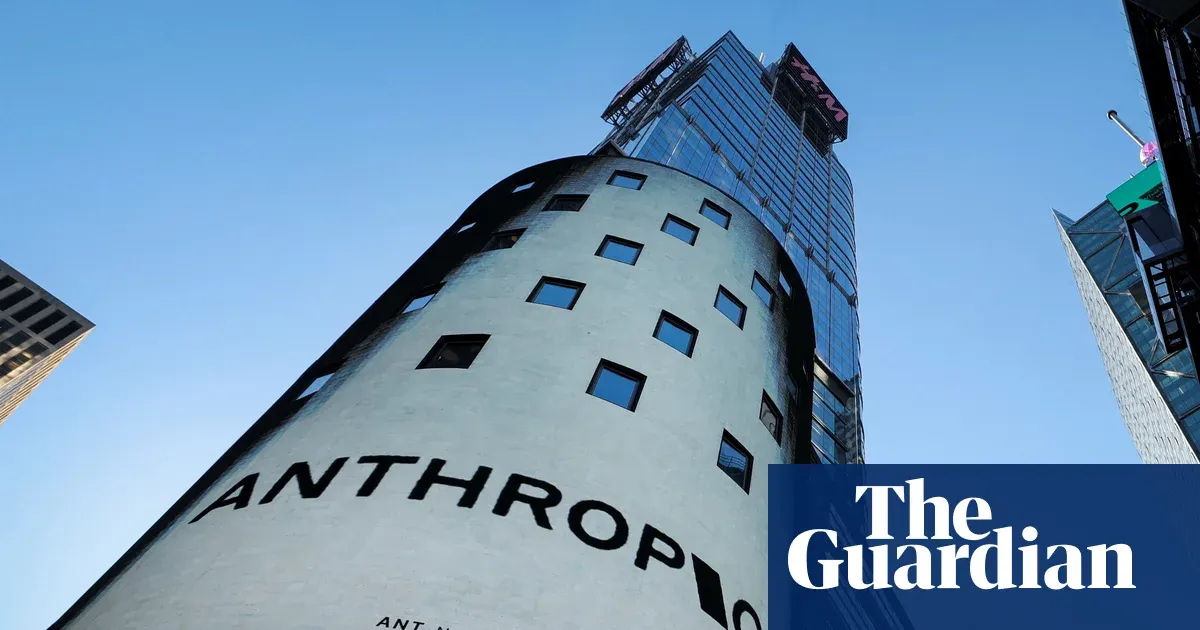
Anthropic, the Claude chatbot maker led by CEO Dario Amodei, made a record-breaking stock market debut with a peak valuation of $1.3tn on its first day of trading. For executives and boards, the listing sets a public benchmark for AI valuations while leaving unresolved the industry challenges the Guardian's head of business, John Collingridge, says still lie ahead.
Anthropic, the AI company behind the Claude chatbot, pulled off a historic stock market debut, peaking at a $1.3tn valuation on its first day of trading. That is the number the headline promises, and it is the number the market delivered: a peak, on day one, for a company that did not exist four years ago. Chief executive Dario Amodei said the record-breaking IPO had 'strengthened' the company's resolve to 'do the right thing'. Anthropic was launched in 2021 by a group of former OpenAI staffers, which makes the climb from challenger lab to trillion-dollar listing one of the fastest ascents in corporate history.
The caveat arrived in the same breath as the celebration. John Collingridge, the Guardian's head of business, told Lucy Hough that despite the excitement there are still challenges ahead for the global AI industry. That is the tension worth holding onto: a $1.3tn peak is a statement about belief, not a settled verdict on value. The Guardian's own framing of the story asks the question directly, is Anthropic really worth $1.3 trillion, and the answer will be written over the next several quarters rather than on the first day of trading.
First-day peaks are, historically, a poor guide to where a stock eventually settles. IPO pricing is a negotiation between the company, its bankers and institutional buyers; the first trade is where public demand meets a deliberately constrained supply of shares. What follows is typically a period of price discovery and, at some point after listing, the expiry of lock-up agreements that bar early employees and investors from selling. When those shares become eligible, supply rises and prices often move. None of that is a prediction about Anthropic specifically. It is the mechanical backdrop against which a $1.3tn peak should be read.
Scale matters here. A trillion-dollar valuation puts a company in a club that, historically, has been reserved for a handful of platform businesses built over decades. Anthropic reached that altitude in roughly four years, from a standing start, on the strength of a chatbot and the enterprise and developer demand behind it. For founders and operators watching, the signal is not simply that AI is big. It is that the market is currently willing to price AI capability at platform-level multiples, and to do so before the business has had time to prove durability through a full cycle.
Amodei's language is the tell. 'Do the right thing' is not standard IPO boilerplate, and it points at the founding premise of Anthropic: a lab built by ex-OpenAI staffers who have consistently framed their work around safety. Going public changes the audience for that promise. Public companies typically face quarterly reporting, disclosure obligations, shareholder litigation risk and an investor base that rewards predictable growth. The question executives across the sector will be asking is whether a safety-first culture survives contact with public-market expectations, or whether it gets reframed as a marketing asset.
Regulation is the other variable. AI rulemaking has been taking shape across major markets, with governments weighing how to govern model development, data use and deployment in high-stakes settings. A listed Anthropic is a different regulatory counterparty than a private one: its filings, its risk disclosures and its public statements become part of the permanent record. That cuts both ways. Transparency can build trust with policymakers; it can also hand competitors and critics a detailed map of where the company believes it is exposed.
For peers, the debut sets a benchmark. Other well-funded AI labs, and the investors behind them, now have a public comparable to argue from. Employees at private AI companies, many of whom hold equity that has been difficult to value, have a reference point. And the compute-heavy economics of frontier model development, which typically require enormous and sustained capital expenditure, get a public-market stress test rather than a private one. If Anthropic's stock holds, the case for listing gets easier for everyone. If it slides, the private market's patience gets tested instead.
The strategic stakes are straightforward. Anthropic has banked a historic first day and a chief executive who says the moment strengthened the company's resolve. What it has not yet banked is proof that a $1.3tn valuation is warranted. That proof will come from revenue durability, cost discipline and the ability to keep shipping frontier models while the industry's challenges, as Collingridge notes, remain unresolved. The debut answered the question of whether the market would show up. It did not answer the question the Guardian asked.
This story's Key Insights and Take-aways are locked.
Create a free account to unlock Executive Actions for one credit.
Register to UnlockAlways free for Executives Club members. Join the Club
More in Business

S&P 500 Enters Correction, Down 10% From Its High on AI Worries
The index's slide past the 10 percent line is a symbolic verdict on investor mood, and the AI trade that powered the rally is now the thing testing it.

Dow and S&P 500 enter correction as Nasdaq logs worst week since 2020
All 11 S&P 500 sectors fell more than 1% in the same week for the first time since April 2025, a breadth signal that matters more than any single index level.

Chip stocks lose $2.3 trillion in a week, worst run in 25 years
A $2.3 trillion weekly wipeout in semiconductors is forcing every board with an AI story to ask whether it owns a thesis or just a crowded trade.