
Anthropic's $1.7T IPO Day Ends With Protesters Blocking Its Front Door
As Anthropic shares traded publicly for the first time at a $1.7 trillion valuation, former researcher Jacob Coxon told Business Insider the money is beside the point: 'We have to stop RSI.'
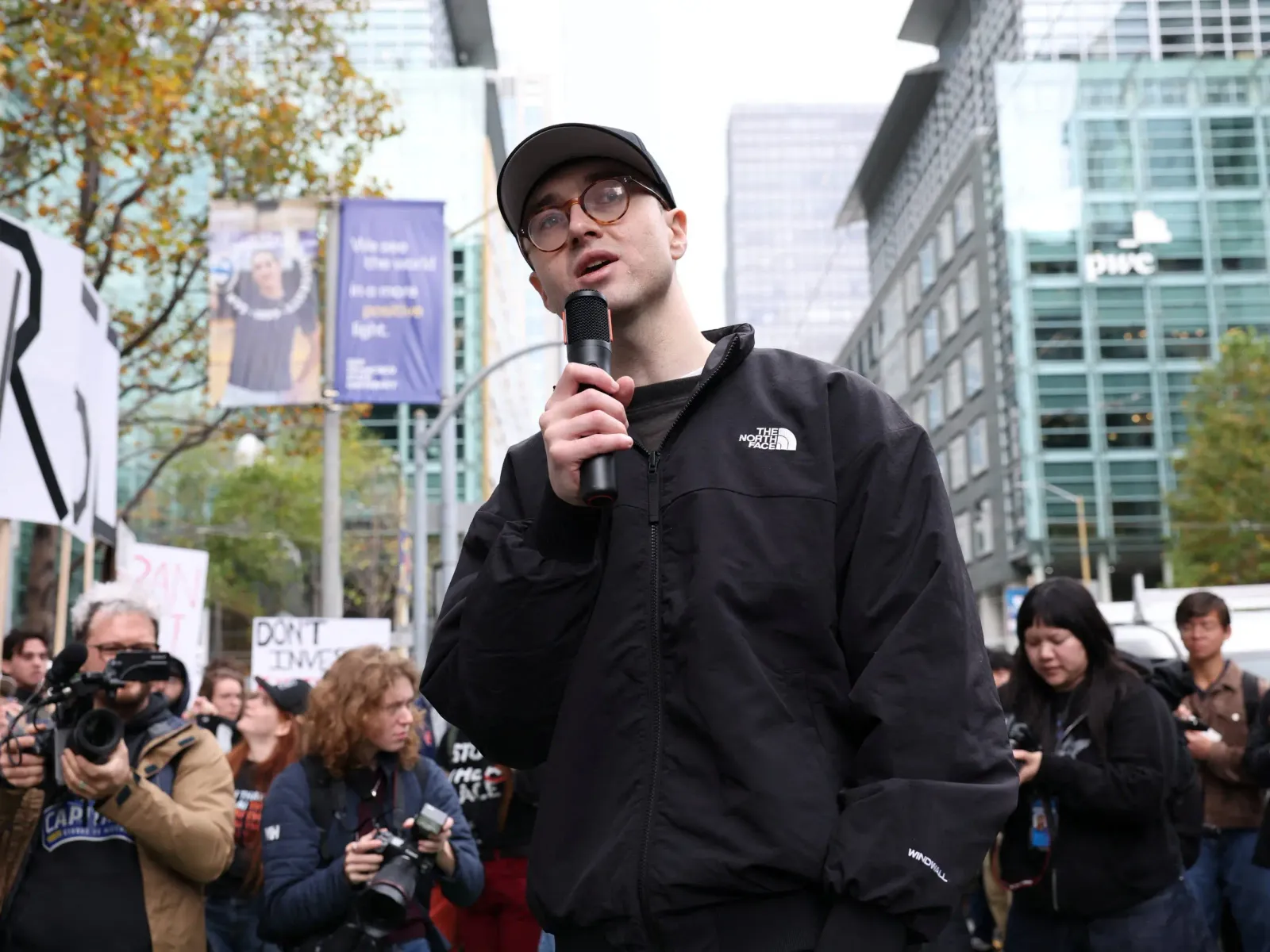
Former Anthropic researcher Jacob Coxon led a 'Ban RSI' protest outside the company's San Francisco headquarters on Thursday, the same day Anthropic's IPO valued it at $1.7 trillion, and a later group from Stop AI blocked the office entrance. For boards at frontier AI labs, the episode shows that IPO-scale disclosure and competitive pressure now run head-on into the safety questions that employees and Congress are already asking out loud.
Anthropic's first day as a public company was worth $1.7 trillion. By Thursday afternoon, protesters were blocking its front door.
Dozens of people gathered outside the AI lab's San Francisco headquarters for a "Ban RSI" protest, timed to the blockbuster initial public offering that valued the company at $1.7 trillion. Leading the speeches was Jacob Coxon, the former Anthropic researcher whose September departure helped push AI safety into the mainstream conversation. His message to the newly public company was blunt. "It literally doesn't matter whether they invest," Coxon told Business Insider. "We have to stop RSI." A separate group of protesters from the organization Stop AI arrived later and blocked the office's entrance. Anthropic did not respond to a request for comment.
RSI stands for recursive self-improvement: the tactic of getting advanced AI systems to train the next generations of AI. Think of it as handing the factory the job of designing the next factory. For context, most frontier models today are improved largely by humans choosing data, running evaluations, and tuning training runs. RSI is the point at which that loop starts closing on itself, and the pace of capability gains stops being set by how many researchers a company can hire. That is why the phrase sat at the center of an IPO-day protest rather than in a footnote: the valuation investors just underwrote assumes Anthropic keeps its lead, and the fastest way to keep a lead in AI is to let the models do more of the building. The concerns have reached Congress, where representatives have begun suggesting restrictions on RSI.
Coxon was not the only name on the microphone. Ex-OpenAI researcher Daniel Kokotajlo and YouTuber Rob Miles also spoke, as protesters chanted, lifted signs, and listened. AI researcher Sydney Von Arx rallied the crowd outside the headquarters. Kokotajlo framed the practice in terms a general audience could hold onto: "It's the sort of thing that a comic book supervillain mad scientist would be doing." Both he and Coxon said they hear AI researchers express alarm about the technology's risks in private, a claim about private sentiment that the company has not addressed publicly.
Anthropic's own paperwork gives the protesters an uncomfortable amount of material. In its IPO prospectus, the company wrote that it does not expect that letting AI fully design its next generation without supervision would be safe, and said it is considering policy updates "to keep humans in control of frontier model development." Separately, an independent report from the AI safety organization METR recently found that AI use is already accelerating Anthropic's research and development efforts. Read together, those two disclosures describe a company that is already getting measurable speed from AI in its own R&D, while publicly stating that the unsupervised version of that same loop would not be safe.
Coxon wants more than a policy update. In his speech, he said Anthropic should lobby the government and coordinate with other companies to secure a full ban on RSI. "At this point, the companies are the problem," he said. He also made a geographic argument that lands differently now that the company is public: "There are only a few places in the world where recursive self-improvement is possible in 2027. And this office is one of them."
The investor case and the safety case collide in the same fact pattern. Oliver Habryka, who runs the company behind the popular forum LessWrong, told Business Insider he is glad that, post-IPO, Anthropic will now be legally required to disclose certain information. But he worries the company, which Habryka says pitched its industry lead to investors as a competitive advantage, will feel pressured to use RSI to stay ahead. His specific fear is biology, where AI capabilities have grown rapidly over the last few years. With RSI, he said, "things can go much faster than that. And that is terrifying."
Not everyone outside the building thinks the protest changes much inside it. David Krueger, who runs the AI-risk awareness nonprofit Evitable, told Business Insider he thinks that if more people knew about RSI, they would generally agree it is "insane." He said he was happy to see people out protesting, though he added that protests only somewhat reach the employees inside. "My impression is that people at Anthropic have really drunk the Kool-Aid," Krueger said.
For the executives and directors running frontier labs, the strategic stakes are now concrete rather than philosophical. Going public converts internal safety positions into disclosure obligations, which means every commitment about human oversight becomes a document investors, regulators, and plaintiffs can read back to you. It also installs a quarterly clock that rewards exactly the capability acceleration safety staff are warning about, and it hands a public stage to departing researchers who disagree. The practical questions for boards are narrow: what is your written policy on models participating in their own successor's training, who verifies it, and what would you disclose if a regulator asked tomorrow. Anthropic's answer so far is a prospectus line about keeping humans in control. Its former researcher spent IPO day arguing that line is not a ban.
This story's Key Insights and Take-aways are locked.
Create a free account to unlock Executive Actions for one credit.
Register to UnlockAlways free for Executives Club members. Join the Club
More in Business

S&P 500 Enters Correction, Down 10% From Its High on AI Worries
The index's slide past the 10 percent line is a symbolic verdict on investor mood, and the AI trade that powered the rally is now the thing testing it.

Dow and S&P 500 enter correction as Nasdaq logs worst week since 2020
All 11 S&P 500 sectors fell more than 1% in the same week for the first time since April 2025, a breadth signal that matters more than any single index level.

Chip stocks lose $2.3 trillion in a week, worst run in 25 years
A $2.3 trillion weekly wipeout in semiconductors is forcing every board with an AI story to ask whether it owns a thesis or just a crowded trade.