
Anthropic's stock rose on day one. The S&P 500 and Nasdaq fell anyway.
A blockbuster debut and a red day for the indexes can both be true; here is the plumbing that explains the split and what it signals for the next wave of AI listings.
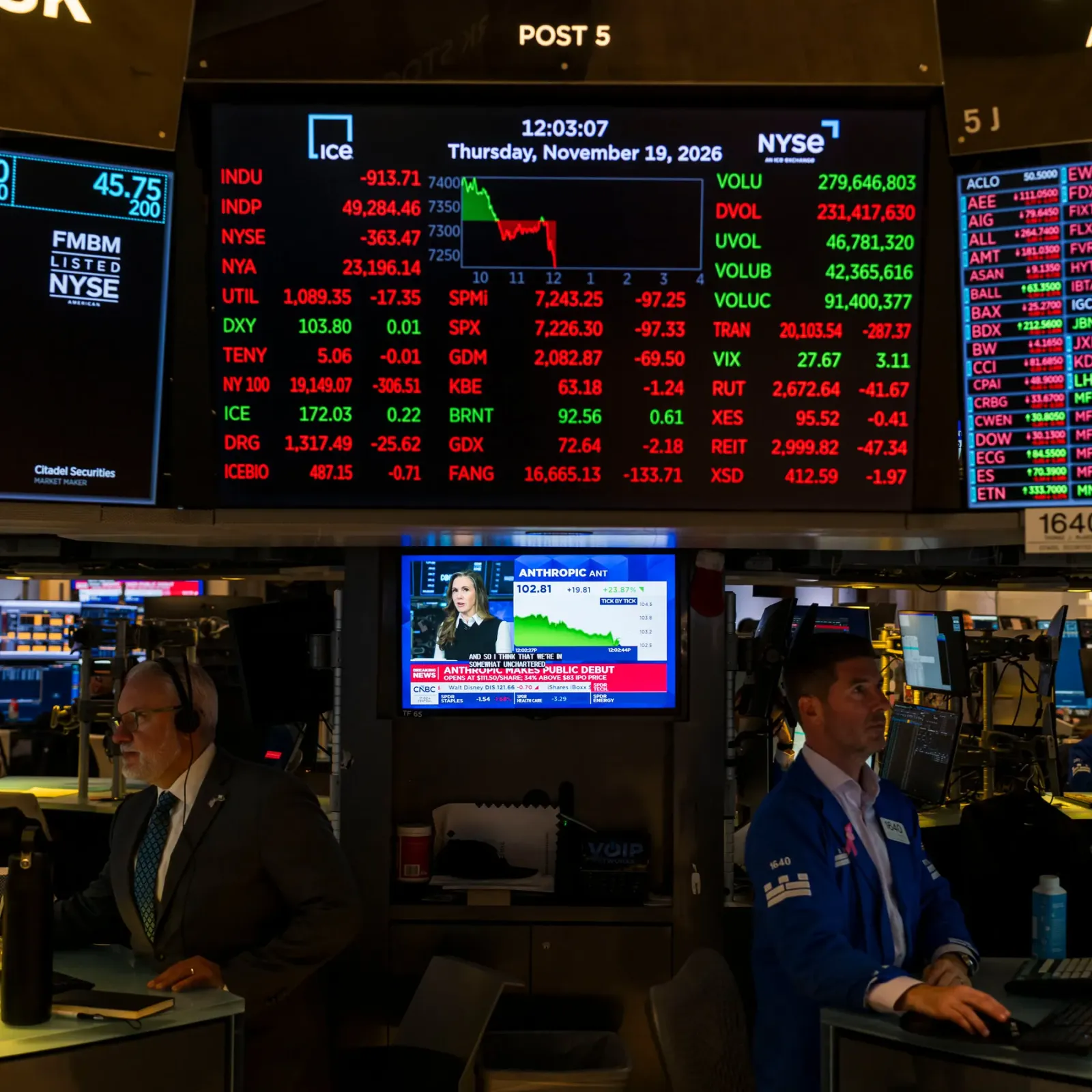
Anthropic's shares rose on their first day of trading while both the S&P 500 and the Nasdaq fell, a divergence the Times attributes to a few factors at play. For decision-makers, the split is a reminder that a hot listing is a supply event that pulls capital out of existing positions, not a rising tide that lifts the index.
Anthropic's shares rose on their first day of trading. The S&P 500 fell. The Nasdaq fell too. Same session, opposite directions, and that split is exactly the kind of thing that makes people assume the market is broken or the headline is wrong. It is neither. As the Times put it when it reported the session, there are a few factors at play. The interesting part is what those factors are, because they tell you more about how money actually moves than any single day's green or red candle.
Start with the simplest one: a big new listing is a supply event, and supply has to be paid for. Every dollar that went into Anthropic's debut came out of somewhere else. Some of it came from cash sitting on the sidelines. A lot of it came from selling existing positions, and the easiest things to sell are the biggest, most liquid names in the market. That is the plumbing behind the paradox. When the funding source is a broad basket of large-cap technology, the index prints red on the same day the marquee name prints green. Nothing has to be wrong for that to happen. It is a transfer, not a verdict.
The second factor is index mechanics, and this is where most casual readers get tripped up. Passive funds do not buy IPOs. They cannot. An S&P 500 index fund typically holds what the index holds, and the index committee historically has wanted to see a track record, including profitability, before it admits a newly public company. The Nasdaq-100 has its own rules and has historically moved faster for the largest listings, but even then, inclusion is a process, not a day-one event. So the buyers on debut day were not index money. They were active managers, hedge funds, crossover investors and retail. Index money shows up later, at a rebalance, and that is the moment the composition of the index actually changes.
Third, the AI trade. Anthropic is an AI company, and the market has spent years trying to price that theme. A new pure-play listing hands investors a cleaner instrument for the same idea, which can pull capital out of older, more diluted ways of owning it. Call it rotation, not rejection. The money did not leave the market. It changed address. And when the address changes, the old neighborhood looks worse than it actually is.
Fourth, float and lockups. Only a slice of a company's shares typically trades on day one. The rest sits with founders, employees and early backers, and those holders are usually locked up for a set period, commonly around 90 to 180 days. That means the day-one price is being set by a small supply meeting a large demand, which is one reason debut pops are so common and so unreliable as a signal of long-term value. The real test arrives when the lockup expires and the float expands.
Fifth, and this is the one boards should be watching: a successful debut is a green light for everyone else in the queue. A strong first day reopens a window that had been shut or only half-open. Expect private companies that have been sitting on the sidelines, especially in AI and adjacent infrastructure, to read Anthropic's tape as permission. That is how IPO windows work. One deal prices well, and suddenly a dozen boards are scheduling bake-offs.
Now the stakes. If you run a private company, the window is more open than it was last week, but the tape underneath it is choppy, and pricing a deal into a falling index is a different exercise than pricing one into a rising one. If you run a public company, understand that your stock can move on someone else's IPO, because you are now a funding source for the next hot listing. And if you are an investor, resist the urge to read a first-day pop as a thesis. It is a liquidity event, not a forecast.
The cleanest way to hold all of this: the divergence between Anthropic's debut and the two major indexes is not a contradiction. It is a map of where the marginal dollar went that day. New supply pulled capital out of old positions, passive money stayed on the sidelines, and the AI trade got a new, sharper instrument. Watch the next few weeks, not the first few hours. If the indexes recover while the new listing holds, the market simply repriced. If the new listing holds while the indexes keep sliding, the market is telling you something narrower and more uncomfortable: the money is concentrating, and concentration cuts both ways.
This story's Key Insights and Take-aways are locked.
Create a free account to unlock Executive Actions for one credit.
Register to UnlockAlways free for Executives Club members. Join the Club
More in Business

S&P 500 Enters Correction, Down 10% From Its High on AI Worries
The index's slide past the 10 percent line is a symbolic verdict on investor mood, and the AI trade that powered the rally is now the thing testing it.

Dow and S&P 500 enter correction as Nasdaq logs worst week since 2020
All 11 S&P 500 sectors fell more than 1% in the same week for the first time since April 2025, a breadth signal that matters more than any single index level.

Chip stocks lose $2.3 trillion in a week, worst run in 25 years
A $2.3 trillion weekly wipeout in semiconductors is forcing every board with an AI story to ask whether it owns a thesis or just a crowded trade.