
Artemis II proves NASA’s Deep Space Network “worked well” after near overload on Artemis I
A DSN stress test in late 2022 hit science downlinks, but Artemis II launched April 1 with fewer data demands.
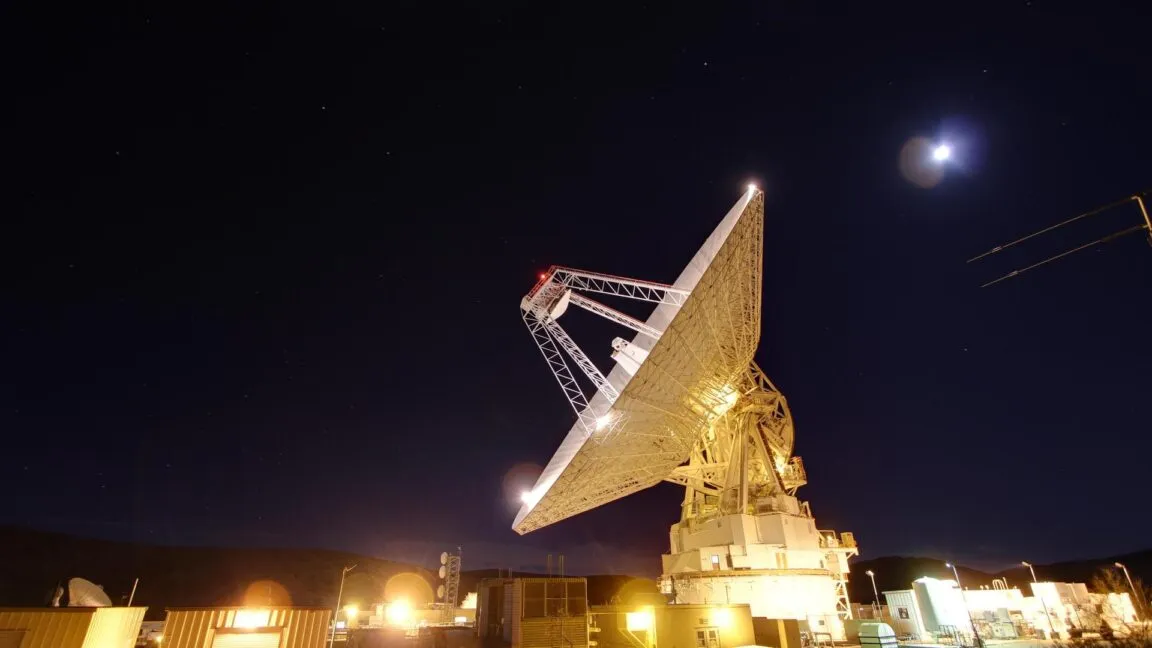
NASA says its Deep Space Network, or DSN, worked well during Artemis II after coming close to breaking in the late-2022 period surrounding Artemis I. The consequence for decision-makers: scheduling and network contention can directly reshape which missions get their science data when.
NASA leaned on its Deep Space Network again for Artemis II, and this time the agency says it “worked well” during the mission. Artemis II launched April 1 and flew for a little more than nine days, connecting Mission Control to the Orion capsule as it soared more than a quarter of a million miles from Earth.
That sentence sounds calm, but it is really the resolution to an earlier communications crisis. During Artemis I, nearly four years ago, the global array of deep space communications antennas could not keep up with routine demands from 40 robotic science missions plus the extraordinary surge required for NASA’s Orion space capsule as it flew around the Moon. The result was concrete operational damage: reduced or delayed downlinks from several high-profile science missions, including the James Webb Space Telescope and Mars rovers, because the data-hungry Artemis I mission took priority on NASA’s communications network.
To understand why executives should care, treat the DSN like a single, shared “industrial-grade cloud” with limited capacity that multiple customers fight over. DSN antennas are a finite resource, and deep space telemetry is not the kind of workload you can elastically scale on demand. When one mission ramps up traffic, other missions either wait, reduce downlink schedules, or accept delayed data. That is exactly what happened after the Artemis I experience in late 2022. Even if the DSN is designed to operate across diverse missions, the peak load created by Orion plus the ongoing routine demand from many robotic science targets pushed the system toward its limits.
Artemis I also introduced another kind of contention: small but numerous objects. It launched 10 CubeSats into deep space, many of which required tracking and telecom services from the DSN. Artemis II carried fewer CubeSats, which matters because every additional tracked asset adds telemetry and scheduling pressure. In other words, Artemis II did not just arrive “after” a near-break. It arrived with a different mix of payload and, crucially, a shorter mission duration that relieved the communications overload.
After nearly four years, the operational test of DSN resilience returned on Artemis II. With a crew of four flying inside the spacecraft, NASA’s appetite for data from Orion on Artemis II was even higher than it was on Artemis I. That is a key nuance: you might assume a later mission would be lighter, but the source makes clear the human crew increased DSN demand for data. So the “worked well” outcome is not explained by Artemis II being boring. Instead, the mission’s duration and traffic mix pulled the system back from overload. Artemis II was shorter than the 25 days Artemis I spent in space, and the shorter window helped alleviate the communications strain.
There is also a broader governance and capital allocation angle hidden inside these link schedules. NASA’s DSN decisions effectively determine which programs get immediate science value and which accept delayed return. When downlinks are reduced or delayed, downstream teams that rely on timely data for operations, science analysis, and follow-on planning can lose momentum. That can cascade into budget justification, re-planning, and stakeholder confidence. In late 2022, missions such as the James Webb Space Telescope and Mars rovers were specifically cited as seeing reduced or delayed downlinks while Artemis I took priority, which is a real example of how shared infrastructure can redistribute “who wins” at the mission level.
For leaders at any organization running a portfolio across shared constraints, the lesson is straightforward: paperwork demand and operational reality diverge under peak events. The source summarizes that dynamic as, “Some missions are using more than what their paperwork would say.” Artemis II’s “worked well” outcome is the payoff that proves the system can recover, but the Artemis I period is the warning that the recovery has a cost in other missions when prioritization shifts. Executives should treat deep space communications like a governance problem as much as an engineering one: you need clear prioritization logic, realistic load modeling, and contingency planning for when one flagship program’s surge collides with many other programs’ ongoing needs.
This story's Key Insights and Take-aways are locked.
Create a free account to unlock Executive Actions for one credit.
Register to UnlockAlways free for Executives Club members. Join the Club
More in Technology

OpenAI says 10,000 agents cracked a 90-year math problem in 88 hours
The company's claim is audacious, but one mathematician is pushing back. Here's what it means for AI-driven discovery.
Meta still serves child sexual abuse ads on Instagram in India - BBC report
A new report following the BBC Eye investigation says the ads are still there - what it signals for every platform with a self-serve ad engine.

White House yanks 'Build the Wall' game after Tetris Company copyright warning
The administration's arcade game vanished in hours - and the takedown playbook every brand can learn from.