

Bessent Blames WSJ Photo for Military Base Move, Vows to Keep Squeezing Iran
The Treasury Secretary says an aerial image that let his Georgetown home be geolocated put him under military protection, and he is not backing down on the IRGC.
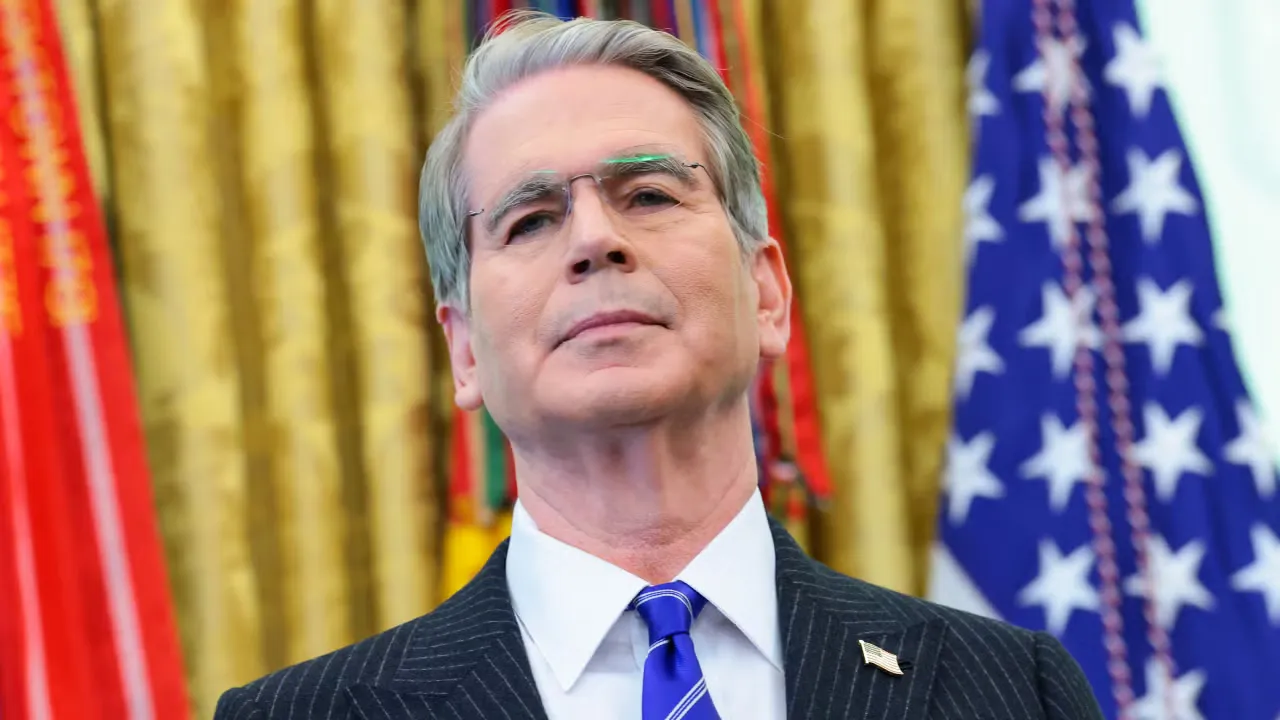
Treasury Secretary Scott Bessent confirmed on CNBC that he remains under U.S. military protection on a base, blaming a Wall Street Journal photo of his Georgetown home that allowed it to be geolocated amid intensifying Iranian threats. The episode turns a routine editorial decision into a national security variable, and signals that senior U.S. officials are operating under wartime threat conditions while sanctions pressure on Iran continues.
Treasury Secretary Scott Bessent is not hiding it. In a wide-ranging CNBC interview on Friday, the top U.S. economic official confirmed he is still living under U.S. military protection and pinned the relocation on a single editorial decision: The Wall Street Journal's publication of a photo of his Georgetown home. "As I've said before, very unfortunate that an irresponsible editor at The Wall Street Journal published a photo of my house with a geo-locate in it the day I bought it," Bessent said. "But, you know, we'll move on. Life on the military base is good, and we're going to continue squeezing the IRGC until they are ready to stick to a deal."
The chain of events, as reported: On Nov. 10, The New York Times reported that Bessent had relocated to a military base, a move eventually confirmed by the Trump official himself. U.S. officials said the move was motivated by an aerial photograph published by The Wall Street Journal of Bessent's Georgetown residence that allowed the home to be geolocated. Iranian threats against Bessent's life reportedly intensified around that time. Bessent did not soften his posture on Friday. "I'm not going to be cowered by the Iranians," he said. "If the Iranians are after me, it means that they are being squeezed. We're going to continue squeezing them."
Strip away the Washington finger-pointing and the story is about something more operational: a photograph, a geolocation, and a cabinet secretary's home address treated as a targeting input. Historically, U.S. cabinet members live in private residences under standard protective details; moving a Treasury Secretary onto a military installation is the kind of step typically reserved for acute, specific threat environments. That is the real headline here. The person who signs off on sanctions policy, manages the government's borrowing, and speaks for the U.S. dollar in global markets is now sleeping behind a military perimeter.
Bessent is far from alone. According to reports, Secretary of Defense Pete Hegseth, Secretary of State Marco Rubio, White House Chief of Staff Stephen Miller and Attorney General Todd Blanche are all living on military bases right now as well. Read that list again: defense, diplomacy, the White House staff operation, and federal law enforcement, all relocated. For context, that is not a normal posture for an administration at peace. It is a signal that threat streams against senior U.S. officials are being treated as live and persistent, and that the protective apparatus is being stretched across a large slice of the national security cabinet at once.
The IRGC reference matters too. The Islamic Revolutionary Guard Corps is the branch of Iran's armed forces that sits at the center of U.S. sanctions architecture, and it is the entity Bessent is explicitly promising to keep squeezing. His framing is deliberate: the threats are not a reason to ease off, they are evidence the pressure is working. "If the Iranians are after me, it means that they are being squeezed," he said. Whether or not you buy that logic, it is now the stated doctrine of the Treasury Department, and it implies sanctions enforcement, designations, and secondary-pressure tools stay on the table rather than being traded away for de-escalation.
Elsewhere in the interview, Bessent argued that the recent trilateral summit between President Trump, Russian President Vladimir Putin and Chinese President Xi Jinping helped cement the three countries' shared stance on Iran. He did not, however, confirm whether either China or Russia has agreed to put additional pressure on the Iranian regime. "The consensus between the U.S., Russia and China in Shenzhen is that Iran can never have a nuclear weapon and that freedom of navigation in the Strait of Hormuz is paramount," Bessent claimed. "All three countries agree on that." That is a meaningful distinction, and worth sitting with. Agreement on a principle is cheap. Agreement to act, to enforce, to sanction, or to interdict is expensive, and Bessent pointedly left that question unanswered.
For anyone with exposure to energy, shipping, or emerging-market risk, the Strait of Hormuz line is the one to underline. The strait is historically one of the world's most consequential oil chokepoints, and any serious disruption there would ripple through freight rates, insurance premiums, and crude pricing within days. A U.S. Treasury Secretary publicly asserting that Washington, Moscow and Beijing share a position on keeping that waterway open is, in effect, a stability signal aimed at markets. The unresolved question is whether that signal is backed by capability and coordination, or by a communique.
The strategic stakes for peers in similar seats are straightforward. First, personal security is now a policy variable: an address, a photo, a metadata detail can force a relocation and reshape how a principal operates. Second, the administration is signaling that pressure on Iran continues regardless of the threat environment, which means sanctions compliance teams should expect business as usual, not relief. Third, watch whether the Shenzhen consensus converts into concrete commitments from China and Russia. Bessent did not confirm that it has. Until he does, the squeeze is real, the base is home, and the photo is the reason.
This story's Key Insights and Take-aways are locked.
Create a free account to unlock Executive Actions for one credit.
Register to UnlockAlways free for Executives Club members. Join the Club
More in Politics

Fifth Circuit Kills Pregnant Workers' Law Over Pandemic Proxy Votes
A procedural ruling, not a policy one, has blocked a federal pregnancy-accommodation law and put every pandemic-era statute in the crosshairs ahead of an expected Supreme Court appeal.

Measles kills a Virginia child under 5, the state's first death of 2026
Virginia's health department confirmed the death but withheld the child's vaccination status, leaving schools, clinics and employers to plan around the one detail that would explain the most.

Former Brazilian President Bolsonaro Hospitalized with Intestinal Obstruction
The health status of the former far-right leader raises immediate questions about political stability and the trajectory of Brazil's conservative movement.