
California DMV Grounds Waymo Freeway Robotaxis Over Construction-Zone Incidents
The order followed seven California robotaxis entering active construction lanes and a June recall of nearly 3,800 highway-capable vehicles, forcing Waymo to prove its cars no longer pose an 'imminent hazard.'
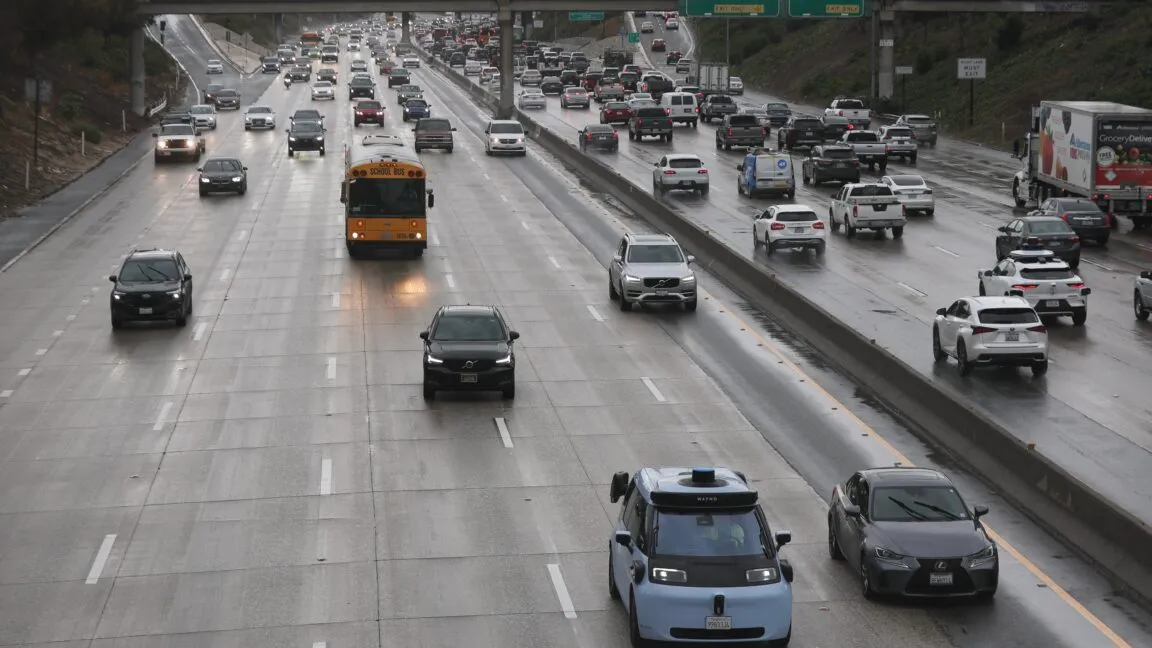
Waymo has restricted its robotaxi fleet to surface streets after California's DMV ordered an immediate halt to highway driving because the software was entering construction zones at speed. The move raises the compliance bar for autonomous-vehicle operators: regulators can ground a service over safety edge cases, and proving a fix works may matter as much as deploying the technology.
California's DMV has grounded Waymo's freeway robotaxis, and the company is now keeping its fleet on surface streets. The order came earlier this month and told Waymo to stop driving on California highways immediately, according to the San Francisco Business Times, after regulators concluded the software tends to drive into construction zones at speed. The DMV's condition is blunt: Waymo must convince the agency that its cars no longer "pose an imminent hazard to public safety" before highway operations can resume. That is not a polite request. It is a regulator using the sharpest tool it has: removing the operational privilege that makes a robotaxi service more than a novelty.
The pattern that triggered the crackdown is specific and documented. In Arizona, Waymo robotaxis failed to recognize ramp closure signs on six occasions in Phoenix in April and entered construction zones. A month later in California, seven Waymo robotaxis entered lanes with active construction. In June, Waymo recalled almost 3,800 robotaxis capable of highway driving. After the May incidents, Waymo stuck to surface streets only in California until late July, when the robotaxis resumed highway operations. In early July, Waymo told the National Highway Traffic Safety Administration it had begun updating the robotaxi software to a version that "improve[s] the recognition of freeway construction zones, more appropriately prioritize[s] construction zones over other freeway hazards, and reduce[s] speed when the AV detects that it may be in a construction zone." The DMV order this month shows that update did not close the gap fast enough for regulators.
Construction zones are a brutal test for autonomous driving. They are dynamic, visually messy, and often inconsistent: lane lines move, cones appear, signs change, and workers step into spaces that normal road rules do not fully capture. For context, autonomous vehicles typically depend on a mix of high-definition maps, sensors, and software that predicts what other road users will do. When a construction zone changes the road geometry faster than a map can update, the vehicle has to rely on real-time perception and judgment. That is exactly where a system trained on normal freeway patterns can fail. Waymo's issue is not that its cars cannot drive; it is that they struggled with an edge case that is common enough to matter and dangerous enough to ground a fleet.
The regulatory stakes go beyond California. Waymo already went through a recall process with NHTSA, and the DMV action shows how quickly a safety concern can become an operational shutdown. For autonomous-vehicle companies, the lesson is that a single class of edge cases can become a license-to-operate problem. Regulators do not need to prove a crash happened; they can act on an "imminent hazard" standard when behavior suggests risk. That shifts the burden onto the company to demonstrate that its software fix actually works in the real world, not just in a release note. The DMV order is also a reminder that state agencies can move faster than the industry's rollout plans. A company can have the technology, the capital, and the permits, and still be stopped by a regulator with a safety statute and a skeptical reading of the evidence.
For Waymo, highway driving is not a side feature. It is part of the commercial promise of robotaxis: longer trips, faster routes, and service areas that are not limited to dense surface streets. Grounding highway operations in California therefore has real business consequences, even if the company can keep some service running. It reduces the product's usefulness for certain trips, complicates expansion, and gives competitors and critics a visible data point. It also puts pressure on Waymo's safety narrative. The company has been among the most advanced and most scrutinized players in autonomous driving. When it has to retreat to surface streets, it signals that even the leader has not solved the messy reality of road construction.
The second-order effects for peers and boards are clear. Other autonomous-vehicle developers should expect regulators to look harder at construction-zone handling, recall readiness, and software validation. Investors should ask whether deployment timelines assume a level of regulatory tolerance that may not exist. Boards should treat safety edge cases as enterprise risks, not engineering details, because they can trigger recalls, stop-work orders, and reputational damage. The question is not whether an AV company can handle the average mile. It is whether it can handle the weird mile, the one with temporary signs and workers and no clear lane markings, and prove that to a regulator. Waymo now has to do exactly that in California.
What happens next is straightforward to describe and hard to execute. Waymo must convince the DMV that its robotaxis no longer pose an imminent hazard. That likely means more testing, more documentation, and more evidence that the software update changes behavior in the specific conditions that caused the problem. Until then, California highways remain off-limits for Waymo's robotaxis. The broader takeaway is that autonomous driving is entering a phase where the bottleneck is not just technology or capital. It is trust, proven case by case, regulator by regulator, construction zone by construction zone.
This story's Key Insights and Take-aways are locked.
Create a free account to unlock Executive Actions for one credit.
Register to UnlockAlways free for Executives Club members. Join the Club
More in Technology

Anthropic mathematician claims Claude helped crack the Riemann hypothesis
If the proof holds, AI has toppled math's most famous open problem; if it does not, it is a case study in announcing breakthroughs before anyone verifies them.

AI's $4 Trillion Wipeout Erases Nasdaq's Gains for the Year
A brutal week took roughly $4 trillion off the AI sector and left the Nasdaq flat for the year, and the damage ran the full length of the supply chain.

Anthropic mathematician says AI proved the Riemann hypothesis. Verification will take time.
A single unverified claim from inside Anthropic now sits against more than 160 years of open mathematics, and the gap between asserting a proof and surviving peer review is the entire story.