
China blocks Bloomberg reporter from Trump-Xi-Putin talks over one question
A single question cost Bloomberg its seat in the room for the trilateral opening remarks, and the White House pool report shows how fast access becomes leverage.
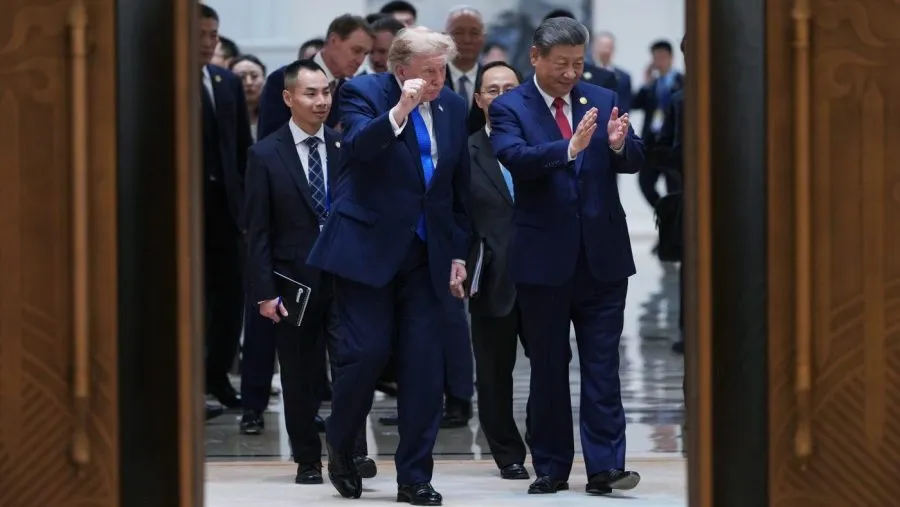
China blocked a Bloomberg reporter from covering the opening remarks of President Trump's trilateral meeting with Chinese President Xi Jinping and Russian President Vladimir Putin, with the White House press pool report tying the exclusion to a question she asked during Trump's bilateral meeting. The move converts routine press access into a diplomatic lever, a warning to any executive whose information advantage depends on being in the room.
China blocked a Bloomberg reporter from being in the room for the opening remarks of President Trump's trilateral meeting with Chinese President Xi Jinping and Russian President Vladimir Putin. According to the White House press pool report, the reason was the question she asked during Trump's bilateral meeting earlier in the program. One question, one closed door, and no camera for a wire service that sells its speed to the entire financial world.
The detail that matters most is not the exclusion itself. It is the mechanism. In US presidential coverage, a small rotating group of reporters, the pool, travels with the president and shares its material with the full press corps. The pool exists precisely so that a single seat can serve hundreds of newsrooms. When a host government removes one pool member, it does not remove one outlet's coverage. It removes everyone's. That is what happened here: Bloomberg's seat was the press corps' eyes on the opening remarks, and the room went dark for all of them.
Host governments typically control credentials and staging at summits, and opening remarks are usually choreographed for imagery rather than information. Leaders sit, cameras roll for a few minutes, and reporters are escorted out. The stagecraft is the point. What is unusual is the stated cause. Press credentials are normally pulled for space, security, or a filing dispute. Here, per the pool report, the trigger was a question. That reframes the credential as a consequence rather than a logistics decision, and it hands any host government a clean, low-cost tool: punish the question, and the next reporter thinks twice.
There is history to lean on here. Chinese officials have historically kept tight control over access to senior leaders and have treated unscripted questioning as a breach of protocol rather than a routine part of the job. Summits involving Xi Jinping are typically managed down to the second, with questions routed, screened, or simply not entertained. For a White House press operation, the calculation runs the other way: a shouted question is not an insult, it is the job description. Two press cultures with opposite instincts about the same five seconds of tape is how a credential becomes a casualty.
Now widen the lens. Access is the currency of summit coverage, and currency can be spent. A government that can decide who stands in the room can also decide whose account of the meeting reaches markets first. Bloomberg is a financial information business at its core, and its reporters cover the tape as well as the politics. Opening remarks from a US, Chinese, or Russian leader are market-moving events in the literal sense: currencies, energy, defense names, and emerging-market debt all reprice on a sentence about trade, tariffs, or war. When a wire is excluded from the room, its subscribers do not get a slower version of the news. They get a version shaped by whoever was allowed to stay, which means an information gap that someone else can trade on.
The second-order effects are worth naming. First, pool discipline gets tested. If a question can cost a seat, reporters face pressure to stay silent in staged moments, and the pool's value as a shared resource erodes from the inside. Second, retaliation becomes a template. Once one host government demonstrates that a credential is revocable over a question, other hosts have a precedent that costs them nothing to invoke. Third, the asymmetry lands on corporate desks. Executives who rely on the financial wires for real-time readouts of leader remarks are, in practice, relying on the willingness of foreign governments to let those wires in.
What to watch next is concrete. Whether the White House press office or Bloomberg pushes back publicly, and how the next pool rotation for a similar multilateral event is handled, will show whether this stays a one-off or becomes policy. Watch, too, whether the opening remarks are released in transcript form after the fact. A transcript restores the information but not the timing, and in markets timing is most of the trade.
For anyone running a business with exposure to US-China or US-Russia relations, the takeaway is not that a reporter lost a seat. It is that the room where leaders say the first unscripted-sounding thing of a summit is now a contested space, and access to it is negotiable. Build your intelligence chain on the assumption that the most valuable five minutes of a summit may be visible only to the people the host chooses. Diversify sources, assume the tape moves before the transcript lands, and treat press access itself as a geopolitical variable rather than a housekeeping detail.
This story's Key Insights and Take-aways are locked.
Create a free account to unlock Executive Actions for one credit.
Register to UnlockAlways free for Executives Club members. Join the Club
More in Politics

Fifth Circuit Kills Pregnant Workers' Law Over Pandemic Proxy Votes
A procedural ruling, not a policy one, has blocked a federal pregnancy-accommodation law and put every pandemic-era statute in the crosshairs ahead of an expected Supreme Court appeal.

Measles kills a Virginia child under 5, the state's first death of 2026
Virginia's health department confirmed the death but withheld the child's vaccination status, leaving schools, clinics and employers to plan around the one detail that would explain the most.

Former Brazilian President Bolsonaro Hospitalized with Intestinal Obstruction
The health status of the former far-right leader raises immediate questions about political stability and the trajectory of Brazil's conservative movement.