
China Never Approved GTA 6. Analysts Still See 10 Million Copies.
Rockstar's blockbuster has no legal release in China, yet imported consoles and offshore stores are driving an estimated 3 to 5 million first-week copies, with a far bigger PC prize locked behind a licensing wall.
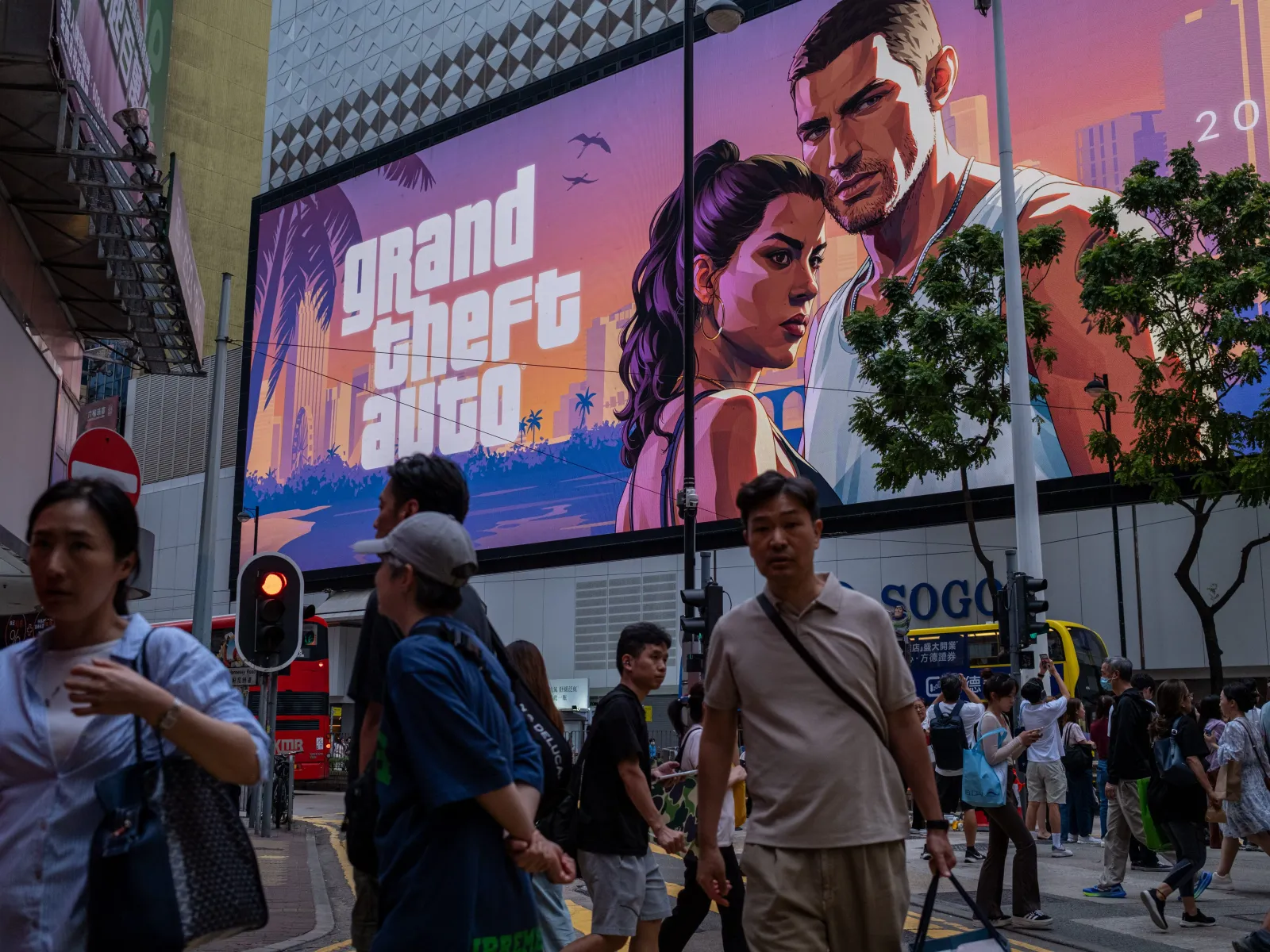
Rockstar Games and publisher Take-Two Interactive are watching Grand Theft Auto VI sell into mainland China through a gray market of imported consoles and Hong Kong and Taiwan digital stores, even though Beijing has never approved a Grand Theft Auto title. Consultants Zac Ling and Montgomery Singman estimate millions of copies will move anyway, which means unlicensed demand, platform moderation risk, and a potential PC windfall that no one has figured out how to legally capture.
At 2 a.m. Thursday in Shenzhen, Daniel Camilo turned on his PlayStation 5 with anticipation. Grand Theft Auto VI was finally here. Technically, it was not: Rockstar's twice-delayed blockbuster has no official release in mainland China, where Beijing tightly controls national game licensing and censors titles that promote violence, unlawfulness, nudity, or vulgarity. No Grand Theft Auto game has ever been approved. That did not stop Camilo, a 39-year-old gaming consultant from Portugal who has lived in Shenzhen, China's Silicon Valley, for 15 years. He had downloaded the game before its launch, he told Business Insider.
He is far from alone, and that is where the money is. Zac Ling, project manager at Shanghai-based consultancy Daxue Consulting, estimates mainland Chinese players will contribute roughly 3 to 5 million copies to GTA VI's first-week sales. Montgomery Singman, a 40-year gaming development and licensing veteran who spent two decades in China, pegs eventual sales to mainland Chinese gamers at no fewer than 10 million copies. Analysts broadly estimate the game will sell 5 to 10 million copies on consoles in China, a market where it is not legally sold.
There is no disc version of GTA VI, so bootleg physical copies are off the table. Official consoles sold in China are region-locked, meaning players can only download titles Beijing has approved. The workaround runs through the gray market: buy a PlayStation 5 or Xbox Series X/S from overseas. Retail and online stores in China are known to stock foreign consoles, which were previously illegal to sell but were unbanned in 2015. From there, a player buys a Chinese-language digital copy from a Taiwanese or Hong Kong Xbox Live or PlayStation Network store. That appears to be what happened en masse this week. Chinese gamers flooded local social media with photos of their TVs showing Rockstar's title pre-downloaded in their living rooms. On Weibo, the GTA 6 hashtag had 320 million views as of Friday morning local time.
The streaming wave is bigger still. On Douyin, China's version of TikTok, streams and videos related to the game had racked up 9.97 billion views as of Friday, per the platform's statistics. Business Insider created a new Douyin account on Thursday and found that 9 of the first 20 streams on its explore page featured gameplay from the game. China has about 1.125 billion internet users, and mobile livestreams are a primary way the country consumes games; Chinese government-affiliated research estimated 260 million livestream viewers in China in 2020. Singman sees a ceiling. "The problem is that the nature of some of the content is illegal, which is tricky," he said. "The game is not sanctioned, but the streamers can screen capture and give comments on their gameplay so they can get traffic."
That crackdown may already be in motion. Before release, a document appearing to highlight internal livestreaming rules from ByteDance began circulating online, listing acts of violence and carjacking as disapproved content for local streamers. The document was later deleted and its authenticity is unclear, but Singman said it aligns with how moderation in China works. "Sometimes Chinese netizens feel that Douyin goes above and beyond what the government was requiring. So it makes sense," he said. ByteDance, which owns and operates Douyin, did not immediately respond to a request for comment. Like every social media firm in the country, it answers to Beijing's censorship authorities.
The real China opportunity may still be ahead. Consoles are niche in a market where PC and mobile gaming dominate. Ling gauged there are about 15 million core console gamers in China, while some analyst firms estimate the country has between 280 million and 320 million PC gamers. Many of those players stick to free titles such as Valorant and League of Legends. Rockstar released PC versions of its last two major titles, Red Dead Redemption 2 and Grand Theft Auto V, roughly a year to a year-and-a-half after their console launches. It has not announced a PC launch date for GTA VI. Even if one comes, Chinese PC players would need workarounds of their own. Singman said a typical licensing process can take nine months to a year, during which Beijing can demand that certain features be altered. "But GTA is one of the most controversial games," he said. "And I don't think Rockstar will do a different, clean version for the Chinese market." China's National Press and Publication Administration did not immediately respond to a comment request.
Rockstar and Take-Two did not respond to comment requests sent outside regular business hours. The company is not running physical ads in mainland China, though it has done so in Hong Kong. For executives watching this play out, the lesson is about demand that exists without a distribution channel. Millions of players are effectively self-provisioning: importing hardware, routing payments through offshore storefronts, and consuming the game through livestreams that platforms may soon be forced to throttle. Rockstar captures revenue without a marketing dollar, a local partner, or any control over pricing, data, or customer relationships. The same dynamic applies to any consumer product that is culturally wanted but regulatorily unwelcome: the gray market becomes the launch channel, and the platform hosting the hype becomes the compliance risk.
This story's Key Insights and Take-aways are locked.
Create a free account to unlock Executive Actions for one credit.
Register to UnlockAlways free for Executives Club members. Join the Club
More in Business

S&P 500 Enters Correction, Down 10% From Its High on AI Worries
The index's slide past the 10 percent line is a symbolic verdict on investor mood, and the AI trade that powered the rally is now the thing testing it.

Dow and S&P 500 enter correction as Nasdaq logs worst week since 2020
All 11 S&P 500 sectors fell more than 1% in the same week for the first time since April 2025, a breadth signal that matters more than any single index level.

Chip stocks lose $2.3 trillion in a week, worst run in 25 years
A $2.3 trillion weekly wipeout in semiconductors is forcing every board with an AI story to ask whether it owns a thesis or just a crowded trade.