
China's EV Share Hits 70.6% as Petrol Sales Take the Hit
Seven of every 10 mainland car buyers are expected to go electric in November, and the CPCA's 70.6% reading puts petrol models, not EV appetite, at the center of China's sales slowdown.
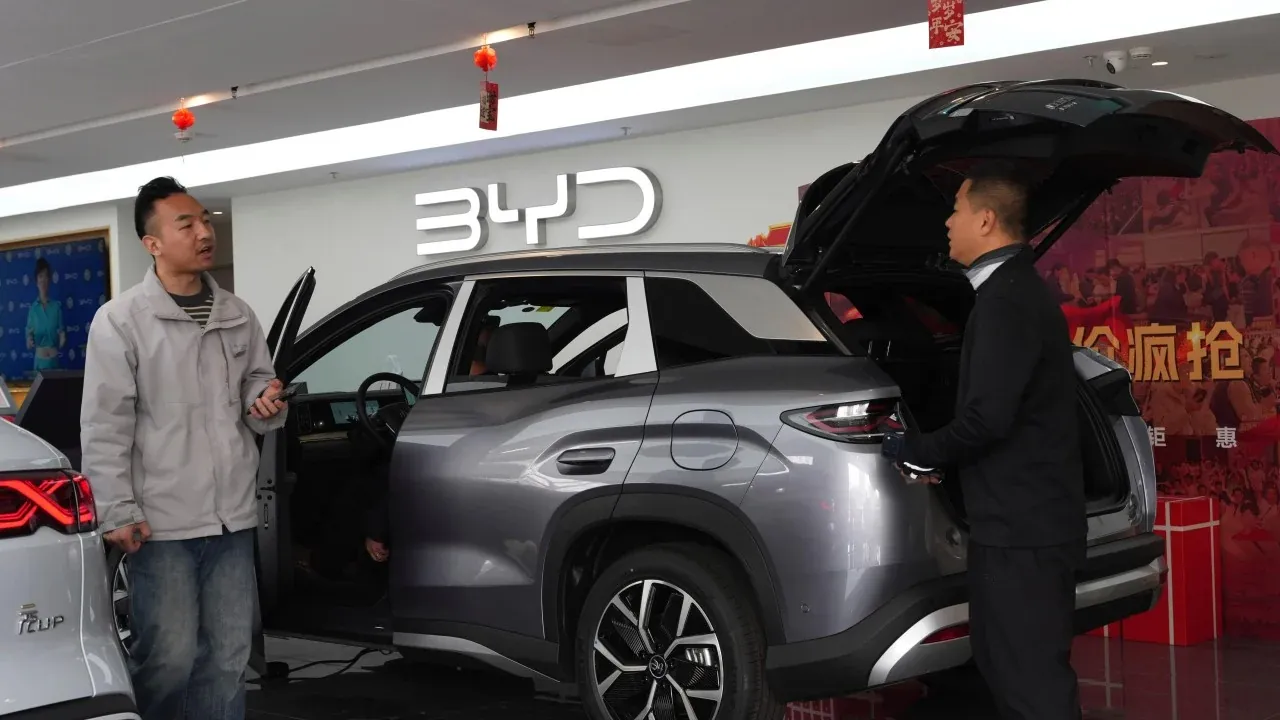
China's Passenger Car Association expects 1.15 million EV deliveries in November, or 70.6% of mainland car sales, as petrol models absorb the weakness in the world's largest auto market. For automakers, suppliers, and investors, the milestone turns China's EV mix into a scale and cost benchmark that will shape product plans, factory loading, and capital allocation well beyond the mainland.
Seven out of 10 car buyers in mainland China this month will opt for an electric vehicle, according to the China Passenger Car Association, and the scale is the story. Carmakers were expected to deliver 1.15 million EVs, a category that includes pure-electric models and plug-in hybrids, to mainland customers in November, equal to 70.6 per cent of total car sales, the CPCA said in a statement on Thursday. That is not a niche slice of a curiosity market. It is the mainstream purchase in the world's largest auto market, and it lands as petrol-guzzling options fall further out of favour.
The immediate read for executives is that the weak spot in China is petrol, not electric demand. The CPCA's 70.6 per cent figure implies that just under 30 per cent of sales sit outside the EV bucket, and the source of the pressure is conventional cars taking the brunt of the drop in overall sales. For boards that still model China as a gradual hybrid transition, the November expectation is a sharper signal: the consumer mix has already moved far enough that legacy petrol line-ups are the exposure, not the EV bet. That is a mix shift with direct budget consequences for product, plants and marketing.
The 1.15 million unit number also matters because it translates a percentage into industrial volume. One month of EV deliveries at that level gives battery makers, component suppliers, dealers and charging operators a demand base that petrol-only programmes cannot match. Because the CPCA counts both battery-electric and plug-in hybrid vehicles in the EV total, the milestone is broader than a pure-battery story. Plug-in hybrids can bridge charging gaps and price points for buyers who are not ready to go fully electric, while still pulling volume away from conventional petrol models.
That composition is why the number should be read as a demand signal, not just a policy scorecard. The CPCA is an industry consortium, and its statement is an expectation for November deliveries, not a final audited tally. Final registrations can shift the mix, and monthly figures can be noisy. The CPCA statement gives executives a timely checkpoint rather than a definitive full-year verdict. But the direction is hard to miss: when seven of every 10 buyers in the world's largest car market choose EVs, the cost curve, the product cadence and the dealer model all get set by EV competition rather than by petrol incumbents.
For global automakers, the strategic problem is one of mix and timing. A company with a petrol-heavy China line-up now faces a smaller addressable pool for its legacy products, while rivals with competitive EV and plug-in hybrid portfolios get the volume that supports lower unit costs. That pressure does not stay inside China. The mainland is the volume base that often determines supplier scale and technology costs for the rest of the industry, so a 70.6 per cent EV share informs factory loading, battery sourcing and model launch plans far beyond the country's borders.
Suppliers face the same reset from a different angle. Component makers that have lived on petrol powertrains must rebalance toward electric drive systems, power electronics and battery-adjacent parts, or risk watching their China revenue base shrink with the petrol mix. Investors, meanwhile, should watch whether the November number holds in final data and whether the pressure on petrol models turns into deeper discounting. A market at this adoption level can still have price wars, but the fighting ground is increasingly electric.
The bottom line is not that China is about to go electric. It is that this month's expected deliveries say the mainstream already has. For CEOs, CFOs and boards, the 70.6 per cent milestone turns a long-running debate into a capital allocation question: how fast to shift product development, factory capacity and dealer incentives toward EVs, and how much legacy petrol exposure to carry while the mix keeps moving. The risk now is less about missing a trend than about being late on cost, cadence and channel in the world's most important car market.
This story's Key Insights and Take-aways are locked.
Create a free account to unlock Executive Actions for one credit.
Register to UnlockAlways free for Executives Club members. Join the Club
More in Business

S&P 500 Enters Correction, Down 10% From Its High on AI Worries
The index's slide past the 10 percent line is a symbolic verdict on investor mood, and the AI trade that powered the rally is now the thing testing it.

Dow and S&P 500 enter correction as Nasdaq logs worst week since 2020
All 11 S&P 500 sectors fell more than 1% in the same week for the first time since April 2025, a breadth signal that matters more than any single index level.

Chip stocks lose $2.3 trillion in a week, worst run in 25 years
A $2.3 trillion weekly wipeout in semiconductors is forcing every board with an AI story to ask whether it owns a thesis or just a crowded trade.