
China’s EVs hit 66.7% of new car sales in June’s first week
CPCA data shows two of every three new mainland cars were electric or plug-in hybrid during seven days ending June 7.
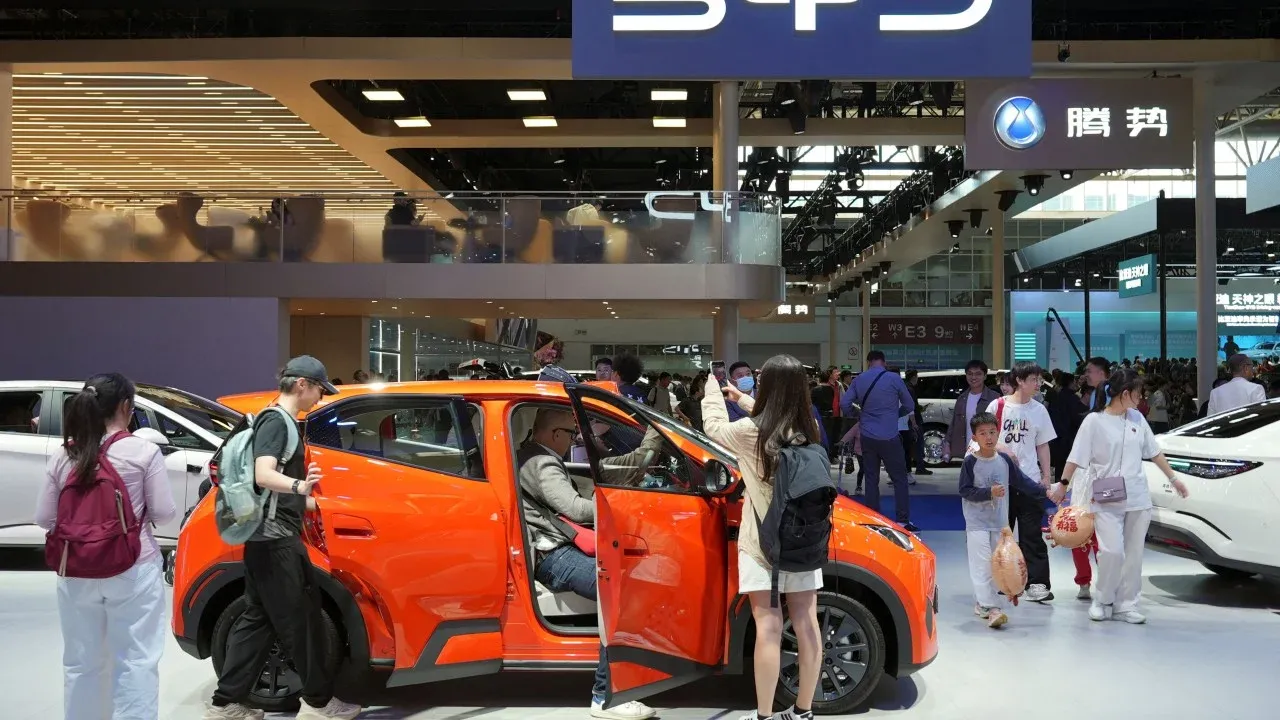
The China Passenger Car Association (CPCA) reports electric and plug-in hybrid vehicles reached 66.7% of new car sales in mainland China in the first week of June, up from 62.9% in May. The shift raises immediate planning pressure for automakers, suppliers, and investors as demand rebalances around battery-powered powertrains.
Electric vehicles captured a record 66.7% of new car sales in mainland China during the first week of June, and the most important part is what it means in real buying behavior: in the seven days ending June 7, two out of every three new cars sold on the mainland were either pure electric or plug-in hybrid vehicles, according to data from the China Passenger Car Association (CPCA).
That 66.7% figure is not just a headline number. It is a demand signal with momentum. CPCA data also shows the penetration rate climbed from 62.9% in May to 66.7% in June's first week, meaning the market did not merely settle into a new normal. It accelerated.
To understand why this matters for executives, start with the basic math of where automakers win and lose. When EV and plug-in hybrid sales move from “growing segment” to “dominant share,” the entire order book shifts. Production schedules, supply contracts, and inventory targets tend to follow the share of demand because manufacturing is not infinitely flexible. Even if any company believes the growth rate will moderate, a jump in penetration still changes what customers expect on dealer floors and what competitors must match.
This is also where the “global energy crisis” framing becomes relevant, even if you are not an energy analyst. The source describes this surge as a sign that battery-powered carmakers are benefiting from that crisis. In practical terms, energy price volatility and concerns around fuel costs can influence consumer preferences and business planning. If buyers expect relative cost advantages from electricity versus gasoline or diesel, they can treat EVs as a hedge. That hedge can convert into market share faster than many traditional planning cycles anticipate.
There is a second-order implication for boards and management teams: competitive pressure becomes structural. Once electric and plug-in hybrid vehicles account for two-thirds of new sales, the competitive baseline rises. Late movers face a harder problem because the market is not waiting for them to ramp. Dealers, fleet buyers, and distributors get used to stocking and promoting electric options. Over time, that can create a feedback loop where visibility and availability reinforce demand.
The CPCA penetration rate also suggests the market transition is not uniform by technology type. The headline blend includes both pure electric vehicles and plug-in hybrid vehicles. That matters because hybrids can act as a bridge for customers who want some flexibility while still adopting partial electrification. For companies across the product portfolio, the presence of plug-in hybrids in the mix may influence pricing strategy, marketing spend, and the mix of engineering resources between battery-only platforms and electrified internal combustion architectures.
For capital allocators and investors, the record week creates a timing question: what happens next when the market has already “proved” the shift in behavior? When a segment reaches such a high share quickly, it can raise the stakes for capacity investments and supply chain commitments. Supplier ecosystems can reprice based on forecast demand, and automakers can face pressure to lock in batteries, power electronics, and related components. Those moves have cash implications in the near term and technology risk over the medium term.
Finally, the managerial takeaway is urgency wrapped in a single statistic. If the penetration rate can climb from 62.9% in May to 66.7% in the first week of June, then planning assumptions that treat EV adoption as slow, linear, or mainly “policy-driven” might be too conservative. The strategic stakes are simple: the next production and product decisions will be made against a market that is already buying electric and plug-in hybrid vehicles at scale. For any executive overseeing automotive programs, component strategies, or regional expansion, the question is not whether EVs are growing. It is how fast your organization can re-align to a market where, right now, two out of every three new cars being sold are electrified.
This story's Key Insights and Take-aways are locked.
Create a free account to unlock Executive Actions for one credit.
Register to UnlockAlways free for Executives Club members. Join the Club
More in Business
SpaceX raises $75bn in public sale, setting up Elon Musk’s record stock-market debut
A $75 billion public raise before a record listing turns SpaceX’s next chapter into a trillionaire test for markets.
SpaceX sets IPO at $135, selling 555M+ shares and launching trading Friday
Elon Musk's rocket company prices its world-scale IPO at $135 per share, moving into public markets immediately.
SpaceX prices IPO at $135 per share, starting the biggest listing ever
SpaceX moves from rumor to price point: $135 per share signals a new bar for private-market exits and public-market gravity.