
Chip prices and a weak yen just added $5bn to Japan's AI bill
Japan's sovereign AI buildout is absorbing a $5bn cost surge from rising chip prices and a sliding yen, a reminder that national compute ambitions are priced in dollars.
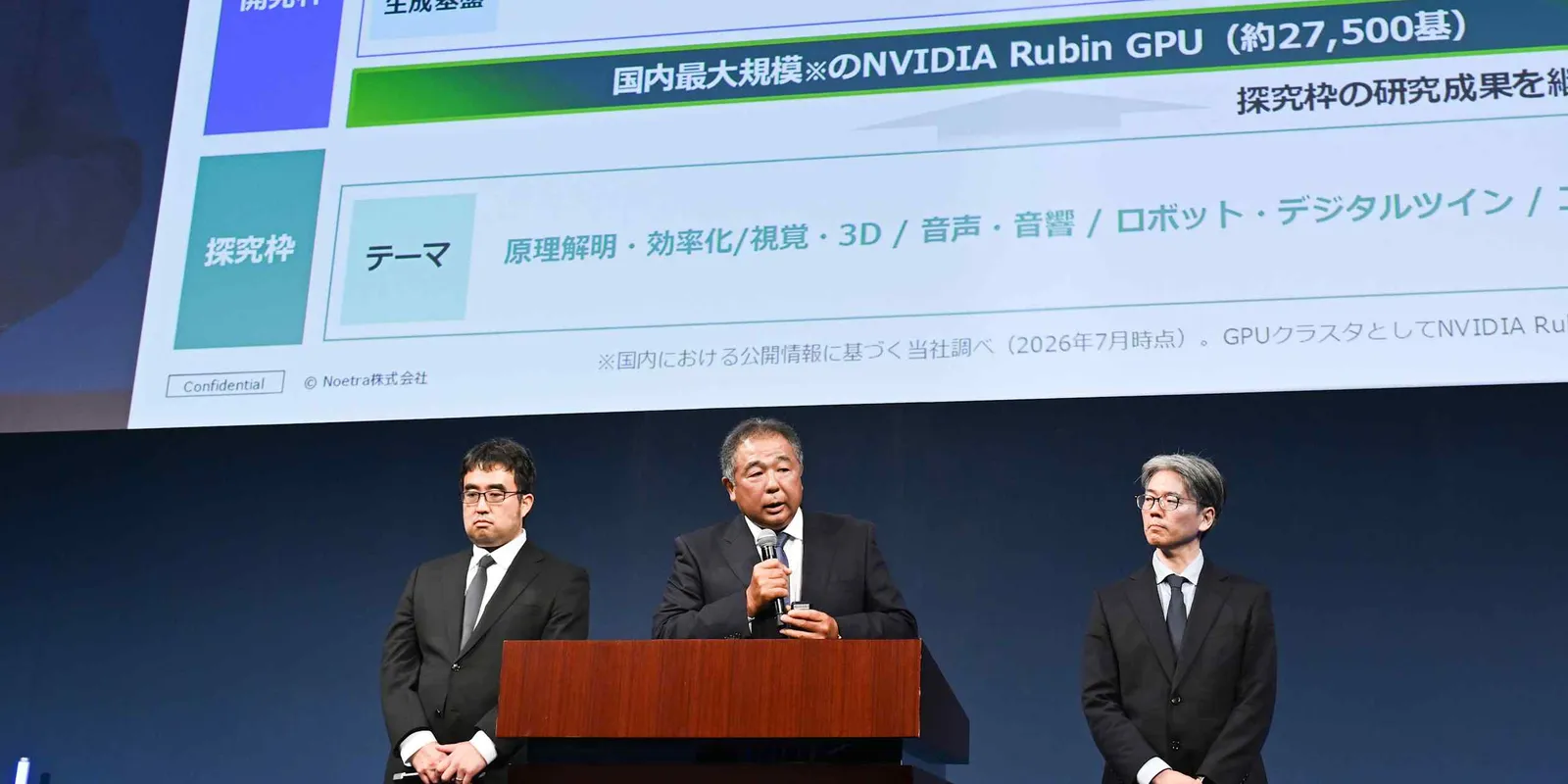
Japan's sovereign AI project is facing a $5bn cost surge, per Nikkei Asia, as rising chip prices and a weaker yen inflate the price of imported compute. For executives and policymakers, it is a live case study in how AI capex carries embedded currency and supply-chain risk that rarely shows up on the same budget line.
Japan's push to build sovereign artificial intelligence capacity is now staring at a $5bn cost surge, driven by two forces that have nothing to do with the software: rising chip prices and a weakening yen. That is the finding from Nikkei Asia, and it lands as one of the clearest examples yet of how a national technology strategy can be repriced by forces entirely outside the strategy itself. The scope of the project has not changed. The bill has.
The mechanics are worth understanding, because they will repeat. AI accelerators, the specialized processors that do the heavy lifting in model training and inference, are typically priced and sold in US dollars. Japan's project, like most state-backed compute programs, is funded in local currency. When the yen slides against the dollar, every rack, server, and networking component bought from abroad costs more yen than the budget assumed. Stack rising chip prices on top and the same physical buildout carries a materially larger price tag. A $5bn surge is not a rounding error. It is the kind of gap that forces a government to choose between spending more, building less, or building slower.
Sovereign AI, for context, is the idea that a country should own and control a meaningful share of the compute, models, and data infrastructure it depends on. Historically, most governments rented that capacity from a handful of hyperscale cloud providers, most of them American. The sovereign push is a bet that AI is strategic infrastructure, closer to a power grid or a port than to a software subscription. Data residency rules, national security reviews, and a desire not to be a price-taker in someone else's cloud have pushed capitals from Tokyo to Brussels to Abu Dhabi toward building their own.
The problem is that the hardware layer of that ambition is globally traded and denominated in dollars. The AI accelerator market is concentrated among a small number of suppliers, and when demand outruns supply, prices typically rise rather than fall. Memory, advanced packaging, and the specialized networking that stitches thousands of chips together have all run tight at various points in the current buildout. For a buyer on a fixed budget, that combination is brutal: you are negotiating in a seller's market while your own currency is weakening.
That leaves the project's planners with a familiar menu of bad options. They can go back for more money, which means a political fight and a fresh appropriation. They can stretch the timeline, which means the compute arrives later than the models it was meant to train. They can cut scope, which means fewer chips or a smaller cluster than the strategy called for. Or they can renegotiate with suppliers, which works better when you are a hyperscaler buying at volume than when you are a single national program with a public mandate.
The second-order effects are where this gets interesting for anyone outside Japan. Every country pursuing a sovereign AI program is running the same arithmetic, and most of them are also buying in dollars. That makes the exchange rate a technology policy variable, not just a macroeconomic one. A finance ministry that models AI capex purely in local currency is modeling it wrong. The same logic applies to large enterprises: if your AI roadmap depends on imported accelerators, your budget carries an FX exposure that rarely sits on the same line as your cloud spend.
There is also a timing dimension. Compute procurement is lumpy. Programs tend to buy in large tranches, which means the exchange rate on the day of the order matters enormously. A project that phases its purchases can, in principle, spread that risk across quarters. A project that buys in one go takes a single, concentrated bet on the currency. For a national program with a fixed appropriation and a public deadline, that is an uncomfortable place to be.
The strategic takeaway for executives and boards is straightforward. AI capex is not a domestic line item. It is a dollar-denominated import exposed to chip pricing cycles and currency swings, and the two can move against you at the same time, which is exactly what Japan is now confronting. The countries and companies that plan for that volatility, by hedging, phasing purchases, or building in contingency, will be the ones whose AI strategies survive contact with the invoice.
This story's Key Insights and Take-aways are locked.
Create a free account to unlock Executive Actions for one credit.
Register to UnlockAlways free for Executives Club members. Join the Club
More in Technology

Anthropic mathematician claims Claude helped crack the Riemann hypothesis
If the proof holds, AI has toppled math's most famous open problem; if it does not, it is a case study in announcing breakthroughs before anyone verifies them.

AI's $4 Trillion Wipeout Erases Nasdaq's Gains for the Year
A brutal week took roughly $4 trillion off the AI sector and left the Nasdaq flat for the year, and the damage ran the full length of the supply chain.

Anthropic mathematician says AI proved the Riemann hypothesis. Verification will take time.
A single unverified claim from inside Anthropic now sits against more than 160 years of open mathematics, and the gap between asserting a proof and surviving peer review is the entire story.