
Costco's $7,000 generators are selling out, and the buying started before the outages
Mizuho's David Bellinger says 21 of 26 Costco generators are gone and pantry-loading is back, with Walmart, Home Depot and Lowe's next in line.
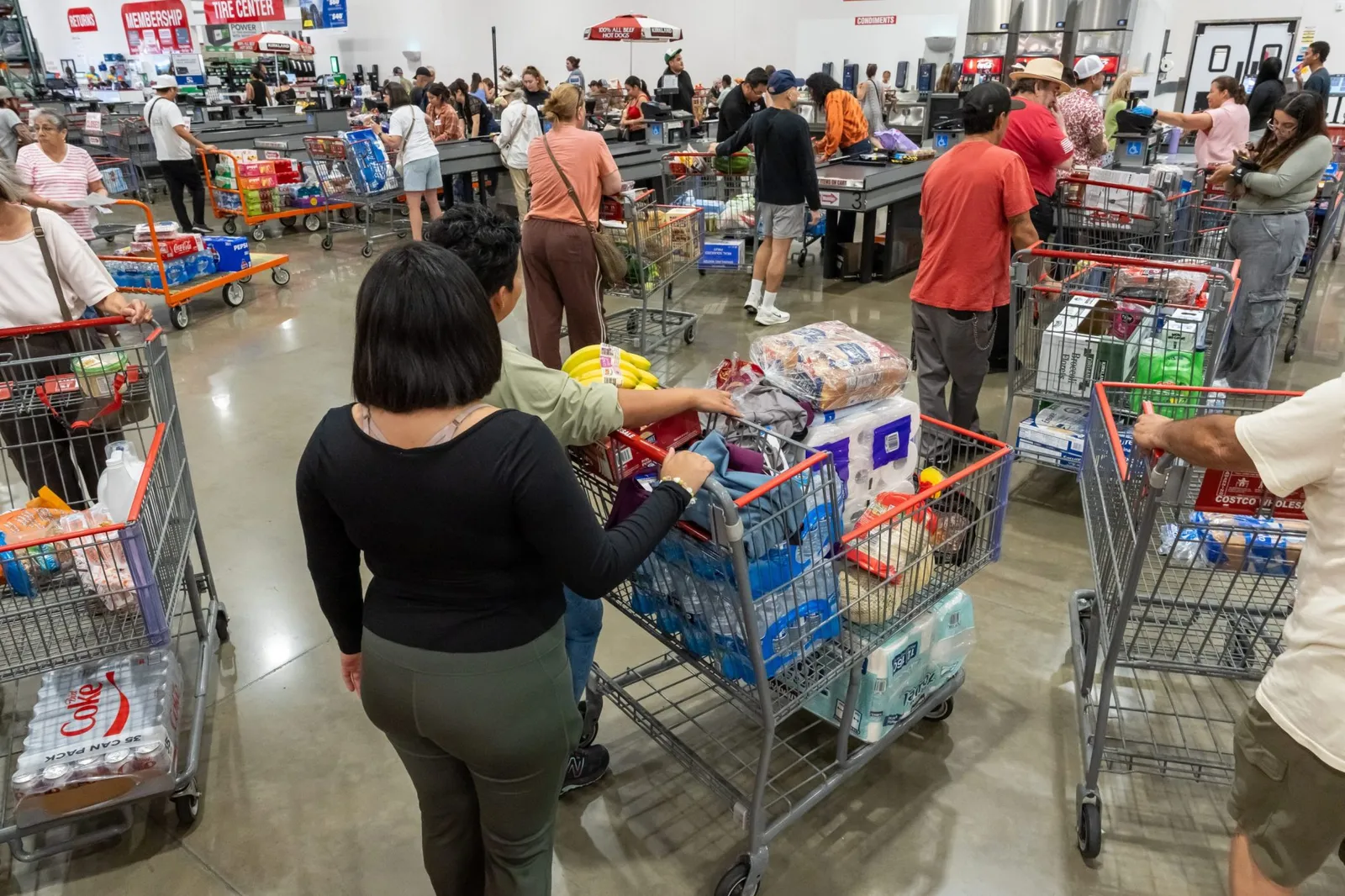
Mizuho analyst David Bellinger says 21 of the 26 high-ticket generators on Costco's website were sold out as of Sunday night, and Costco CFO Gary Millerchip told Bloomberg that rice, canned goods, water, paper products and batteries moved faster toward the end of October. For operators, the buying started more than two weeks before the Nov. 12 and Nov. 13 outages, which means government readiness warnings are now a leading consumer demand signal that shows up in inventory before it shows up in comparable sales.
Costco's generator aisle is the new toilet paper aisle. As of Sunday night, 21 of the 26 high-ticket generators on Costco's website were sold out, according to Mizuho Securities analyst David Bellinger. One of the sold-out models, a Kohler, runs about $7,000. Bellinger told clients that consumer anxiety after the Microsoft Outlook outage, the ground stop for all U.S. airline flights and apocalyptic concerns flaring up on social media is behind the buying. He raised his Costco price target to $1,150 from $1,100 and said Walmart and Sam's Club could see similar "pantry-loading lifts." The last time Costco members bought like this was March 2020, when then-CFO Richard Galanti told investors the buying was "off the charts" across the U.S. On March 12 of that year, U.S. toilet paper sales were up 734% from the same day a year earlier.
Here is the part that should make operators sit up: the buying started before the outages did. The stockpiling began more than two weeks before Microsoft 365 went down on Nov. 12 and the FAA's nationwide ground stop on Nov. 13, which halted departures for more than four hours, the longest in 25 years. In late October, governments sent the warnings. On Oct. 21, CISA said critical PHP vulnerabilities required immediate patching; PHP runs nearly 70% of websites. The next day, the U.K. launched its "Be Ready" campaign, urging families to keep three days of water, shelf-stable food and cash. Within days came reports that the Pentagon wants every major base in the lower 48 states able to run on its own for at least 90 days. All of it landed during what was dubbed "Black October," a month of cyberattacks on hundreds of companies and institutions.
So what is actually moving off shelves? Costco CFO Gary Millerchip told Bloomberg that stronger sales of rice, canned goods, water, paper products, generators and batteries came toward the end of October. Mizuho says Home Depot and Lowe's could sell more generators, too. Smaller sellers are seeing the same thing. Survival Frog, which sells emergency food, radios and other survival gear, saw sales jump 450% between Oct. 27 and Nov. 16 compared with prior weeks, CEO and founder Byron Walker told Axios. Most of the recent buyers were new customers, and food, led by canned meats, is the top seller, followed by radios, solar generators, battery packs and water filters. Competitors saw similar trends, Walker said. "You can't turn on the news without hearing about a new cyber attack or a tech meltdown," he said.
The reported numbers have not caught up yet, which is where the analytical edge sits. Costco's U.S. comparable sales excluding gas rose 8.1% in the four weeks ended Nov. 1, the same pace as the first nine weeks of its fiscal year. Mizuho estimates U.S. growth sped up to 11% to 12% in the last week of October and into early November, and holiday shopping may be part of that. The Federal Reserve's cash data covers only the week before the bank outages. Currency in circulation averaged about $2.5 trillion in the week ended Nov. 11, roughly 3% more than a year earlier, according to the Fed's weekly H.4.1 release. The next reading, covering the week of the Chase outage, comes out Thursday afternoon.
The previous Costco hedge has gone cold. A few years ago, the warehouse club's one-ounce gold bars sold out within hours after their 2023 launch, and Costco capped how many bars each member could buy. That trade has cooled. U.S. Mint sales of gold bullion coins fell 34% in the first 10 months of 2026 from a year earlier, to 185,500 ounces, and October's 11,000 ounces were down 58% from October 2025. North America was the only region to see outflows from gold ETFs in October, $512 million, according to the World Gold Council. Gold fell 6.3% for the month and fell to about $3,693 an ounce on Thursday, its lowest since September 2025. Costco members who bought bars in September are down about $700 apiece, by 24/7 Wall St.'s math. The ultrawealthy got there first: Reid Hoffman told The New Yorker in 2017 that he believed more than half of Silicon Valley's billionaires had invested in "apocalypse insurance." For everyone else, apparently, there's Costco.
Officials keep insisting the outages are not connected. Secretary of State Marco Rubio said Wednesday there's "zero evidence" linking them. "The Microsoft incident has nothing to do with what we saw with the FAA," he said. Vice President JD Vance told Fox News' Laura Ingraham that friends have asked him whether they should be "preparing to build a bunker" or stock up on food and water. "And my answer to that is no," he said. "We do not see some crisis coming down." The cleanup tells a messier story. Director of National Intelligence Jay Clayton told Fox Business that patching after last month's PHP alert left some systems, including at the NSA, that would "not come back up." Microsoft blamed a "latent defect" in a network fix deployed over the summer. The FAA is switching off its new routers and leaning on 25-year-old equipment, and the White House is starting to admit AI is part of the story.
In Axios' Behind the Curtain column, Jim VandeHei and Mike Allen wrote that government officials and AI experts expect the disruption to last for months, under a catchphrase gaining currency: "Software Beirut." They told readers to keep more cash on hand in case their bank is down for a day or two, the same advice Britain gave in October.
For executives, the signal is not that the world is ending. It is that consumer demand is now priced off institutional credibility, and that credibility is wobbling. A patch alert from CISA, a civil-defense pamphlet from Whitehall and a Pentagon readiness target became, within days, a 450% sales spike at a survival-gear retailer and a sold-out generator wall at the largest warehouse club in America. That is a demand shock that shows up in inventory plans, freight and working capital before it shows up in a comparable-sales line. It also cuts the other way: gold buyers from September are underwater, a reminder that fear trades reverse fast. The companies that read this correctly will treat resilience as both a product line and a balance-sheet item. The ones that do not will be explaining, next quarter, why they were the last to notice.
This story's Key Insights and Take-aways are locked.
Create a free account to unlock Executive Actions for one credit.
Register to UnlockAlways free for Executives Club members. Join the Club
More in Business

S&P 500 Enters Correction, Down 10% From Its High on AI Worries
The index's slide past the 10 percent line is a symbolic verdict on investor mood, and the AI trade that powered the rally is now the thing testing it.

Dow and S&P 500 enter correction as Nasdaq logs worst week since 2020
All 11 S&P 500 sectors fell more than 1% in the same week for the first time since April 2025, a breadth signal that matters more than any single index level.

Chip stocks lose $2.3 trillion in a week, worst run in 25 years
A $2.3 trillion weekly wipeout in semiconductors is forcing every board with an AI story to ask whether it owns a thesis or just a crowded trade.