
David Ellison Confirms Musk Stake in Skydance: 'An Honor and a Privilege'
The Skydance CEO told the DealBook summit that Musk is a shareholder, a confirmation that puts the world's most followed businessman inside a studio mid-consolidation.
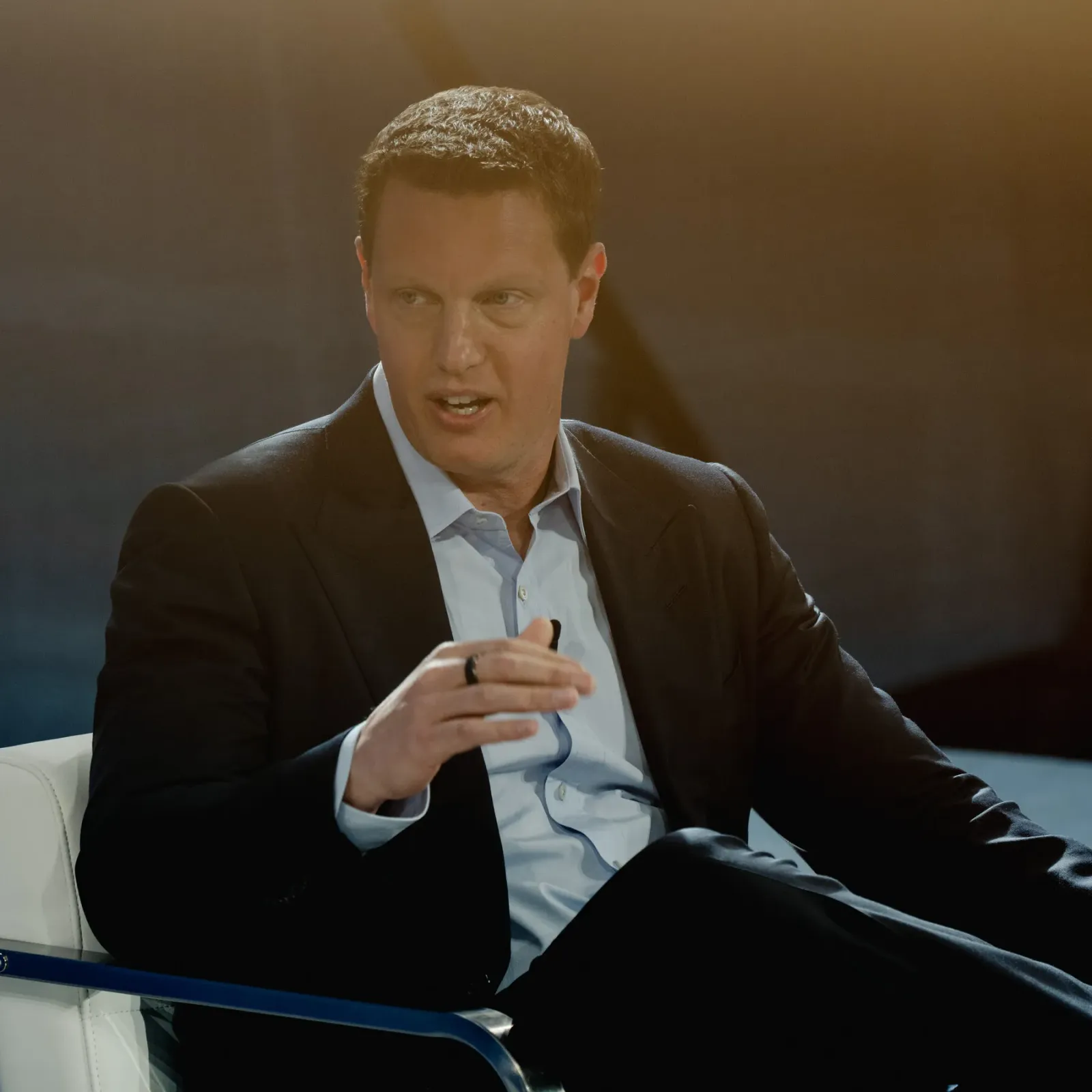
Skydance CEO David Ellison confirmed at the DealBook summit that Elon Musk is a shareholder in his studio, calling it "an honor and a privilege." The disclosure, made without any stake size, price, or terms, puts a platform owner and prolific communicator on the cap table of a company navigating one of Hollywood's biggest consolidation fights.
David Ellison, the chief executive of Skydance, walked onto the DealBook stage and confirmed what Hollywood had been whispering about for months: Elon Musk is a shareholder in his studio. Ellison's framing was warm and deliberate, calling it "an honor and a privilege" to have Musk on the cap table. That is the entire disclosure. No number, no date, no structure. And yet it lands as one of the more consequential sentences to come out of a media conference this year, because it puts the world's most followed businessman inside a company trying to reshape one of America's oldest studios.
Start with what was not said, because the silence is the signal. Ellison did not disclose how much Musk owns, when he bought in, what he paid, or whether the stake came as cash, stock, or something more creative. He did not mention a board seat, information rights, or any operating role. He did not say whether the investment is passive. For a private studio in the middle of a contested consolidation fight, a confirmed shareholder with no terms attached is not a rounding error. It is a message to counterparties, rivals, and regulators that the cap table now includes a name that changes the temperature of every room it enters.
For context, Skydance is not a boutique. It is the studio behind franchise-scale films including the Mission: Impossible series and Top Gun: Maverick, and it has been working to close a combination with Paramount Global, a legacy media company whose assets span a broadcast network, cable channels, and a streaming service. Deals of that shape in US media typically require regulatory sign-off, and the ownership roster is exactly the kind of detail that regulators, counterparties, and investors pick apart. Adding Musk to that roster does not change the legal test on its own. It changes the politics, the press cycle, and the number of people who care about the outcome.
Why would a studio chief welcome that? Because Musk brings three things money alone cannot buy: capital, distribution, and attention. He controls X, the social platform he bought and renamed, which functions as a real-time wire service for media, finance, and politics. He runs xAI, Tesla, and SpaceX, which means his balance sheet and his bandwidth are both enormous. And he is one of the most followed accounts on the internet, capable of turning a studio's trailer, a casting decision, or a corporate filing into a global conversation within an hour. For a company selling attention, that is not a novelty. It is inventory.
The complication is that the same megaphone cuts both ways. Musk's platform has been at the center of advertiser pullbacks and public fights over content moderation, and his political engagement has made him a polarizing figure in exactly the rooms where media companies sell advertising and negotiate carriage. A studio with Musk as a shareholder inherits that debate whether it wants to or not. Talent, partners, and advertisers will each run their own calculus. Some will see a signal of ambition and deep pockets. Others will see a brand risk attached to a name they cannot control.
There is also a governance question that boards should sit with. Strategic investors are usually welcomed for what they bring beyond cash: distribution deals, technology, access. But a shareholder who is also a platform owner, a competitor in adjacent markets, and a prolific public communicator is a different category of partner. The value is real, and so is the optionality problem. If the relationship sours, unwinding it is not a simple share buyback. It becomes a story, and stories about Musk travel further than most companies can manage.
The broader lesson for founders and boards is that cap tables are now narrative assets. A decade ago, a private investor list was a footnote. Today, a single confirmation on a conference stage can reset how the market, the press, and regulators read a company's strategy. Executives should assume that any notable shareholder will eventually be disclosed, and that the disclosure itself will be treated as news. The question is not whether to take strategic money. It is whether you have a plan for what that money says about you the moment someone asks.
This story's Key Insights and Take-aways are locked.
Create a free account to unlock Executive Actions for one credit.
Register to UnlockAlways free for Executives Club members. Join the Club
More in Business

S&P 500 Enters Correction, Down 10% From Its High on AI Worries
The index's slide past the 10 percent line is a symbolic verdict on investor mood, and the AI trade that powered the rally is now the thing testing it.

Dow and S&P 500 enter correction as Nasdaq logs worst week since 2020
All 11 S&P 500 sectors fell more than 1% in the same week for the first time since April 2025, a breadth signal that matters more than any single index level.

Chip stocks lose $2.3 trillion in a week, worst run in 25 years
A $2.3 trillion weekly wipeout in semiconductors is forcing every board with an AI story to ask whether it owns a thesis or just a crowded trade.