

DeepMind's TacticAI predicts football plays up to 8 seconds early, Palmeiras tests live
A new AI coaching layer can forecast open-play dynamics from broadcast visuals, and Palmeiras is the first to run it live.
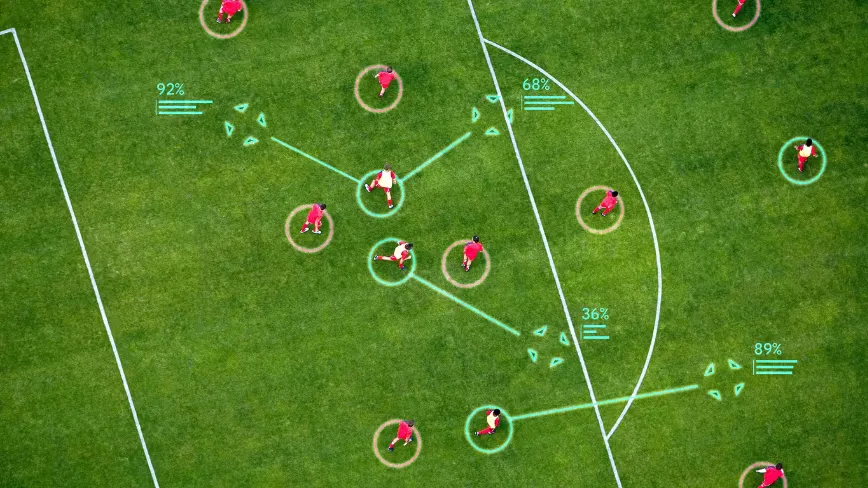
Google DeepMind built TacticAI, an AI system that predicts football plays up to eight seconds ahead using geometric deep learning and broadcast-style visual data. Palmeiras is the first Brazilian club to use it for live open-play analysis, giving decision-makers a front-row seat to how AI could reshape sports operations and strategy.
Google DeepMind’s TacticAI can predict football plays up to eight seconds before they happen, and Palmeiras is using it first for live open-play analysis. That eight-second window sounds small, but in football terms it is a long time. It is the difference between reacting to what already happened and adjusting while the play is still forming.
What makes this notable is the input and the output. TacticAI does not just classify plays after the fact. It uses geometric deep learning to model player movement and forecast the dynamics of the match forward in time, up to eight seconds into the future. From that forecast, it can recommend tactical adjustments. In other words, it takes broadcast-style visual data, turns it into a forward-looking model of how players are likely to move and interact, and then translates that into game-time tactical guidance.
Palmeiras being “the first to use it” for live open-play analysis matters because it is the transition from lab to stadium. Many AI systems can look impressive in recorded footage or offline evaluation. Live use is a different game. The system has to be reliable enough to operate during real matches, under the speed and noise of open play, where players constantly change pace, spacing, and intent. The moment a club puts an AI into that workflow, it is also implicitly making a bet about value: that the insights the system produces are actionable, not just interesting.
There is also a broader operational story here for executives. Sports clubs are not just teams on the pitch. They are data-driven organizations with scouting, performance staff, analysts, and increasingly, tech teams. When a tool like TacticAI recommends tactical adjustments based on predicted dynamics, it changes who influences decisions. It can add another layer between coaching intent and player execution, potentially compressing the time it takes to diagnose what is happening and what needs to change next. Even if coaches remain the ultimate authority, the informational advantage is the point. If you can anticipate the shape of a play before it fully develops, you can train the response, not just the reaction.
Technically, the key phrase in the original reporting is “geometric deep learning.” Without drowning you in jargon, the practical translation is that the model treats the field like a system of interacting coordinates and relationships, rather than just a pile of pixels. Player movement is inherently spatial. TacticAI’s approach, as described, builds a representation of motion and relationships among players, then forecasts how that configuration will evolve over the next few seconds. That forecasting is what turns passive viewing into predictive analysis.
Second-order implications are where boards and senior operators should start paying attention. If tools like this become common, clubs that adopt them early can build a competitive loop: more accurate tactical adjustments can translate into better in-game outcomes; better outcomes can justify further investment; further investment can deepen the data pipeline and increase the model’s usefulness for future seasons. Over time, the “analytics advantage” stops being a dashboard and becomes a decision engine. That can shift budgeting priorities, including how much a club allocates to AI infrastructure, data capture, and analyst tooling.
There is also a governance and regulatory angle, even though the source does not mention specific regulators. Football already lives in a world of rules about match operations, broadcast rights, and the collection and use of data. If broadcast-style visual data is used to power predictive systems, clubs and technology partners typically need to be careful about rights management, data licensing, and compliance with league and competition policies. Even where legal requirements are straightforward, teams will still face practical questions: who owns the derived insights, how systems are validated, and what happens when a model behaves differently than expected in a live setting.
For executives beyond sports, the real takeaway is the product pattern. TacticAI is not positioned as a generic “AI that watches.” It is positioned as an AI that forecasts forward in time, then recommends adjustments. That is a workflow shift from analysis to action. Palmeiras’ decision to use it live is a signal that predictive AI can cross the gap from retrospective insights to real-time decision support in high-stakes environments where seconds matter. If you run a team, a studio, a platform, or an analytics org, this is a case study in what “time-to-decision” looks like when AI is no longer only explaining the past.
This story's Key Insights and Take-aways are locked.
Create a free account to unlock Executive Actions for one credit.
Register to UnlockAlways free for Executives Club members. Join the Club
More in Technology

OpenAI says 10,000 agents cracked a 90-year math problem in 88 hours
The company's claim is audacious, but one mathematician is pushing back. Here's what it means for AI-driven discovery.

Meta still serves child sexual abuse ads on Instagram in India - BBC report
A new report following the BBC Eye investigation says the ads are still there - what it signals for every platform with a self-serve ad engine.

White House yanks 'Build the Wall' game after Tetris Company copyright warning
The administration's arcade game vanished in hours - and the takedown playbook every brand can learn from.